
You are standing in the supply house parking lot on a slow Tuesday in February, and your buddy just told you he switched to ServiceTitan. So you pull it up on your phone to see what it costs. There is no price. There is a “Book a Demo” button and a form that wants your tech count before anyone says a number. That is on purpose, and it is the first thing to understand before the pitch.
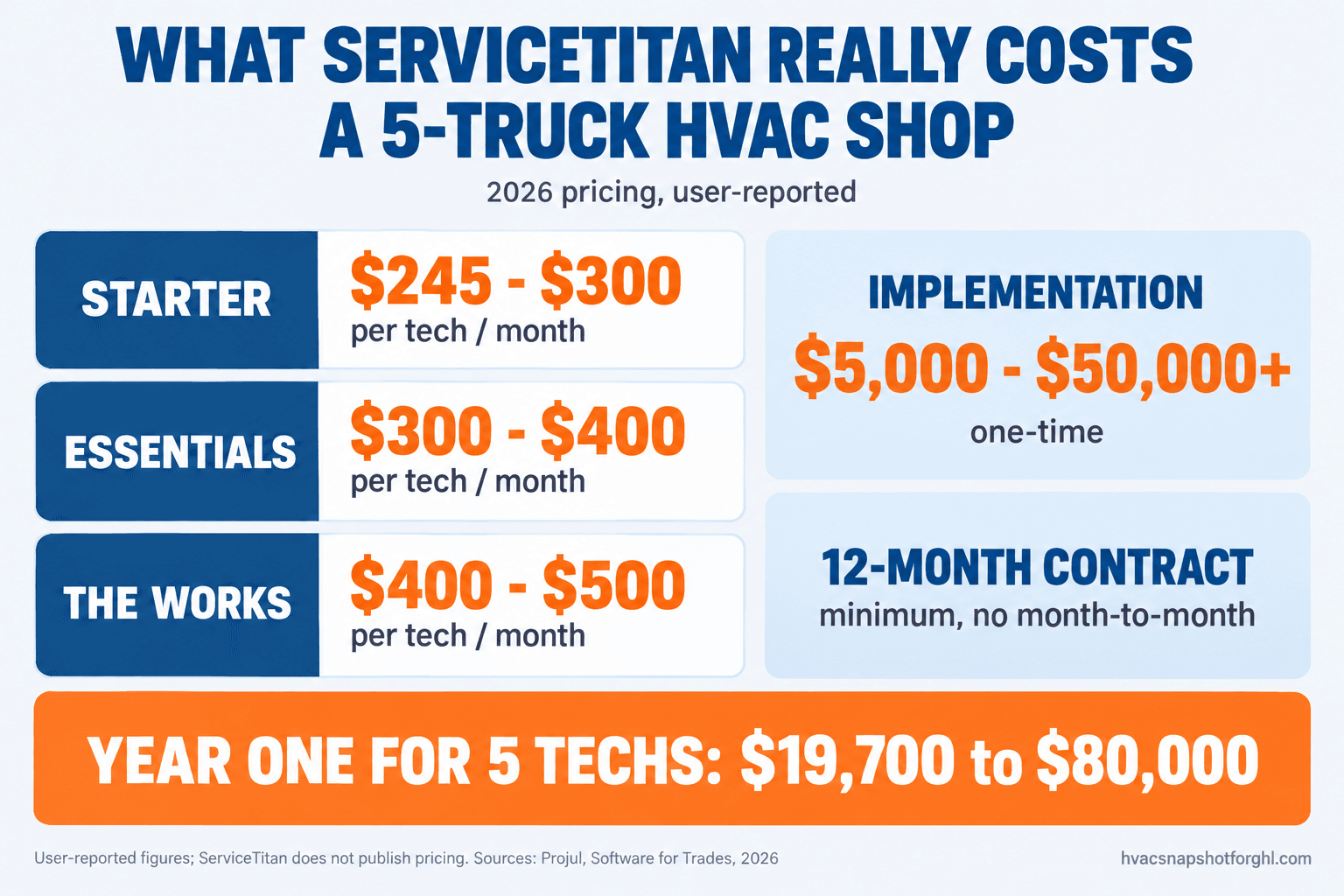
Here is the short version. In 2026, a 5-truck HVAC shop running ServiceTitan is looking at roughly $1,625 to $2,500 a month in subscription, somewhere between $5,000 and $50,000 for the one-time setup, and a 12-month minimum contract, which lands year one anywhere from about $19,700 to $80,000 depending on tier and add-ons. None of that is published by ServiceTitan. Every number here is user-reported or third-party estimated, and I will tell you where each one came from.
On this page
- Why ServiceTitan won’t just tell you the price
- What ServiceTitan costs per tech in 2026
- The costs that never show up in the demo
- The Pro modules: where the base price stops being the price
- What it costs as you add trucks
- Three real scenarios: solo, 5 techs, 15 techs
- The nine questions to ask before the demo
- The 10DLC bill every texting shop pays anyway
- Objections and honest answers
- Frequently asked questions
Why ServiceTitan won’t just tell you the price
Two of the biggest names in the trade, ServiceTitan and FieldEdge, do not publish a single price. Every quote runs through a sales call and a proposal built after they know your tech count and your revenue. That is not an accident. Demo-gated pricing lets a vendor charge each shop close to what it looks like it can pay, and it anchors you on features for 90 minutes before anyone says a number out loud.
There is a reason the pressure is real. ServiceTitan went public in December 2024 on the Nasdaq as TTAN at $71 a share (CNBC, 2024). A public company answers to shareholders, so the quote you get is designed to move up, not down. The only defense is knowing your own numbers cold before the call. This teardown flags every figure as a published list price or a user-reported number so you can tell them apart.
What ServiceTitan costs per tech in 2026
ServiceTitan sells in three tiers. The names shift between sources, but the pattern holds: a starter tier, a mid tier, and a top “The Works” tier that bundles everything. Here is where the teardowns land it.
Those ranges come from teardowns that compiled user reports (Projul, 2026; Software for Trades, 2026); ServiceTitan has never confirmed them. Notice the model, not the number: you pay per technician, per month, so your bill goes up for good every time you add a seat. A $325-a-tech plan sounds fine at three trucks; at ten it is a different company’s worth of software spend.
And the subscription is only half the invoice. The one-time implementation fee is charged separately, runs from about $5,000 for a small rollout to $50,000 or more for a complex one, and onboarding can take two to twelve months before you are fully live, which you pay for while still learning the system (Projul, 2026).
The costs that never show up in the demo
The monthly per-tech figure is the part they put on the slide. The rest decides what you actually spend, and each has burned a shop that looked only at the sticker.
The implementation ambush. A $5,000 to $15,000 setup fee for a small-to-mid shop can equal a full year of a simpler tool’s subscription, and it lands in year one on top of everything else (Software for Trades, 2026). Ask for it as a single written number, not a “typically around” range, before you commit a day to evaluating the platform.
Per-tech creep. On a per-seat plan, hiring is a permanent raise on your software bill: go from 5 trucks to 8 and your subscription climbs by thousands a year for the same features. The rep quotes today’s count, so quote it yourself at the count you expect in two years.
Payment processing. ServiceTitan, like most of these platforms, wants to run your card payments, and the spread is commonly 2.5 to 3.5 percent (Software for Trades, 2026). On $1.5 million a year in card volume, one point is $15,000, which can quietly dwarf the software fee and never shows up next to the per-tech number. Ask whether you can bring your own processor.
The contract and the exit. ServiceTitan is sold on a 12-month minimum, not month-to-month, and larger shops get pushed toward multi-year deals with early-termination penalties (Projul, 2026). A tool you cannot cleanly leave can raise your rate at renewal and dare you to move; one operator reported a 15 to 20 percent bump. Before you sign, ask in writing what it costs to export your data if you leave, then diary the cancellation window the day the contract starts.
The Pro modules: where the base price stops being the price
Here is what makes the per-tech number almost meaningless on its own. ServiceTitan’s headline features live in a stack of add-on “Pro” modules that cost extra on top of your base tier: Marketing Pro, Dispatch Pro, Phones Pro, Pricebook Pro, Scheduling Pro, Sales Pro, and Fleet Pro, together a reported $50 to $150 or more per user, per month (Software for Trades, 2026).
If the feature you came for lives in Marketing Pro or Dispatch Pro, the quote that excited you was never the real quote. Two Pro modules at $100 a seat add $12,000 a year to a five-tech shop, before the setup fee. Pinning down which features are bundled and which are a line item is exactly what the question list below is for.
What it costs as you add trucks
One decision drives your bill more than any other: you pay per technician, so your cost rises in a straight line every time you add a van. Here is the subscription alone as you grow, at a representative $325 per tech per month, before setup and add-ons.
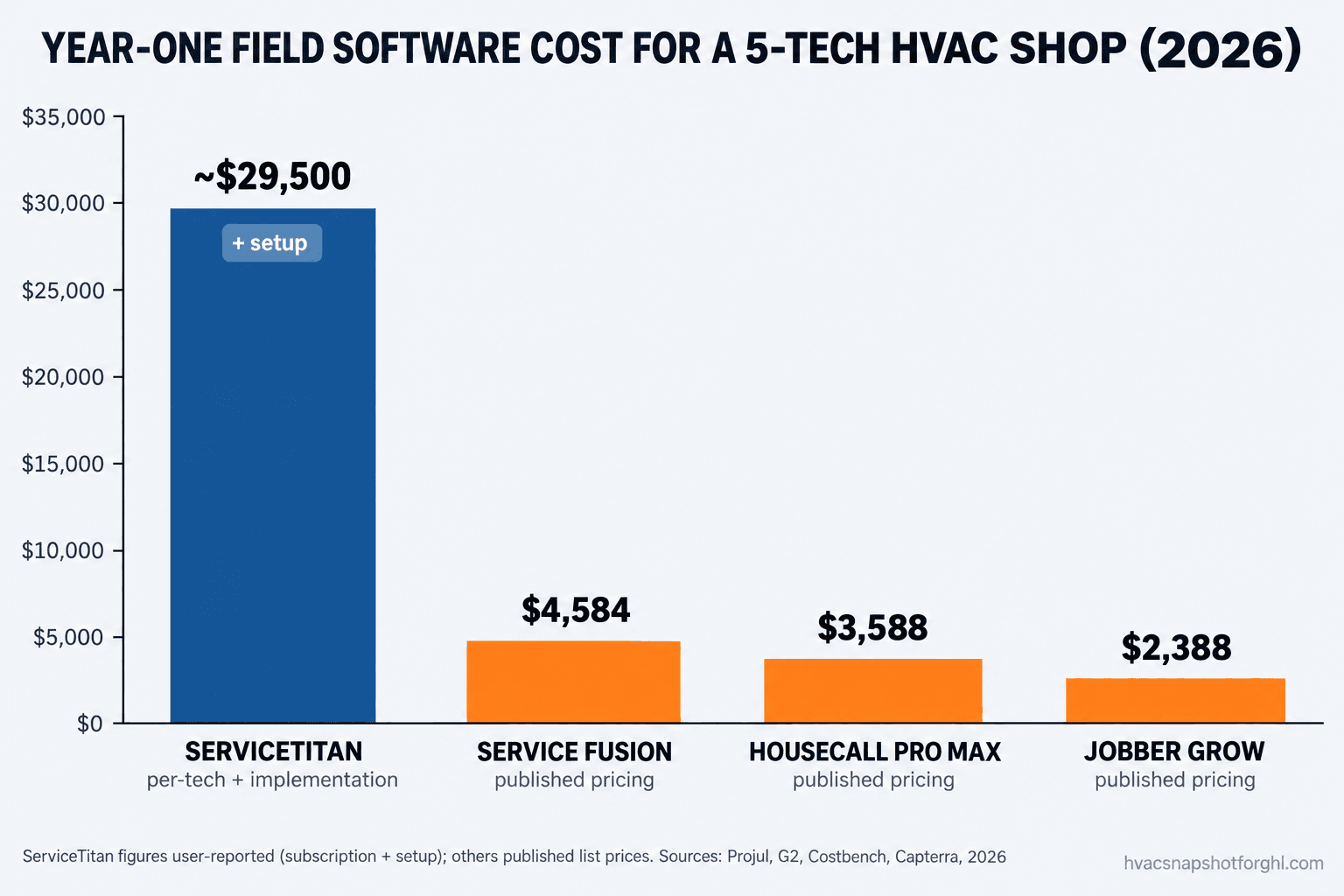
Now hold that against a flat, unlimited-user tool. Service Fusion charges per company, not per seat, at roughly $245, $382, and $627 a month, all with unlimited users (G2, 2026). A five-tech shop and a fifteen-tech shop pay the same base. Published per-user tools sit in between: Housecall Pro MAX runs about $299 a month and Jobber tops out at $499 (Costbench, 2026; Capterra, 2026). Here is that money for a five-tech shop in year one.
ServiceTitan vs the published alternatives (2026)
| Platform | Published price? | Pricing model | 5-tech cost, rough |
|---|---|---|---|
| ServiceTitan | No, demo only | Per technician | ~$19,500/yr + $5K-$50K setup |
| FieldEdge by Xplor | No, demo only | Per technician (reported) | Quote only |
| Service Fusion | Yes | Flat, unlimited users | ~$4,584/yr |
| Housecall Pro MAX | Yes | Per user, tiered | ~$3,588/yr |
| Jobber Grow | Yes | Per user, tiered | ~$2,388/yr |
Three real scenarios: solo, 5 techs, 15 techs
The right answer changes with your size. Run it three ways.
The solo operator plus a helper. You are the tech, the dispatcher, and the bookkeeper. ServiceTitan is a non-starter here: reviewers and an early Battery Ventures investor memo call it a poor fit below a handful of trucks with back-office staff (Battery Ventures). The per-tech cost is wrong, the onboarding is wrong, and you will use a fraction of the platform. A published per-user plan like Jobber Core at $49 a month or Housecall Pro Basic near $59 gets scheduling, invoicing, and payments done for under $800 a year.
The 5-tech shop. Five techs at a reported $325 each is about $1,625 a month, $19,500 a year, before a $5,000 to $15,000 setup fee lands in year one, and before any Pro module. A flat Service Fusion plan does the core job for $4,584 a year for the same five techs plus the whole office. The question is not whether ServiceTitan is better, it is whether the extra $20,000-plus a year buys depth a five-truck residential shop will actually use.
The 15-tech shop. Now the per-tech model is brutal. Fifteen techs at a reported $325 to $500 is $4,875 to $7,500 a month, and with the larger implementation fee enterprise shops get quoted, Projul’s own table puts a shop this size near $49,000 to $140,000 in year one (Projul, 2026). Some shops this size genuinely need the depth and the math pencils out. But a flat-model tool still runs the same fifteen techs for well under $10,000 a year.
The cheapest tool is not automatically the right tool. Know what the pricing model does to your bill at the size you will be in two years, not the size you are today. If what you want is just the phone answered, the quote followed up, and the review requested without a five-figure platform, that is a different build, covered in the custom software route for HVAC companies and the full pricing teardown across every major vendor.
The nine questions to ask before the demo
Steal this. Walk into every demo, ServiceTitan and FieldEdge included, with these written down. It turns a 90-minute pitch into a 20-minute fact-find and forces the real numbers onto the table.
The demo fact-find, ask all nine:
- Price per technician, per month, at my exact tech count?
- Is that per user or per company? If per user, what does one more tech cost?
- Which features are in the base tier, and which ones are a paid Pro module?
- The one-time implementation fee, as a single number, not a range?
- How long does onboarding take before we are fully live?
- Contract term? Does it auto-renew, and what is the cancellation window?
- The price after any intro discount expires, and your typical renewal increase?
- The card processing rate, and can I use my own processor?
- Cost to export my customers, job history, and photos if I leave, in what format?
If the rep will not put the setup fee or the export cost in writing, that is your answer. Here is the line that cuts through the dance: “Send me the per-tech price, the setup fee, and the contract term in an email and I will book a demo after I read it.” Knowing your true cost per booked job and cost per lead before the call, and building the number into your annual marketing and software budget, keeps the renewal from catching you in July.
The 10DLC bill every texting shop pays anyway
One more cost shows up no matter which platform you pick, because the phone carriers set it, not the software vendor. The moment you send business texts in the US, reminders, “tech is on the way,” review requests, you are in A2P 10DLC territory, paying registration and per-message fees on top of your subscription.
The pieces are small but real: a one-time registration around $24.50 for a low-volume sole proprietor or about $71.91 for a standard high-volume brand, a per-campaign monthly fee of $2 to $10, and a carrier surcharge of roughly $0.003 per message segment (Twilio 10DLC pricing). It is the same bill whether you text through ServiceTitan, Jobber, or a GoHighLevel build.
The part that bites is compliance, not the surcharge. Texting without clean consent and a working opt-out is a TCPA exposure, and the penalties dwarf the carrier fees. Get consent and registration right once and the ongoing cost is trivial. I break it down with the exact consent wording in the TCPA and 10DLC guide for HVAC contractors.
Objections and honest answers
“I already pay for ServiceTitan. Am I wasting money?” Not necessarily. If you run enough trucks to use the depth and the integrations, the per-tech cost can pay for itself. The waste is paying enterprise per-tech pricing for a shop that opens a third of the platform. Run the nine-question fact-find on your own renewal: if the gap to a flat-priced tool is five figures a year and you are not using the depth, you just found a raise.
“Isn’t ServiceTitan just the best, so it should cost the most?” It is a strong, deep platform, and for a big shop that lives in it, the price can be fair. But “best” and “best for a five-truck residential shop” are different questions. Most of what a small shop needs is dispatch, scheduling, invoicing, and follow-up, and a flat-priced tool or a done-for-you build delivers that without the per-tech meter running every time you hire.
“What about ServiceTitan Pro for small shops?” The pricing is still demo-gated and the same questions apply: per user or per company, Pro module versus base, setup fee, contract. A “small business” badge does not change the model. Ask the nine questions anyway.
“Do I have to be technical to run a flat-priced alternative?” No. The alternative to a $30,000 ServiceTitan year is not a weekend of you wiring up workflows after a service day, it is a system that ships configured. The GoHighLevel platform underneath is powerful, and setting it up for HVAC is exactly the work you should not be doing yourself. (Disclosure: that is our GoHighLevel affiliate link, so we may earn a commission if you sign up. It costs you nothing extra.)
The bottom line
The price ServiceTitan will not show you is the smallest part of the story. What decides your bill is the model, the setup fee, the Pro-module stack, and the seat count you will have in two years. Go into every demo with your numbers and the nine questions in hand, and make them put the setup fee, the renewal price, and the export cost in writing. The vendors worth your money can do it in an email. The rest are counting on you not to ask.
Frequently asked questions
ServiceTitan pricing, common questions
How much does ServiceTitan cost for a small HVAC shop in 2026?
ServiceTitan does not publish pricing, so every figure is user-reported. Third-party teardowns put it at roughly $245 to $500 per technician per month across three tiers, plus a one-time implementation fee of $5,000 to $50,000 or more, on a 12-month minimum contract (Projul, Software for Trades, 2026). For a 5-tech shop that is about $19,500 a year in subscription before the setup fee, and it climbs every time you add a truck.
Does ServiceTitan have a setup or implementation fee?
Yes, and it is separate from the subscription. Third-party teardowns report a one-time implementation fee of about $5,000 to $15,000 for a small-to-mid shop and $50,000 or more for a large or complex rollout, with onboarding taking two to twelve months before you are fully live (Projul, Software for Trades, 2026). Ask for it as a single written number before you commit.
Is ServiceTitan worth it for a 3-truck shop?
Usually not. Reviewers and an early investor memo describe ServiceTitan as a poor fit below a handful of trucks with back-office staff (Battery Ventures). A 3-truck residential shop typically uses a fraction of the platform while paying the per-tech cost, the multi-month onboarding, and the setup fee. A flat, unlimited-user tool or a done-for-you build is usually the better value at that size.
What is a cheaper alternative to ServiceTitan?
Flat, unlimited-user tools are the clearest savings. Service Fusion charges per company, about $4,584 a year for five techs plus the whole office, versus roughly $19,500 or more on ServiceTitan (G2, 2026). See the full ServiceTitan alternatives breakdown and the per-tech vs unlimited pricing math.
Does ServiceTitan lock you into a contract?
Yes. ServiceTitan is sold on a 12-month minimum, not month-to-month, and larger shops are often pushed toward multi-year agreements with early-termination penalties (Projul, 2026). Before you sign, ask what it costs to export your data if you leave and in what format, and diary the cancellation window the day the contract starts.
About the author
Tony Escalante is an HVAC Operations & Dispatch Strategist based in Phoenix, AZ. He ran the dispatch desk and service board for a multi-truck residential cooling shop for a decade before moving into systems work, and he writes about turning chaotic summer call volume into bookable, trackable jobs, and about where the real money leaks between the phone and the invoice.
Related posts
- What HVAC Software Really Costs in 2026: A Small-Shop Pricing Teardown
- The Best ServiceTitan Alternatives for a Small HVAC Shop (2026)
- Per-Tech vs Unlimited-User HVAC Software Pricing: Where the Break-Even Really Is
- FieldEdge Pricing in 2026: What to Ask Before the Demo
- 10DLC + TCPA for HVAC Contractors: A Plain-English Guide