
It is a Tuesday in February and the phones are quiet, so you finally sit down to answer the question that has nagged you since summer: how much are you actually paying to run the office? You pull up ServiceTitan and there is no price, just a “Book a Demo” button. An hour later you have five tabs open, three different pricing models, and no clear answer. That hour is why this post exists.
Here is the short version. In 2026 a small HVAC shop pays anywhere from about $600 a year on a cheap solo plan to more than $65,000 in year one on ServiceTitan, and the biggest thing driving that gap is not features, it is the pricing model: per-technician billing punishes you every time you add a truck, while flat, unlimited-user pricing does not move. This teardown walks every major vendor, the hidden costs that never show up on the pricing page, and three real cost scenarios.
On this page
- Why nobody will just tell you the price
- The vendor-by-vendor teardown
- The costs that never show up on the pricing page
- Per-tech vs flat pricing: the break-even that decides everything
- Three real scenarios: solo, 5 techs, 12 techs
- The questions to ask before you sit through any demo
- The 10DLC bill every texting shop pays
- Objections and honest answers
- Frequently asked questions
Why nobody will just tell you the price
Two of the biggest names in the trade, ServiceTitan and FieldEdge, do not publish a price at all. Every quote runs through a sales call and a custom proposal built after they know how many trucks you run and how much you bill. Demo-gated pricing lets a vendor charge each shop what it looks like it can pay, and it anchors you on features for an hour before anyone says a number. ServiceTitan is a public company now, listed on the Nasdaq as TTAN after its December 2024 IPO at $71 a share (CNBC, Dec 2024), which means real pressure on revenue per customer. That is not a reason to avoid them, just to know your numbers cold before the call.
So this teardown leans on two kinds of data: the published tiers from vendors who show their work, and the user-reported figures from operators who signed the ServiceTitan and FieldEdge contracts.
The vendor-by-vendor teardown
What each major platform charges in 2026, and who each one fits.
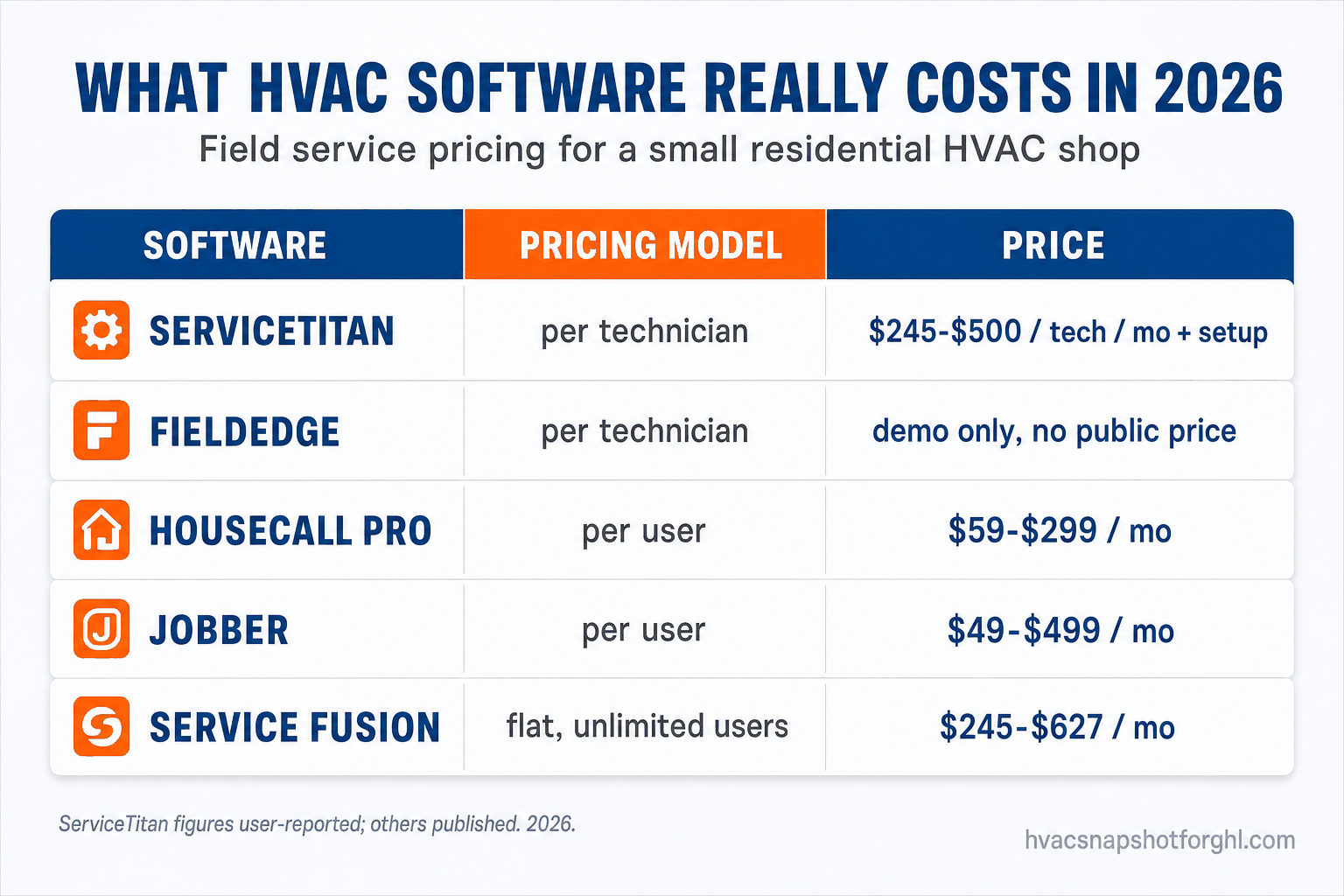
ServiceTitan. The enterprise flagship. No public pricing. Third-party teardowns put it at roughly $245 to $500 per technician per month, with the entry tier near $245 to $300, the mid tier near $325 to $345, and the top “The Works” tier near $400 to $500 (Projul, 2026; TrustPro, 2026). On top of that sits a one-time implementation fee from $5,000 for a small shop to $50,000 or more for a large one, on an annual contract, with onboarding that can take two to twelve months (ServiceStorm, 2026). It is a deep platform, built and priced for shops with the volume to absorb it. For a 3-truck residential shop it is usually more system, and more cost, than the work requires.
FieldEdge by Xplor. Demo-gated like ServiceTitan, aimed at established HVAC and plumbing shops that want QuickBooks-tight accounting. Ask for the per-tech rate, setup fee, and contract length in writing before you invest a day evaluating it.
Housecall Pro. Published pricing, which earns it points. Basic is $59 a month billed annually ($79 monthly) for one user, Essentials is $149 for up to five users, and MAX is $299 with extra seats around $35 each (Costbench, 2026). Watch the add-on trap: advanced reporting, sales proposals, and dedicated onboarding live on the higher tiers, so the plan you start on is rarely the plan you end on.
Jobber. Also published, and popular with smaller shops. Billed monthly the tiers run Core $49, Connect $139, Grow $199, and Plus $499, each with one user and extra seats around $29 (Capterra, 2026). Clean product, but the per-seat math climbs as you add techs.
Service Fusion. The one that prices differently, and the reason this teardown matters. Now under EverCommerce’s EverPro brand, it charges per company, not per user: three flat tiers at roughly $245 (Starter), $382 (Plus), and $627 (Pro) a month, all with unlimited users (G2, 2026). A 3-tech shop and a 30-tech shop pay the same base. Add-ons like GPS tracking sit outside that, but the seat count never moves the base.
And the short lists skip real competitors: Successware has deep legacy HVAC and accounting penetration, while Simpro, FieldPulse, and Workiz round out the field.
HVAC field service software pricing at a glance (2026)
| Platform | Published price? | Pricing model | Starting cost |
|---|---|---|---|
| ServiceTitan | No, demo only | Per technician | ~$245-$300/tech/mo + setup |
| FieldEdge by Xplor | No, demo only | Per technician (reported) | Quote only |
| Housecall Pro | Yes | Per user, tiered | $59/mo (annual) |
| Jobber | Yes | Per user, tiered | $49/mo |
| Service Fusion | Yes | Flat, unlimited users | ~$245/mo |
The costs that never show up on the pricing page
The monthly number is the part they show you. These are the parts that decide what you actually spend, each a failure mode that has burned shops before.
Implementation and onboarding. On enterprise platforms this is the cost that ambushes people. ServiceTitan’s setup fee alone can match a year of a smaller tool’s subscription, and the two-to-twelve-month onboarding means you pay while still learning it (ServiceStorm, 2026). Ask for the setup fee as a written number, not a range.
Per-user creep. On any per-seat plan, growth is a tax. On Jobber’s Plus plan a five-person office is the $499 base plus four seats; on a flat plan it is just the base. The per-seat cost feels small on the demo and compounds quietly as you grow.
Payment processing. Most of these platforms want to run your card payments, and the spread (commonly around 2.9% plus $0.30 a transaction) can dwarf the software fee. On $1.5M a year in card volume, half a point is $7,500. Read the processing rate as carefully as the subscription.
Data export, lock-in, and contract length. Ask, in writing, what it costs to get your customer list, job history, and photos out if you leave, and in what format. Month-to-month gives you an exit; an annual contract with auto-renewal takes it away. A tool you cannot cleanly leave is one that can raise your rate at renewal and dare you to move, so diary the cancellation window the day you sign.
Per-tech vs flat pricing: the break-even that decides everything
Strip away the feature lists and one decision drives your bill more than any other: are you paying per technician or per company?
Per-technician pricing feels reasonable when you are small. Three hundred dollars a tech, three techs, fine. The problem is it turns every hire into a permanent raise on your software bill. Grow from 3 trucks to 8 and your ServiceTitan-style bill roughly doubles, for the same software. Flat, unlimited-user pricing does not move whether you run 3 techs or 30. Here is where the two cross.
The lines cross almost immediately. A flat plan around $382 a month beats a $325-per-tech plan the moment you have two techs. At twelve techs the per-tech plan is running near $3,900 a month while the flat plan has not budged. If you plan to add trucks, per-tech pricing is a headwind you feel every month. The exception is the true solo operator: at one seat, the cheap per-user tiers undercut a $245 flat plan easily. Flat pricing is a growth play, not a solo play.
Three real scenarios: solo, 5 techs, 12 techs
The right answer changes with your size. Run the framework three ways.
The solo operator (owner plus a helper). You are the tech, dispatcher, and bookkeeper. The cheap per-user plans win outright: Jobber Core at $49 a month or Housecall Pro Basic at $59 get scheduling, invoicing, and payments done for under $800 a year. ServiceTitan is a non-starter here; both the per-tech cost and the multi-month onboarding are wrong for one truck.
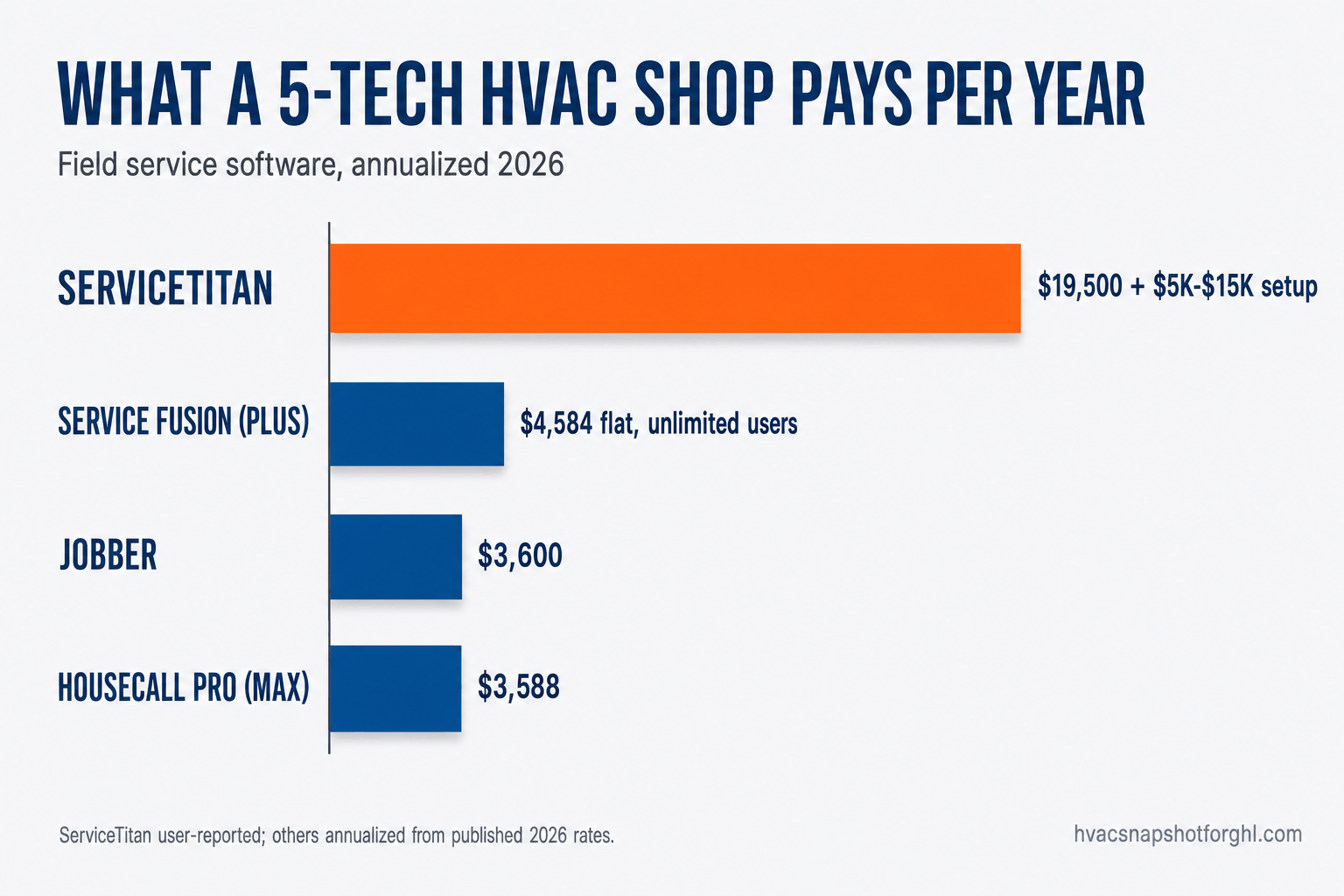
The 5-tech shop. This is where the models separate. On ServiceTitan-style per-tech pricing, five techs at roughly $325 each is about $1,625 a month, or $19,500 a year, before a $5,000 to $15,000 implementation fee lands in year one. Service Fusion Plus is a flat $4,584 a year for the same five plus every office user. Housecall Pro MAX or Jobber run $3,600 to $5,000 a year. For most residential shops this size, the enterprise premium buys depth you will not use.
The 12-tech shop. Now the per-tech tax is brutal. Twelve techs on a per-tech plan runs $3,900 to $4,800 a month, $47,000 to $58,000 a year, and the implementation fee scales up too, so year one can clear $65,000. The flat-model shops barely move: Service Fusion Pro is $627 a month, about $7,524 a year, for all twelve plus the office. The bigger you get, the more per-tech billing costs you for the same software.
The cheapest tool is not automatically the right tool, but you should know exactly what the pricing model does to your bill at the size you are actually going to be, not the size you are today. A shop planning to double its trucks should weigh the per-tech curve heavily; a shop staying put can shop on features. For shops that would rather not run a field service platform at all and just want the phone answered and follow-up automated, that is a different build, covered in the custom software route for HVAC companies and the GoHighLevel migration playbook.
The questions to ask before you sit through any demo
Steal this. Walk into every demo, ServiceTitan and FieldEdge included, with these written down. It turns a 90-minute pitch into a 20-minute fact-find.
The demo fact-find (ask all nine):
- Price per technician, per month, at my exact tech count?
- Is that per user or per company? If per user, what does one more tech cost?
- The one-time implementation fee, as a number, not a range?
- How long does onboarding take before we are fully live?
- Contract term? Does it auto-renew, and what is the cancellation window?
- The price after any intro discount expires?
- The card processing rate, and can I use my own processor?
- Cost to export my customers, job history, and photos if I leave, in what format?
- What is on this plan versus the next tier up?
If a salesperson will not put the setup fee or the export cost in writing, that is your answer. The vendors that show their pricing can answer all nine in an email; the ones that hide it keep you in the demo instead. Knowing your true cost per booked job and cost per lead before the call, and building it into your annual software budget, keeps the renewal from surprising you.
The 10DLC bill every texting shop pays
Here is a cost that shows up no matter which platform you choose, because the phone carriers set it, not the software vendor. The moment you send business texts in the US (reminders, “tech is on the way,” review requests) you are in A2P 10DLC territory and pay registration and per-message fees on top of your subscription.
The pieces are small but real: a one-time brand and campaign registration (low-volume sole proprietors pay less than standard registrations), a per-campaign monthly fee typically $2 to $10, and a per-message carrier surcharge that starts around $0.003 per segment and is rising in 2026 (Twilio 10DLC pricing). It is the same bill whether you text through ServiceTitan, Jobber, or a GoHighLevel build.
The part that actually bites is the compliance. Texting customers without proper consent and a clean opt-out is a TCPA exposure, and the penalties dwarf the carrier surcharge. Get consent and 10DLC registration right once and the ongoing cost is trivial. We break it down, with the exact consent wording, in the HVAC TCPA and 10DLC guide.
Objections and honest answers
“I already pay for ServiceTitan. Am I wasting money?” Not necessarily. If you run enough trucks to use its depth, the per-tech cost can pay for itself. The waste is paying enterprise per-tech pricing for a shop that uses a fraction of the platform. Run the fact-find on your own renewal: if the gap to a flat-priced alternative is five figures and you are not using the depth, that is your answer.
“Isn’t cheaper software just worse software?” Price and pricing model are two different things. Service Fusion is not cheaper because it is worse; it is cheaper for a growing shop because it charges per company instead of per seat. A flat, done-for-you system is scoped to what a residential shop actually does and skips the enterprise features you will never open.
“Do I have to be technical to run a done-for-you system?” No. The alternative to a $50,000 ServiceTitan implementation is not a weekend of you building workflows, it is a system that ships configured. The GoHighLevel platform underneath is powerful, and setting it up for HVAC is exactly the work you should not be doing after a service day. (Disclosure: that is our GoHighLevel affiliate link, so we may earn a commission if you sign up. It costs you nothing extra.)
The bottom line
The price you see, or do not see, is the smallest part of the story. What decides your bill is the pricing model, the implementation fee, and the seat count you will have in two years. Per-tech pricing is a growth tax; flat, unlimited pricing is a growth hedge; the cheap per-user tiers are perfect for a solo truck and get expensive as you scale. Go into every demo with your numbers and the nine questions in hand, and make them put the setup fee, the renewal price, and the export cost in writing. The vendors worth your money can answer in an email. The rest are counting on you not to ask.
Frequently asked questions
HVAC software pricing, common questions
How much does ServiceTitan cost for a small HVAC shop?
ServiceTitan does not publish pricing, so every figure is user-reported. Third-party teardowns put it at roughly $245 to $500 per technician per month, plus a one-time implementation fee of $5,000 to $50,000 or more, on an annual contract (Projul, ServiceStorm, 2026). For a 5-tech shop that is about $19,500 a year before the setup fee, and it climbs every time you add a truck.
What is the cheapest field service software for a solo HVAC operator?
For a one-truck shop, the cheapest published plans are Jobber Core at $49 a month and Housecall Pro Basic at $59 a month billed annually for one user (Capterra, Costbench, 2026). Both cover scheduling, invoicing, and payments. Flat unlimited-user plans like Service Fusion cost more at one seat and only pay off once you add techs.
Is per-technician or flat pricing better for HVAC software?
It depends how many techs you run and plan to run. Per-technician pricing (ServiceTitan, and reportedly FieldEdge) is cheapest at one seat but becomes a tax on growth. Flat, unlimited-user pricing (Service Fusion) costs more for a solo operator but wins the moment you have two or more techs. At twelve techs, a per-tech plan can run $47,000 or more a year while a flat plan stays near $7,500.
What hidden costs should I watch for in HVAC software?
Five: the one-time implementation fee (which can reach five figures on enterprise platforms), per-user creep as you add seats, card processing rates (often around 2.9% plus $0.30, which can exceed the software fee at high volume), data-export or lock-in costs when you leave, and auto-renewing annual contracts. Ask about each before you sign.
Do I have to pay 10DLC fees regardless of which platform I use?
Yes. A2P 10DLC fees are set by the phone carriers, not the software vendor, so they apply whether you text through ServiceTitan, Jobber, Housecall Pro, or a GoHighLevel build. Expect a one-time registration, a per-campaign monthly fee around $2 to $10, and a carrier surcharge near $0.003 per segment (Twilio). The bigger issue is TCPA compliance, which our TCPA and 10DLC guide covers.
About the author
Rachel Okonkwo is a GoHighLevel Automation Consultant based in Columbus, OH. She builds CRM workflows for home-service contractors and the agencies that white-label for them, and she is opinionated about which tools actually pay back inside 30 days. She writes the implementation-heavy pieces: pricing, pipelines, triggers, and the systems that replace a stack of disconnected software.