
Every growing HVAC shop hits the same wall. The off-the-shelf platform that felt like an upgrade at five trucks — ServiceTitan, Housecall Pro, Jobber, FieldEdge — starts fighting you at fifteen. You pay per tech for modules you never open. Your dispatcher keeps a spreadsheet on the side because the “board” doesn’t match how the shop actually runs. Invoices live in QuickBooks, leads live somewhere else, and the one report the owner actually wants doesn’t exist. The software stopped scaling with you a while ago; you just kept paying for it.
Here’s the short version: custom software for HVAC companies means building the CRM, customer portal, dispatch dashboard, and AI agents around how your shop already works — instead of bending your shop around someone else’s product and renting it by the seat forever. For a small contractor it rarely makes sense; for a growing multi-truck operation buried in per-tech fees and disconnected tools, a purpose-built system you own outright often pays for itself in recovered hours and cleaner data. Below is the 2026 data on when that switch is worth it — and the honest signals that tell you it’s not yet.
On this page
- What does “outgrowing” your field service software actually mean?
- The field service software market is booming — and built for the average shop
- Pain 1: You pay per tech for a platform built for enterprise
- Pain 2: Your data lives in five disconnected tools
- Pain 3: No customer portal, no owner dashboard, no single source of truth
- Build vs. buy: when custom software actually pays off
- What we build for HVAC contractors
- Five signs you’ve outgrown off-the-shelf
- Frequently asked questions
What does “outgrowing” your field service software actually mean?
Outgrowing your field service software means the tool now costs you more in workarounds, per-seat fees, and lost data than it saves you in features — you’re paying to fit your shop into its shape instead of the other way around. It’s not that ServiceTitan or Housecall Pro are bad products. They’re good products built for the middle of a very large market. The problem starts when your shop’s process drifts away from that middle: a maintenance-plan structure the software can’t model, a dispatch rule your board can’t enforce, a report the owner needs that no screen produces.
The tell isn’t dramatic. It’s the spreadsheet your dispatcher keeps “just to be safe.” It’s the office manager re-keying invoices from one system into QuickBooks. It’s the $200-a-month module you bought for one feature. Individually they’re minor. Added up across a year and a growing crew, they’re a second, invisible payroll — and they’re the reason a purpose-built system starts to look cheap.
The field service software market is booming — and built for the average shop
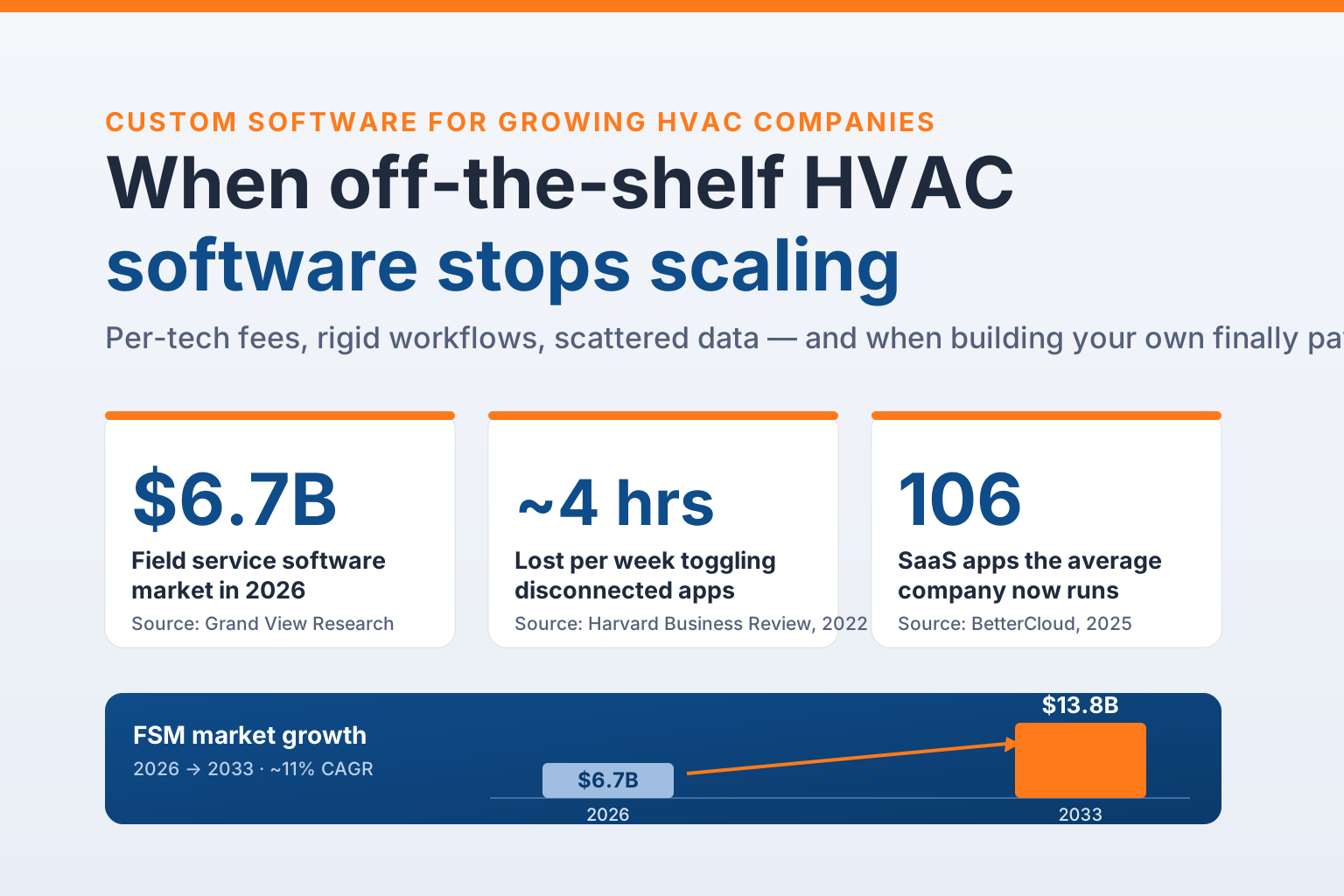
Field service management (FSM) software is one of the fastest-growing categories in business tooling. Independent analysts put the global market at roughly $6.7 billion in 2026, on track for about $13.8 billion by 2033 — an ~11% compound annual growth rate (Grand View Research, 2026). A second tier-one estimate lands in the same range: about $6.1 billion growing to $13.8 billion by 2034 at 10.7% CAGR (Fortune Business Insights, 2026). Two firms, two methods, one story: enormous, compounding demand.
Here’s the catch that matters for a contractor. A market that big rewards software built for the widest possible slice of buyers. That’s the right business decision for a platform vendor — and the exact reason the product can’t fit your shop precisely. There are roughly 118,000 HVAC contracting businesses in the U.S. employing hundreds of thousands of technicians (IBISWorld, 2025; the BLS counts about 425,000 HVAC mechanics and installers, with 8% job growth projected through 2034 — BLS, 2024). Off-the-shelf FSM has to average across all of them. Your shop isn’t the average — and past a certain size, the gap between “the average shop” and “your shop” is where the money leaks.
Pain 1: You pay per tech for a platform built for enterprise
The enterprise FSM platforms are genuinely capable — and priced and built for scale most contractors never reach. ServiceTitan’s own IPO filing is instructive: the company serves about 8,000 customers and processed roughly $62 billion in gross transaction volume, on trailing revenue near $685 million (ServiceTitan Form S-1, SEC, 2024). Do the division and that’s on the order of $85,000 in average annual revenue per customer. That number tells you who the product is really designed for.
For a large, mature contractor, that spend can absolutely pay back. For a five-to-fifteen-truck shop, it often means paying enterprise pricing — frequently billed per technician or per seat — for a fraction of the feature set, plus implementation and add-on modules on top. You end up subsidizing capabilities built for hundred-truck operations while the two workflows you actually care about still don’t fit. The platform didn’t do anything wrong. You’ve just outgrown the plan it put you on — in the wrong direction.
Pain 2: Your data lives in five disconnected tools
This is the quiet killer, and it’s measurable. Leads in one tool, jobs in another, invoices in QuickBooks, reviews in a third app, ad data on a dashboard nobody opens. Every handoff between those tools is a person re-typing something a computer already knew — and every re-type is a chance to drop a follow-up or fat-finger a number.
The research on this is blunt. Workers toggle between applications roughly 1,200 times per day and lose just under four hours a week simply re-orienting after each switch (Harvard Business Review, 2022). More than 40% of workers spend at least a quarter of their week on manual, repetitive tasks like data entry, and about 60% believe they could save six-plus hours a week if those tasks were automated (Smartsheet, 2024). Zoom out to the whole business and Gartner estimates poor data quality costs the average organization $12.9 million a year (Gartner, 2021). Your shop isn’t losing eight figures — but the mechanism is identical, just scaled to your size.
The reason the tools stay disconnected is that stitching them together is genuinely hard. The average company runs 106 SaaS apps (BetterCloud, 2025), and small businesses juggle around nine cloud tools on average — which is why roughly 90% of SMBs say they’d rather consolidate everything into a single system (vcita/inTandem, 2024). Off-the-shelf platforms don’t solve this for you; they add to the pile and leave the integration to you. Custom software flips it — one system, or a set of tools wired to talk to each other automatically, so nobody re-keys anything by hand. If you’re weighing whether to consolidate onto GoHighLevel first, our Chicago HVAC GoHighLevel migration playbook walks through that route before you build anything custom.
Pain 3: No customer portal, no owner dashboard, no single source of truth
Two gaps show up in almost every growing shop we talk to, and neither off-the-shelf FSM fills well.
No branded customer portal. Homeowners chase you for updates because there’s nowhere for them to self-serve — no place to see their appointment window, upload a photo of the equipment nameplate, check maintenance-plan status, or request a follow-up. That’s a support cost and a missed convenience. And customers want the option: 61% prefer self-service for simple issues (Salesforce, 2025), and Gartner projects self-service and live chat will overtake phone and email as the top service channels by 2027 (Gartner, 2025). A portal isn’t a luxury feature anymore; it’s where a growing share of customers expect to interact.
No owner dashboard. The owner wants one screen: leads by source, booked vs. missed calls, revenue per tech, review velocity, seasonal trend. No off-the-shelf product produces exactly that, because it lives across your CRM, your phone system, your invoicing, and your ad accounts. So the numbers get assembled by hand once a month, or not at all — and you fly the business on feel. A custom dashboard that pulls every source into the metrics you actually manage by is often the single highest-ROI thing a shop can build. (If leads-by-source is your first blind spot, our 2026 HVAC cost-per-lead breakdown is a good companion.)
A growing HVAC shop's systems, off-the-shelf vs. purpose-built
Per-tech fees for modules you barely use. A dispatcher who trusts their side spreadsheet more than the board. Invoices re-keyed into QuickBooks by hand. Homeowners calling the office for updates. The owner's real numbers assembled manually once a month — if there's time. You bend the shop to fit the software.
One system shaped around your exact pipeline, maintenance plans, and dispatch rules. Data flows between tools automatically — nobody re-types anything. A branded homeowner portal handles routine questions. One live owner dashboard shows leads, booked vs. missed, and revenue per tech. You own the code outright, with no per-seat tax.
Build vs. buy: when custom software actually pays off
The honest answer is it depends on your size and stability — so here’s the decision laid out plainly rather than sold to you.
Off-the-shelf FSM vs. custom software for HVAC
| Factor | Off-the-shelf (ServiceTitan, Housecall Pro, Jobber) | Custom software (built for your shop) |
|---|---|---|
| Best fit | Startups to ~5 trucks; still finding your process | Stable, specific process; multi-truck and scaling |
| Pricing model | Recurring per-seat / per-tech fees, forever | Fixed project cost; you own it, no per-seat tax |
| Workflow fit | Your shop bends to the product's shape | Product is shaped around how you actually run |
| Your data | Split across the platform + QuickBooks + add-ons | One source of truth; tools wired to talk automatically |
| Customer portal | Limited or add-on; rarely branded to you | Branded homeowner + tech portals, built in |
| Owner reporting | Prebuilt reports; the one you want rarely exists | The exact dashboard you manage by |
| Ownership | You rent access; leave and you lose it | Full IP transfer — the code is yours |
| Time to value | Days to start, but capped by the product's limits | Weeks to build; no ceiling on what it can do |
Buy off-the-shelf when you’re small, moving fast, or your process is still changing — it’s cheaper and someone else maintains it. Build custom when your process is settled and specific, the per-seat math has gotten painful, and the workarounds have quietly become a second payroll. Most shops don’t need to rip everything out on day one, either: the highest-ROI first build is usually a single custom piece — an owner dashboard, a customer portal, or an integration that ends the QuickBooks re-keying — bolted onto what you already run.
What we build for HVAC contractors
This is where a done-for-you partner matters, because “build custom software” sounds slow and expensive — and it doesn’t have to be. Our custom software service builds the specific systems HVAC shops keep asking for and can’t buy off the shelf:
- A CRM designed for HVAC — service calls, equipment history, maintenance plans, warranty tracking, seasonal buckets, tech assignment, and your exact pipeline. Yours, not rented.
- Customer & job portals — a branded homeowner portal for appointments, photos, and maintenance-plan status, plus a tech-facing job view with everything needed on site.
- Dispatch dashboards & owner reporting — a live board built to how your dispatcher thinks, and one dashboard pulling leads, jobs, invoices, and ad data into the numbers you actually manage by.
- Custom AI agents — HVAC-trained voice receptionists, reactivation callers, and support bots that take real actions and book real jobs (the same territory as GoHighLevel’s AI Employee for HVAC, but built to your process).
- Integrations & data pipelines — connect ServiceTitan, Housecall Pro, Jobber, FieldEdge, QuickBooks, and Stripe so data flows automatically instead of being re-keyed by hand.
The economics have changed, too. We build with Claude Code — Anthropic’s AI-assisted development tooling — which lets a small senior team ship production software roughly 10× faster than a traditional dev shop: same quality, lower cost. Simple agents ship in 2–3 weeks; full apps in 6–12 weeks. Projects run fixed-price (roughly $3K–$50K+ depending on scope) or $75/hr, and full IP transfer is included by default — the code lives in your repo and runs under your accounts. If your build mostly needs to extend or migrate into GoHighLevel rather than stand alone, that’s our GHL development track instead; not sure which you need, book a call and we’ll point you the right way.
Five signs you’ve outgrown off-the-shelf
If three or more of these sound like your shop, custom software is worth a conversation:
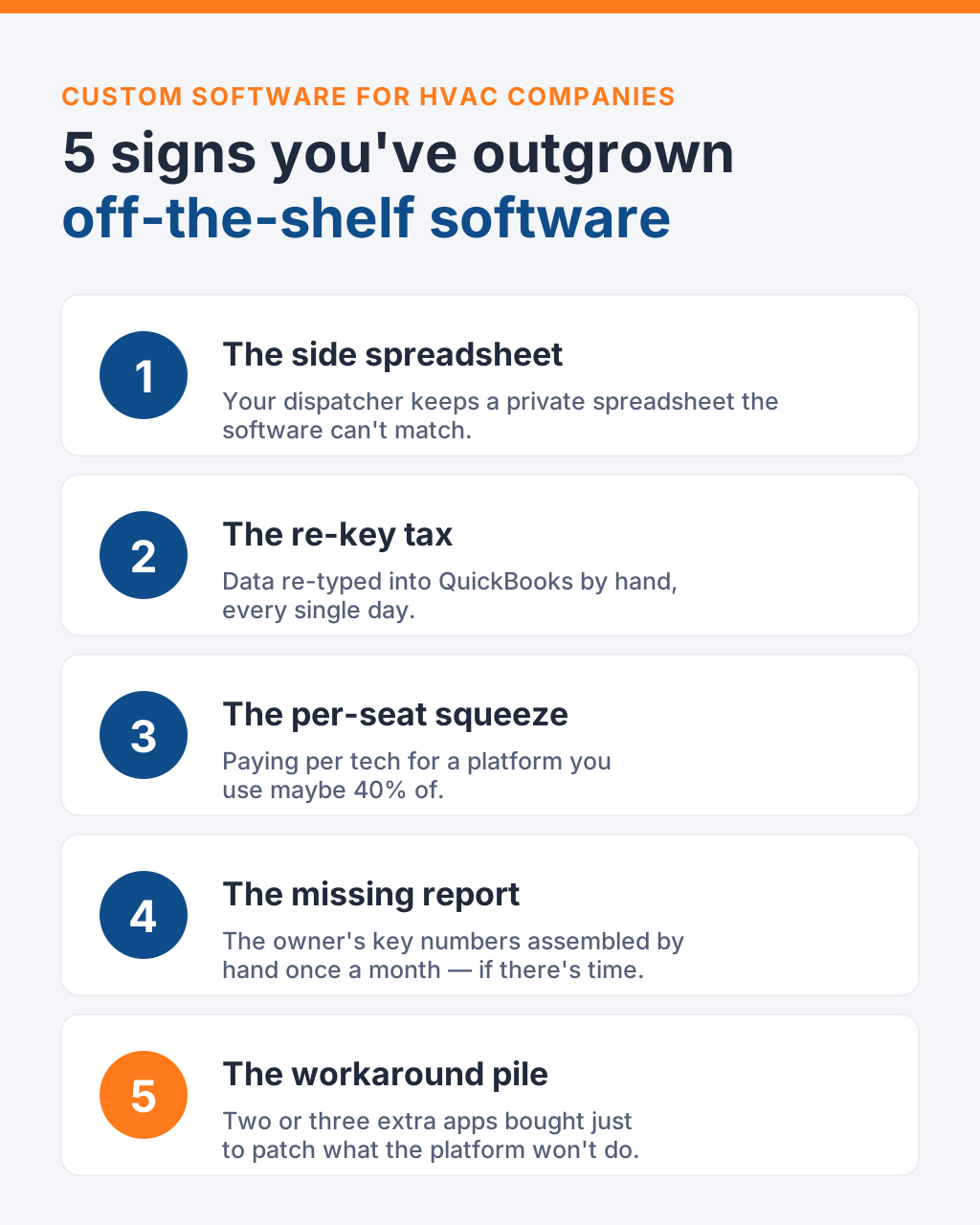
- The side spreadsheet. Your dispatcher or office manager keeps a private spreadsheet because the software doesn’t match reality.
- The re-key tax. Someone re-types data from one system into another every day — usually into QuickBooks.
- The per-seat squeeze. You’re paying per tech for a platform you use maybe 40% of, and the bill grows every time you hire.
- The report that doesn’t exist. The owner’s key numbers get assembled by hand once a month, or not at all.
- The workaround pile. You’ve bought two or three extra apps just to patch what the main platform won’t do.
None of these is fatal alone. Stacked together and growing, they’re the off-the-shelf tax — and the reason a system you own outright starts to look like the cheaper option, not the expensive one.
The shops that switch aren’t chasing shiny software. They’re tired of paying twice — once for the platform, and again for all the human hours spent working around it.
Frequently asked questions
Custom software for HVAC companies — FAQ
What does it mean to "outgrow" my field service software?
It means the tool now costs you more in per-seat fees, manual workarounds, and scattered data than it saves you in features. Off-the-shelf platforms like ServiceTitan, Housecall Pro, and Jobber are built for the average shop, so as your process gets more specific, the gap between how the software works and how you work turns into wasted hours and lost data. The classic tells are a side spreadsheet your dispatcher trusts more than the board, and daily re-keying of data between systems.
Is ServiceTitan too expensive for a small HVAC shop?
It depends on your size. ServiceTitan is genuinely powerful, but its own IPO filing shows it serves about 8,000 customers on roughly $685M of trailing revenue — around $85,000 in average annual revenue per customer (ServiceTitan S-1, SEC, 2024). That tells you the product is designed for larger, mature contractors. For a five-to-fifteen-truck shop, you often pay enterprise, per-tech pricing for a fraction of the features. It can still pay back at scale — just be clear-eyed about whether you're the customer it was built for.
Should an HVAC company build custom software or buy off-the-shelf?
Buy off-the-shelf when you're small (under ~5 trucks), moving fast, or your process is still changing — it's cheaper and someone else maintains it. Build custom when your process is stable and specific, the per-seat math has gotten painful, and workarounds have become a second payroll. Most shops start with one high-ROI custom piece — an owner dashboard, a customer portal, or an integration that ends the re-keying — bolted onto what they already run, rather than replacing everything at once.
How much does custom HVAC software cost, and how fast can you build it?
Fixed-price projects typically run about $3K–$50K+ depending on scope, with milestone payments and a 30-day warranty; hourly is $75/hr with no minimums. Because we build with Claude Code (AI-assisted development), a small senior team ships production software roughly 10× faster than a traditional shop — simple AI agents in 2–3 weeks, full apps in 6–12 weeks. Book a discovery call for a firm quote on your specific build.
Can custom software integrate with ServiceTitan, Housecall Pro, Jobber, or QuickBooks?
Yes — integrations and data pipelines are a core build. We connect ServiceTitan, Housecall Pro, Jobber, FieldEdge, QuickBooks, Stripe, and your dispatch tool so data flows automatically instead of being re-keyed by hand. You don't have to rip out what works; often the first project is simply wiring your existing tools together and adding the one dashboard or portal you're missing.
Do I own the code?
100%. Full IP transfer is included by default — no licenses, no lock-in, no per-seat tax. The code lives in your repository, deploys to your infrastructure, and runs under your accounts. That's the core difference from renting an off-the-shelf platform: with custom software you own the asset, and it keeps working the way your shop works even as you grow.
About the author — Rachel Okonkwo is a GoHighLevel automation consultant who builds CRM workflows, review engines, and AI receptionists for home-service contractors and the agencies that white-label for them. She writes the implementation-heavy pieces on pipelines, integrations, and the systems that actually run an HVAC shop. This article is educational and illustrative; figures are drawn from the cited public sources and general ranges, and specific costs and outcomes vary by shop.
Related reading