
It’s the second week of August and your dispatch board is a wall of red. Every tech is running two jobs behind, the phone has not stopped since 7am, and you turned down three calls yesterday because there was nobody to send. By every measure you can see from the truck, business is good. Then your bookkeeper sends the numbers for July, and the checking account has barely moved. You worked the busiest month of the year and you are looking at a balance that says you ran a slow one.
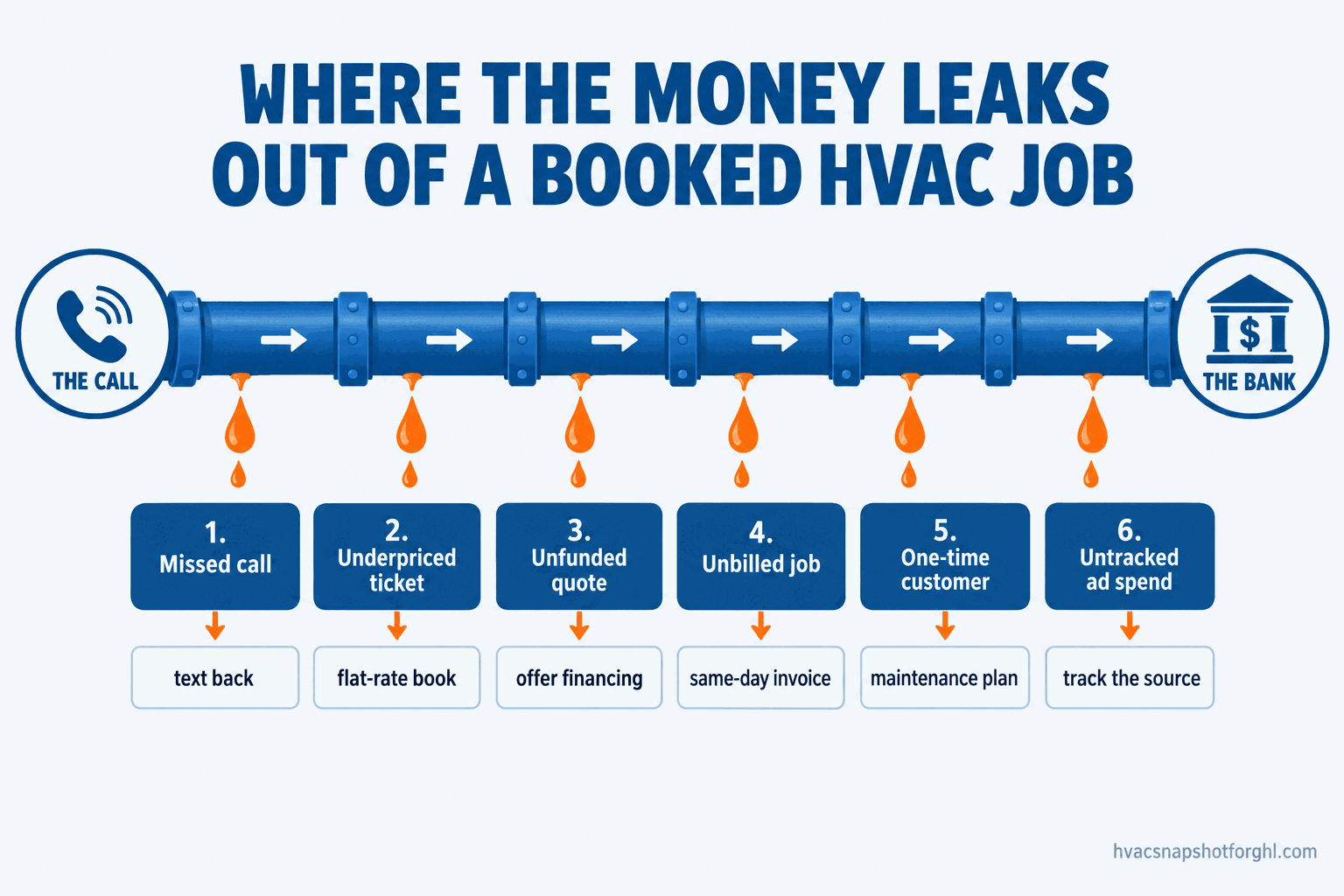
If that gap has ever made you want to throw your phone across the cab, you are not imagining it and you are not alone. A shop can be slammed and still broke, and the reason almost never shows up on the dispatch board. The money does not leak where you are looking. It leaks in the quiet gaps between a job you already won and the cash actually landing in the bank: the call that rang out, the ticket you underpriced, the quote nobody funded, the invoice that never got sent, the customer you served once and never saw again.
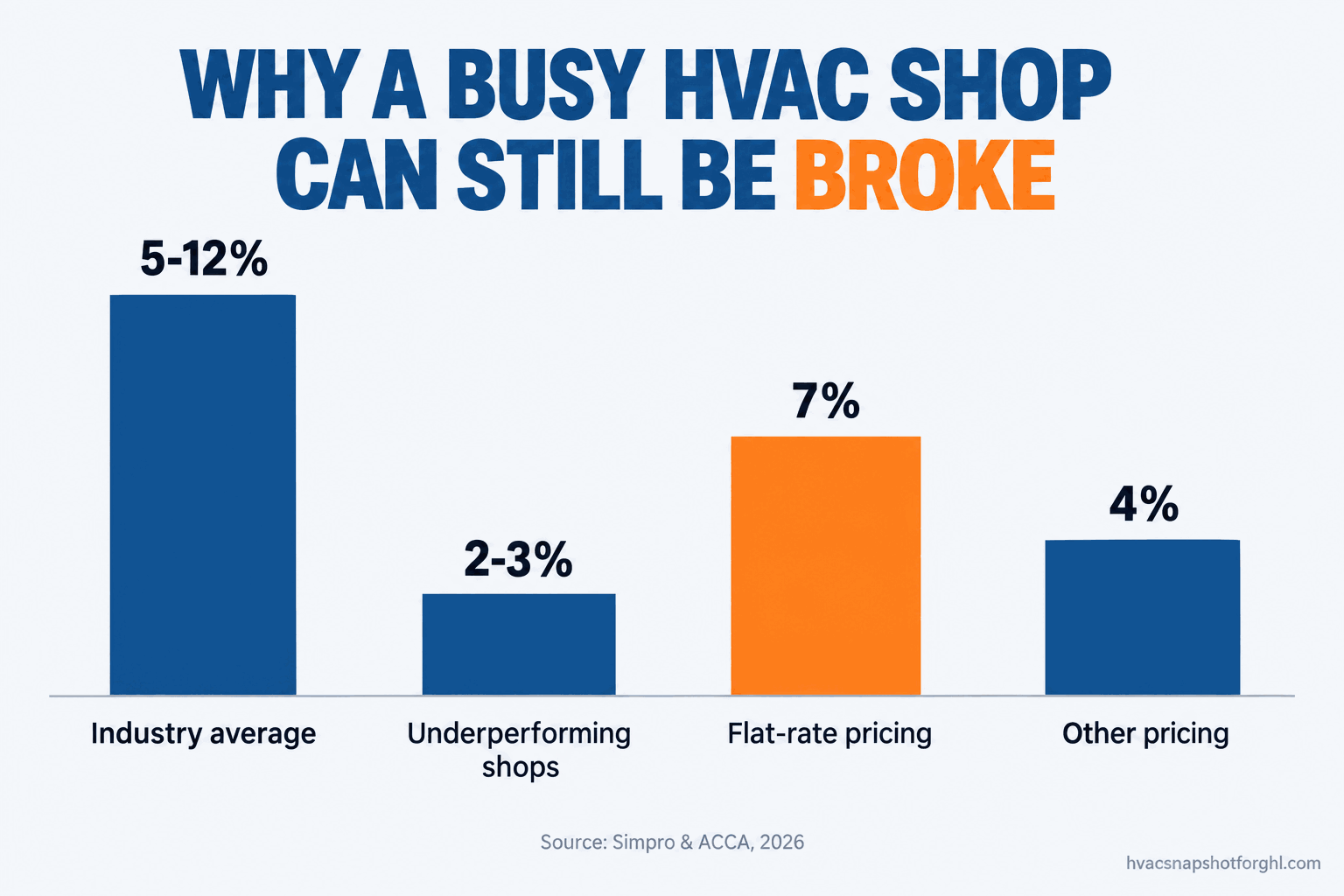
Here is the short version, up front. The industry average net profit margin for an HVAC contractor runs roughly 5% to 12%, and plenty of busy shops sit as low as 2% to 3% (Simpro HVAC industry statistics, 2026). That thin a margin means the difference between a good year and a scary one is not more calls. It is plugging the six leaks below, most of which cost you nothing but a system to catch them.
On this page
- Why a busy shop can still be broke
- The six places the money leaks
- Leak 1: The call that rang out
- Leak 2: The ticket you underpriced
- Leak 3: The replacement nobody funded
- Leak 4: The job you finished but never billed
- Leak 5: The customer you saw once
- Leak 6: The ad spend with no scoreboard
- The steal-this message pack
- Run it for three different shops
- Staying legal: TCPA and 10DLC
- Objections, answered straight
- Frequently asked questions
Why a busy shop can still be broke
Start with the number nobody frames for you. Revenue is not money. A shop can book a million dollars in work and keep almost none of it, because HVAC is a low-margin trade where the profit lives in a thin band at the end of a long chain of costs: trucks, fuel, equipment, labor, warranty, and the office. The industry average net margin runs about 5% to 12%, and shops that never fix their operations routinely land at 2% to 3% (Simpro, 2026). Three percent of a busy month is not a cushion. It is a rounding error that disappears the first time a compressor comes back under warranty.
That thin margin is exactly why volume does not save you. When you only keep a nickel on the dollar, every leak is magnified. A missed call is not one lost job, it is one lost job plus the ad spend that generated it plus the referral tree it would have grown. An underpriced ticket does not just earn less, it can earn nothing once you back out the true cost of the truck roll. On a fat margin you can absorb sloppiness. On an HVAC margin you cannot, and that is the real reason the busiest shops are so often the ones sweating payroll.
The good news hiding in that math cuts the other way too. Because the margin is thin, small fixes pay back hard. Pricing flat-rate instead of winging it is worth roughly three points of net profit all by itself (ACHR News). Catching the calls you already miss is nearly free found money. You do not need to work more. You need to stop the trade’s six standard leaks, in order.
The six places the money leaks
Think of a single job as water running through a pipe from the first ring to the deposit in your account. At six specific joints, the pipe leaks. Most owners only ever look at the first one, because missed calls are loud. The other five are silent, which is exactly why they drain the most. Here is the whole run, each joint with how it breaks and how to seal it.
Leak 1: The call that rang out
This is the leak you can feel. During a heat wave the phone rings while every line is tied up, and the call rolls to voicemail or just rings out. Small service businesses miss around 62% of their calls during business hours and close to 100% after hours, and 85% of callers do not call back (SchedulingKit, 2026). They dial the next shop on Google. You paid for that lead through your ads, your truck wraps, your reviews, and it walked straight to a competitor because nobody picked up.
The fix is not hiring a receptionist you cannot afford in February. It is a missed-call text-back that fires the instant a call goes unanswered, so the caller gets a reply in seconds instead of a voicemail they will never check. Pair it with after-hours coverage, an AI receptionist or a booking link, so the 10pm call about a dead furnace becomes a booked morning slot instead of a missed one. We covered the mechanics in depth in after-hours missed calls and speed to lead.
How it breaks: the text-back goes out but points nowhere, so the homeowner replies “yes please call me” and that reply lands in an inbox nobody watches until Monday. Seal it by routing every inbound text into a real pipeline with an owner and a clock, so a reply becomes a booked job, not another thing sitting unread.
Leak 2: The ticket you underpriced
Here is the quiet one. Your tech is standing in a hot attic, the homeowner is anxious, and the tech gives a number off the top of his head because that is faster than pulling up a price book. Multiply that by every service call in July and you have a shop that is busy pricing its own work by feel, differently on every truck. Shops that move to flat-rate pricing report about 7% net profit versus 4% for those pricing other ways (ACCA Contractor of the Future survey). That is the gap between a shop that keeps money and one that just moves it.
Underpricing hides because the job still “sold.” You see a booked ticket, not the margin you gave away. But a repair quoted at $280 that should have been $420, run across a busy season, is tens of thousands of dollars of pure profit you handed back one truck roll at a time. The fix is a flat-rate price book every tech quotes from, so the number is the same whether it comes off your best closer or your newest hire, and it already carries your real cost plus your real margin.
How it breaks: you build the price book and nobody uses it, because it lives in a binder in the office and the tech is in an attic. Seal it by putting the price book on the phone in the tech’s pocket, in the same app that holds the dispatch and the quote, so the right number is easier to reach than a guess.
Leak 3: The replacement nobody funded
A homeowner nods at your $9,000 changeout quote and goes quiet. You assume the price scared them off. Usually it did not. They simply cannot pull $9,000 out of checking and were too embarrassed to say so. Offering financing on every job, not just when you remember, lifts close rates from 38% to 49%, and home-services jobs paid with financing run about 4.5x larger because a monthly number lets people buy the right system instead of the cheapest patch (ACHR News, 2026; Wisetack). Yet about a third of contractors still do not offer it at all (ACCA survey).
The average full system replacement already runs around $7,500 and climbs past $10,000 on a high-efficiency or heat-pump changeout (Angi), which is more than most households keep liquid. The fix is to frame the monthly payment next to the cash price on every replacement quote and to put a two-minute application link in the homeowner’s hand before the truck leaves the driveway. Our HVAC financing guide walks the setup, and the quote follow-up system keeps the stalled ones warm.
How it breaks: you offer financing verbally, the tech forgets half the time, and it never appears on the written quote. Seal it by baking the monthly figure and the apply link into the quote template itself, so financing is offered on one hundred percent of replacements without anyone having to remember.
Leak 4: The job you finished but never billed
This one is almost too dumb to admit, which is why it is everywhere. The tech finishes the job, closes the truck, drives to the next call, and the ticket never gets invoiced. Or it gets invoiced three weeks later, by which point the homeowner has moved on and the payment drags for another month. Unbilled and slow-paid tickets are not a sales problem. They are cash you already earned, sitting in limbo, while you float payroll and parts on a credit line that charges you interest for the privilege.
In a thin-margin trade, aging receivables quietly eat the profit you fought for on the job. Every day a completed ticket goes unbilled is a day your money is working for the customer instead of you. The fix is same-day invoicing, triggered the moment a job is marked complete, with an automatic payment link by text and email and a polite reminder sequence if it goes unpaid. The tech closes the ticket, the invoice fires itself, and the homeowner pays from their phone while the work is still fresh and the trust is high.
How it breaks: the reminders never stop, so a customer who already paid by check keeps getting “your invoice is past due” texts and gets angry. Seal it by syncing payment status back to the invoice so a recorded payment cancels the sequence instantly, and by capping reminders at a sane count before a human picks up the phone.
Leak 5: The customer you saw once
You rescued this homeowner at 11pm in July. Then you never spoke again, and next spring they found someone else for the tune-up. That is the most expensive leak of all, because a repeat maintenance-plan customer is worth many times a one-time call and costs almost nothing to keep. It is also the leak that builds enterprise value: when shops are bought and sold, buyers pay a meaningfully higher multiple for a book of recurring agreement revenue than for pure break-fix work (Lightning Path Partners, 2026).
Two systems plug it. First, a maintenance plan offered on every service call and renewed automatically, so a customer becomes a member instead of a stranger. Second, a same-day review request after every job, because 91% of homeowners read online reviews before picking a contractor and most will not consider a shop under four stars (ACHR News / BrightLocal). Reviews turn one happy customer into the reason the next five call you first. Our deep dives on selling maintenance plans and getting Google reviews cover both.
How it breaks: the review request goes to everyone, including the one customer whose job went sideways, and now you have a public one-star. Seal it by routing a quick private “how did we do?” first, sending happy customers to Google and unhappy ones straight to you to fix before it goes public.
Leak 6: The ad spend with no scoreboard
You spend on Google, on Facebook, on the truck wraps, maybe on a lead service, and you genuinely cannot say which dollar brought which job. So you cannot cut what is wasted or double what works, and your marketing budget becomes a guess you re-make every month. It matters more than it looks: shops that invest and track their marketing seriously, around 12% of revenue or more, report about 9% net profit versus 5% for everyone else (Simpro / ACCA data). The difference is not spending more blindly. It is knowing the score.
The fix is lead-source tracking that is actually attached to revenue, not just clicks. Every inbound call, form, and text tagged with where it came from, and that tag carried all the way through to the booked and paid job, so you can see cost per booked job by channel instead of cost per click. Then you stop arguing about marketing and start managing it. If you want the full teardown of where leads vanish before they even reach this stage, the lead leak audit is the pre-booking companion to this piece.
How it breaks: you track the source of the lead but lose it at booking, so you know a call came from Google but never learn whether it became a $9,000 install or a no-show. Seal it by carrying the source tag through the whole pipeline to the paid invoice, which is the only number that tells you what a channel is really worth.
The steal-this message pack
Everything above runs on a handful of short messages. Here they are, ready to drop into your CRM. Swap the names and numbers for yours.
Notice what these are not: a pile of generic marketing blasts. Each one seals a specific joint in the pipe, at the exact moment the money is most likely to leak. That is why a shop running all five quietly out-earns a bigger shop that just runs more trucks.
Run it for three different shops
The six leaks are the same at every size. How you staff and sequence the fixes changes with the shop. Here is how the same plan plays out from a solo truck to a twelve-truck outfit.
| Solo / 1-2 trucks | 5-truck shop | 12-truck shop | |
|---|---|---|---|
| Biggest leak | Missed calls, no billing discipline | Underpricing, dropped follow-up | Lost attribution, no accountability |
| Fix first | Missed-call text-back + same-day invoice | Flat-rate price book + financing | Lead-source tracking + reporting |
| Who owns it | You, from the truck | Office manager + automation | Ops manager / CSR on a dashboard |
| Win to expect | Stop bleeding paid leads and float | +3-5 pts net margin | Managed marketing, higher sale value |
Solo operator. You are the tech, the dispatcher, and the office, so the leaks you cannot watch are the ones that hurt. Automate the two that do not need judgment first: missed-call text-back so a dropped call books itself, and same-day invoicing so you stop floating finished work on a credit card. Those two alone often cover the cost of the whole system in a month.
Five-truck shop. Your leaks are hand-offs and inconsistency. Different techs quote different numbers, and warm replacement quotes fall between the tech who wrote them and the office that was supposed to chase them. Put a flat-rate price book on every phone, offer financing on every quote, and let automation carry the follow-up. This is the size where sealing the leaks is worth three to five points of net margin, real money on your volume.
Twelve-truck shop. At this volume the dangerous leaks are invisible: nobody owns any single stalled quote, and you cannot tell which marketing dollar earns. You need lead-source tracking carried to the paid invoice, a reporting view of recovered revenue by channel, and a person whose job is the pipeline, not the wrench. The payoff is a business you can manage by the numbers and, when the day comes, sell for a real multiple.
Staying legal: TCPA and 10DLC
Four of the six fixes run on text messages, so the rules that govern business texting are load-bearing here. Get them wrong and the fixes do not just risk a complaint, they stop being delivered at all.
First, TCPA and consent. The Telephone Consumer Protection Act governs how you text customers. The safe path is simple: get express consent, log it with a timestamp, and honor opt-outs instantly. When a homeowner hands your tech a number and agrees to texts about their service, that is your consent, so record it. Every message needs a working opt-out, and a STOP has to actually stop. Our TCPA and 10DLC guide for HVAC has the full checklist.
Second, A2P 10DLC registration. To send business texts from a regular 10-digit number, carriers require you to register your brand and campaign. Treat these as illustrative 2026 figures and confirm with your provider: a one-time registration around $24.50 for a sole-proprietor or low-volume brand (closer to $71.91 for a high-volume brand), a per-campaign fee commonly $2 to $10 per month, and a carrier surcharge of roughly $0.003 per message (GoHighLevel A2P fee schedule). Pennies against the leaks you are sealing, but skip registration and your texts get filtered, so the missed-call reply and the invoice link never arrive.
Objections, answered straight
“I’m busy enough, I don’t need more leads.” You are right, and that is the point. This is not about more leads. Every leak above is about keeping the money from work you have already won: calls you already paid to generate, jobs you already finished, customers you already served. Sealing them raises profit without adding a single truck or a single ad dollar. Busy and broke is not a volume problem.
“I already pay for ServiceTitan or Housecall Pro, doesn’t it handle this?” Those platforms can store the data and, on the right tier, fire some of these messages. What most shops never do is actually build the sequences, so the capability sits unused while the leaks keep running. The gap is not the software, it is the wiring. If you are weighing what all of this costs, our HVAC software pricing teardown lays out the real numbers.
“Won’t the automated texts annoy my customers?” Not when each one lands at the right moment and is easy to opt out of. A text that returns a missed call in seconds, or lets someone pay from the couch, reads as attentive, not pushy. The annoying version is the one that keeps billing a customer who already paid, which is exactly the failure mode each fix is built to avoid.
“Do I need to be technical to run this?” No, but somebody has to build it once. The logic is simple, tag the source, fire the right message, stop on payment or opt-out, but wiring it inside a CRM takes focused hours if you know the tool. That is the entire reason done-for-you systems exist: the sequences are assembled and you just plug in your name, numbers, and links.
Frequently asked questions
Why is my HVAC business busy but not making money?
Because volume does not equal profit in a trade with net margins of roughly 5% to 12%. The money leaks between a booked job and the bank: missed calls, underpriced tickets, unfunded replacement quotes, unbilled work, and one-time customers who never come back. Fixing those six leaks raises profit without adding a single lead.
What is a normal net profit margin for an HVAC company?
The industry average runs about 5% to 12%, with well-run shops targeting higher and underperformers often landing at 2% to 3%, according to 2026 HVAC industry data. On a margin that thin, small operational leaks have an outsized effect, which is why plugging them matters more than chasing more calls.
How much do missed calls really cost a small HVAC shop?
More than most owners think. Small service businesses miss around 62% of calls during business hours and nearly all after-hours calls, and about 85% of callers do not call back. Since you already paid to generate each of those leads through ads and reviews, every missed call is a job handed to a competitor for free.
Does offering financing actually increase HVAC sales?
Yes. Contractors who offer financing on every job see close rates rise from about 38% to 49%, and financed home-services jobs run roughly 4.5x larger because a monthly payment lets homeowners buy the right system instead of the cheapest patch. About a third of contractors still do not offer it, which is a leak you can close quickly.
How do I stop finished jobs from going unbilled?
Trigger the invoice automatically the moment a tech marks a job complete, with a payment link by text and email and a short reminder sequence if it goes unpaid. Sync payment status back so a recorded payment stops the reminders instantly. That turns slow, forgotten tickets into same-day payments while the work is still fresh.
Is a maintenance plan worth it for a small shop?
It is one of the highest-value fixes you can make. A recurring plan member is worth many times a one-time caller, costs little to keep, and raises what your business is worth, since buyers pay a higher multiple for recurring agreement revenue than for break-fix work. Offer a plan on every service call and renew it automatically.
Is it legal to text customers invoices and reminders?
Yes, with express consent and the right setup. Under the TCPA you need consent (the homeowner gives it when they share a number for service updates), a logged record of it, and a working opt-out in every message. You also need to register your number for A2P 10DLC so carriers actually deliver your texts.
It’s the second week of August again, and your board is still a wall of red. The difference is what happens behind it. The call you could not pick up got a text back in seconds and booked itself for the morning. The repair your newest tech quoted carried the right number off the price book in his pocket. The $9,000 changeout closed because the homeowner saw $152 a month instead of a wall of cash. The jobs you finished invoiced themselves before the truck reached the next stop. And the customer you rescued is a plan member now, not a stranger you will lose by spring. Same trucks, same phone, same summer. The money just stopped leaking on the way to the bank.