
The phone rings at 8:15 on a Monday in July. You’re elbow-deep in a condenser, so your newest guy grabs it. Homeowner’s first words: “Yeah, hi, how much to replace my AC?” Your guy says what everybody says, “it kind of depends, probably somewhere around eight or nine grand,” and the homeowner says “okay, thanks,” and hangs up. That call just cost you a $9,000 install, and you’ll never know it, because nothing shows up on a report when a price shopper quietly dials the next shop.
Here’s the hard truth about that call: the homeowner was not being cheap. They asked for a number because it’s the only question they know how to ask. They can’t see your trucks, your warranty, or your reviews over the phone, so price is the only lever they’ve got. Answer with a bare number and you’ve handed them exactly what they need to comparison-shop you out of the running, with zero reason to pick you. This piece is about the other way to run that call: a repeatable system that turns “how much?” into a booked in-home estimate, which is the only place a replacement job actually gets won.
On this page
- What is a price-shopper call?
- Why “just give me a number” loses the job
- The 6-stage price-shopper call system
- The steal-this phone script
- Run it for three different shops
- Texting the estimate: TCPA and 10DLC
- Objections, answered straight
- Frequently asked questions
What is a price-shopper call?
A price-shopper call is an inbound call where a homeowner leads with a price question, usually “how much to replace my AC?” or “what do you charge for a new furnace?”, before you’ve seen the home, the equipment, or the problem. It feels like a dead end, because a replacement number is impossible to give honestly over the phone and a wrong one scares the caller off. But it’s actually the opposite: a price-shopper call is a hot lead. Nobody calls three HVAC shops for pricing unless they’re seriously thinking about buying.
The job on that call is not to quote. It’s to convert, to move the homeowner from “give me a number” to “come take a look Thursday at 2.” That matters because of where replacements get sold. You cannot size equipment, check ductwork, spot an electrical issue, or read the room over the phone, and you definitely can’t build the trust that closes a five-figure job. All of that happens on the in-home visit. So the entire call has one measurable goal: a confirmed appointment on the calendar.
Treat it that way and the math changes fast. The same caller who “just wanted a ballpark” becomes a booked estimate, and because most homeowners who intend to shop never actually finish shopping, the shop that books the visit first often becomes the only shop that ever gets in the door. Lose the call and you’re not even in the running. Win it and you’ve skipped the comparison entirely.
Why “just give me a number” loses the job
It feels helpful to answer the question they asked. It isn’t. Here’s what’s actually happening when you blurt a number, and why it hands the job to someone else.
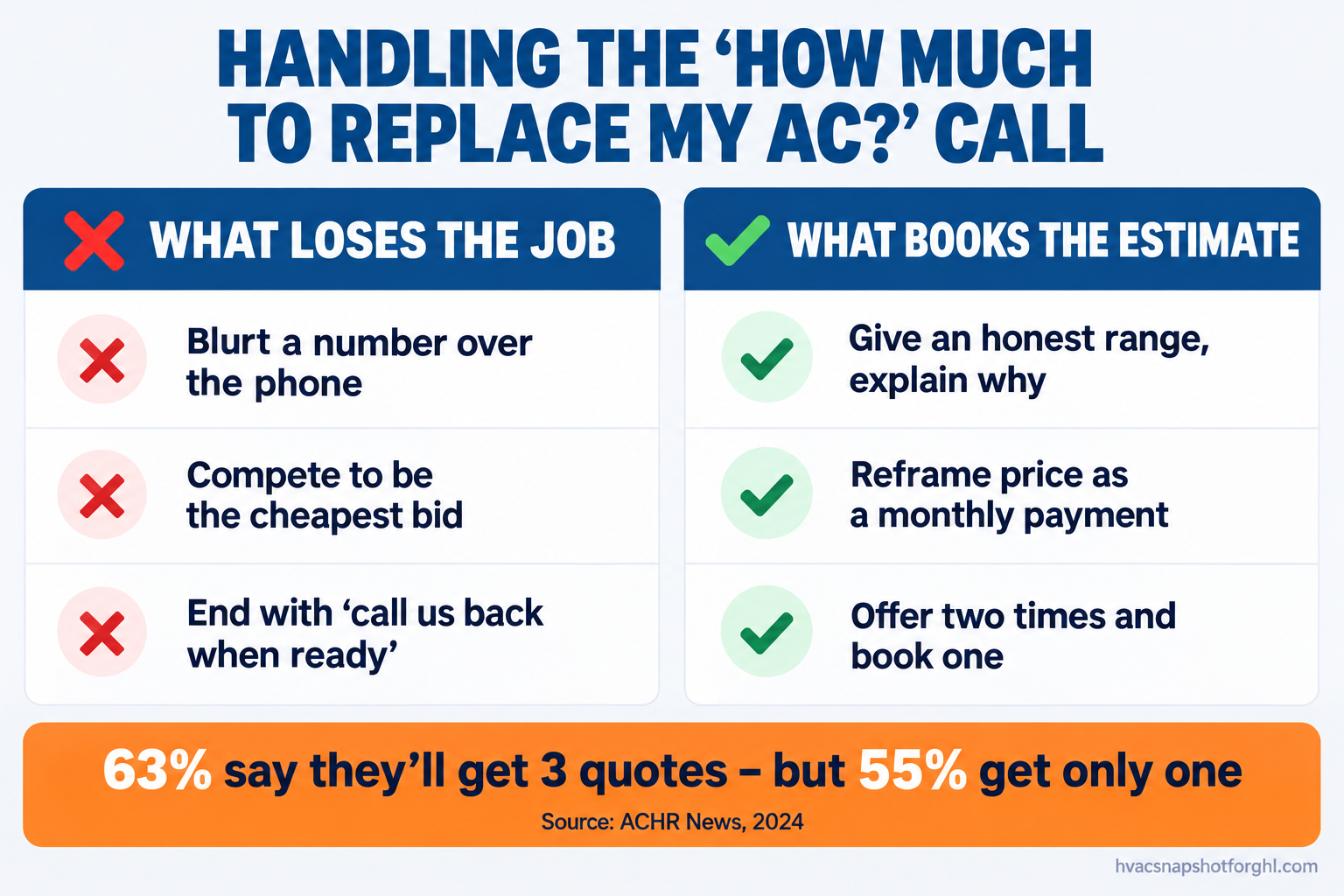
A phone number can only ever be wrong. A replacement depends on the size of the system, the efficiency tier, the state of the ductwork, the electrical, the airflow, and access. Quote low and you either eat the gap or look like a bait-and-switch when the real number lands. Quote high and you scare off a good customer before you’ve had a chance to show value. A full system averages about $7,500 and runs past $10,000 on a high-efficiency changeout (Angi), and that spread is exactly why a phone number is a guess dressed up as an answer.
Price shopping is real, which is the reason to reframe, not to compete on price. A Modernize survey found 43% of homeowners choose their contractor based on the estimate price (ProBuilder, 2018). If you make it a pure number-versus-number fight, you’re training the customer to pick the cheapest bid, which is a race you don’t want to win. The reframe is where you move the conversation from “what’s your price” to “what are you actually getting, and can I make it affordable.”
The caller has one foot out the door. On a hot summer morning they’re calling two or three shops in a row. Whoever earns the appointment first usually wins, because about 55% of consumers end up getting just one quote even though 63% say they plan to get three (ACHR News). The shop that books the visit is often the only shop that ever shows up. A bare number gives the caller nothing to book around, so they hang up and keep dialing. An appointment takes them off the market.
The 6-stage price-shopper call system
Here’s the call, start to finish. Six stages, each with its job, real words you can steal, and the part nobody writes down: how it breaks and what to do about it. The whole thing takes three or four minutes and ends with a time on the calendar.
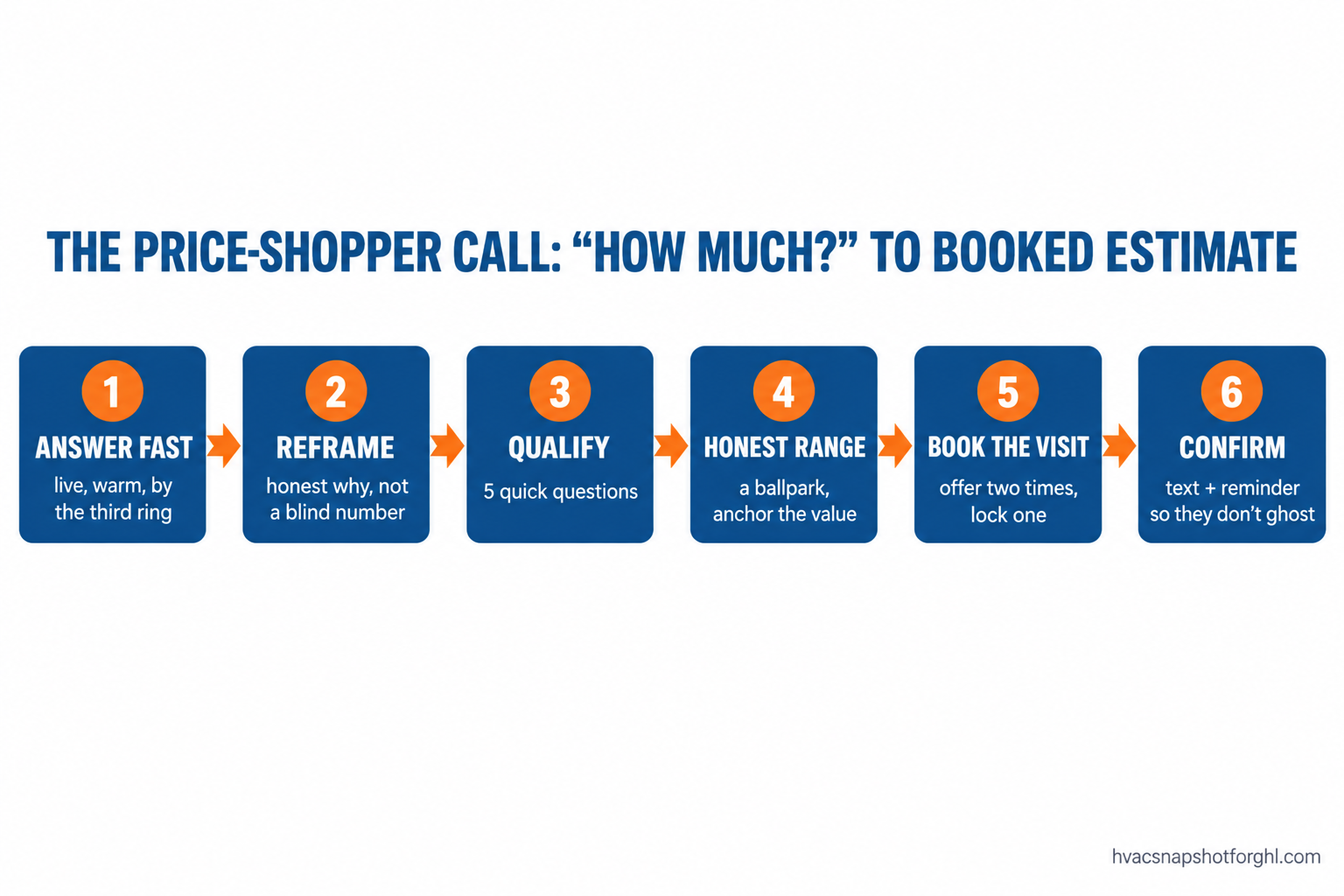
Stage 1: Answer fast and warm, every time
You can’t convert a call you don’t answer. On a July morning the price shopper is dialing down a list, and the first live, friendly human usually wins. Pick up by the third ring, with a real greeting and the shop name, and sound glad they called. If you physically can’t answer while you’re on a roof, that’s what a missed-call text-back or an AI receptionist is for, so the call never goes to voicemail and dies. We break down the cost of that leak in the after-hours missed-call piece.
The copy: “Thanks for calling Ace Comfort, this is Tony. Are you looking to get your AC fixed or replaced? Happy to help.”
How it breaks: the call rings out, hits voicemail, and the homeowner hangs up and dials the next shop without leaving a message. Fix it by making sure every call gets a live answer or an instant text back within seconds, not a mailbox. Speed is the whole first stage.
Stage 2: Reframe the number without dodging it
Do not quote, and do not stonewall either. The homeowner asked a fair question and deserves a straight, honest reason you can’t give a real number blind. Reframe it: the price depends on real things, and getting it wrong over the phone would cost them money. This positions you as the pro who won’t guess, instead of the salesperson ducking the question.
The copy: “Great question, and I want to give you an honest answer instead of a random number. A replacement really comes down to the size of your system, the efficiency you want, and the shape your ductwork and electrical are in. A number over the phone would either be too high and scare you, or too low and change on you later. Neither helps you.”
How it breaks: it turns into a wall (“I can’t give you anything until we come out”), which reads as evasive and sends the caller straight to the shop that at least gave a ballpark. Always pair the “I won’t guess” with the real reasons and, in Stage 4, an honest range. Explain, don’t refuse.
Stage 3: Qualify so the visit is worth everyone’s time
Now you ask the questions that turn a stranger into a real opportunity, and they also make the homeowner feel taken seriously. Keep it conversational, five quick things: what’s going on with the system, how old it is, is it cooling at all, roughly how big is the house, and what’s their timeline. You’re learning whether this is an emergency replacement or a “someday,” and you’re showing them you actually care about their situation, not just the sale.
The copy: “Let me ask you a few quick things so I point you right. What’s the system doing right now, is it blowing warm or not running? And how old is it, roughly? Got it. About how big is the house, and are you hoping to get this handled soon or just planning ahead?”
How it breaks: you skip qualifying and jump to booking, so you fill a truck slot with a tire-kicker or miss that it’s a true emergency that needed same-day. Fix it by making the five questions a non-negotiable part of the call. Thirty seconds of qualifying protects your schedule and tells the customer you’re thorough.
Stage 4: Give an honest range, then anchor the value
Here’s where most shops either chicken out or overpromise. Give a real, wide ballpark, framed as a range for systems like theirs, so the homeowner isn’t flying blind, then immediately anchor what that money buys. A full replacement commonly lands between about $7,500 and $12,000 depending on the system (Angi), and saying so builds trust. Then pivot to value and affordability, because 48% of adults can’t cover even a $2,000 expense from savings (Federal Reserve, 2024), so the real objection is almost never the sticker, it’s “can I afford this.” Mention financing early: contractors who offer it close 49% of jobs versus 38% who don’t (ACHR News).
The copy: “For a home your size, a full replacement usually runs somewhere in the $7,500 to $12,000 range depending on the system and condition, and that’s exactly why we come out and get it right instead of guessing. Most folks use our financing, so it ends up as a monthly payment rather than a big check. When our tech comes out, you’ll get a firm number and a few options to choose from, no pressure.”
How it breaks: you give a single pinpoint number (“it’ll be $9,000”) that becomes a promise you can’t keep once you see the ductwork. Always give a range with the honest reasons it moves, and always tie it to the in-home visit where the real number comes from. The financing playbook covers how to frame the monthly figure.
Stage 5: Book the appointment, that’s the close
This is the only close that matters on this call. You’re not asking “do you want to move forward,” you’re asking “what time works.” Offer two specific slots, assume the booking, and make it easy. A booked, confirmed estimate is the win, because it takes the homeowner off the market and gets your tech in front of them where the job actually sells. Even better if they can self-schedule online when they’re ready, but on a live call, book it right there.
The copy: “Easiest thing is to have our tech come take a look, measure up, and give you firm options. I’ve got tomorrow afternoon or Thursday morning open, which works better for you? Perfect, I’ll lock in Thursday at 10. It’s free and there’s zero obligation.”
How it breaks: you end with “feel free to call us back when you’re ready,” which hands the decision back to a caller who’s still dialing competitors. Never leave the close open. Offer two times and book one. The appointment is the product of this call.
Stage 6: Confirm and follow up so they don’t ghost
A booked estimate isn’t a kept estimate until you lock it in. The moment you hang up, a confirmation text goes out with the date, time, and your name, and a reminder fires the morning of. This cuts no-shows and keeps you top of mind through the window where a competitor might still swoop in. Then, after the visit, the estimate rolls into your quote follow-up system so the number you leave behind actually gets worked instead of dying in silence.
The copy (confirmation text): “Hi Dana, confirmed: Tony from Ace Comfort will be out Thursday 10/30 at 10am to look at your AC and give you firm options. Reply here with any questions. See you then. Reply STOP to opt out.”
How it breaks: you book the slot but never confirm, so the homeowner forgets, or books a competitor who called after you, and your tech rolls up to an empty driveway. Fix it with an automatic confirmation and a morning-of reminder on every booked estimate. The truck-roll you save pays for the whole system.
The steal-this phone script
Everything above in one place, ready to hand your CSR or your newest tech. Swap the names and numbers for yours.
Notice what this script never does: give a firm price, argue about being the cheapest, or end the call without a time on the calendar. Each line moves the homeowner one step closer to the driveway, which is the only place a $9,000 job gets sold.
Run it for three different shops
The script is the same. Who answers and what you automate changes with the size of the shop.
| Solo / 1-2 trucks | 5-truck shop | 12-truck shop | |
|---|---|---|---|
| Who answers | You, from the truck | Office manager / CSR | CSR team + AI overflow |
| Biggest risk | Calls go to voicemail | Inconsistent handling | Volume, no accountability |
| What to automate first | Missed-call text-back + AI answer | The script + booking + confirms | Routing + reporting + AI overflow |
| How the estimate books | You, or self-schedule link | CSR books live | Live or AI, into one calendar |
| Win to expect | Stop losing calls you can’t take | Higher booked-estimate rate | Measurable close on inbound |
Solo operator. You can’t answer while you’re working, and that’s where the jobs leak. Your first move isn’t a fancy script, it’s making sure the call gets answered at all: a missed-call text-back that fires in seconds and an AI receptionist that can qualify and book while you’re up a ladder. When you do answer, run the script. Even a rough version beats the voicemail that’s costing you installs now.
Five-truck shop. Your problem is consistency. One person runs the script beautifully and another blurts a number and loses the job, and you can’t tell which calls you’re dropping. Put the script in front of whoever answers, automate the confirmation and reminder texts, and track how many inbound price calls turn into booked estimates. This is the size where a standard call flow visibly lifts your booking rate.
Twelve-truck shop. At this volume you’re drowning in inbound during the season, and calls get lost or handled a dozen different ways. You need routing, AI to catch overflow so nothing goes to voicemail, and a report on booked-estimate rate by person and by source. Done right, inbound call handling becomes a managed number on a dashboard, not a mystery.
Texting the estimate: TCPA and 10DLC
The confirmation and reminder texts are what keep a booked estimate from ghosting, and texting is also where shops get themselves in trouble. Two things to keep straight.
First, TCPA and consent. The Telephone Consumer Protection Act, enforced by the FCC, governs business texting. When the homeowner gives you their number on the call and agrees to text updates about their appointment, that’s your consent, log it with a timestamp. Keep every message tied to the appointment they asked for, put a clear opt-out in each one, and honor a STOP instantly. Transactional confirmations to a customer who just booked are about as safe as texting gets, as long as you have and record that consent. Our TCPA and 10DLC guide for HVAC walks the full checklist.
Second, A2P 10DLC registration. To send business texts from a regular 10-digit number, carriers require you to register your brand and campaign. Illustrative 2026 costs: a one-time registration around $24.50 for a sole proprietor or low-volume brand (about $71.91 for high-volume), a recurring campaign fee commonly $2 to $10 per month, and a carrier surcharge of roughly $0.003 per message (GoHighLevel A2P fee schedule). Skip registration and carriers filter your confirmations, so your reminder never arrives and your no-show rate quietly climbs.
Objections, answered straight
“If I don’t give a number, won’t they just hang up on me?” Some will, and those were never going to buy from you anyway. The reframe isn’t a refusal, it’s a straight answer plus an honest range plus a free visit. That reads as professional, not evasive. Remember most people who say they’ll get three quotes end up getting one, so the goal isn’t to survive the call, it’s to book the appointment before they dial the next shop.
“I’m not a salesperson, this feels pushy.” It’s the opposite of pushy. You’re not pressuring anyone to buy a $9,000 system on the phone, you’re offering a free, no-obligation visit to get them an honest number. The only “ask” is a time that works for them. Most homeowners are relieved to deal with someone who won’t just blurt a guess and who makes the next step easy.
“My techs and CSR will never remember all this.” They don’t have to memorize a speech, they follow a flow: answer, reframe, qualify, range, book, confirm. Put it on a card by the phone or build it into your CRM so the confirmation and reminder fire automatically. That’s the entire point of a system, it works the same whether your best closer or your newest hire picks up.
“I already pay for ServiceTitan / Housecall Pro, doesn’t it handle this?” Those platforms store the customer and can fire reminders, but they don’t answer the phone with a script, qualify the caller, or catch the call you miss while you’re on a roof. The booking and confirmation can live there; the live handling and the after-hours answer are a separate build. If you’re weighing what you pay for all of it, our HVAC software pricing teardown lays out the real numbers.
Frequently asked questions
Should I give a price over the phone for an HVAC replacement?
Give an honest range, never a firm number. A replacement price depends on system size, efficiency, ductwork, and electrical, so a pinpoint phone quote is either too high and scares the customer or too low and becomes a problem later. Offer a wide ballpark (commonly $7,500 to $12,000 for a full system), explain what moves it, and book the in-home visit where the real number comes from.
How do I handle a customer who only cares about price?
Reframe price around value and affordability instead of competing to be cheapest. Give an honest range, mention financing so it becomes a monthly payment, and book a free in-home estimate. A Modernize survey found 43% of homeowners choose on price, but you win more by making the number feel possible and showing what they get than by being the lowest bid.
What's the goal of a price-shopper call if I'm not quoting?
A booked, confirmed in-home estimate. You can't size equipment, inspect the home, or build trust over the phone, and nobody sells a five-figure replacement by text. The call's only measurable goal is a time on the calendar, because the job gets won in the driveway, not on the phone.
How quickly do I need to answer these calls?
As fast as possible, ideally by the third ring. On a hot day the homeowner is calling several shops in a row, and the first live, helpful answer usually wins. If you can't pick up, an instant missed-call text-back or an AI receptionist keeps the call from going to voicemail and dying, which is where most price-shopper leads are lost.
What should I ask a price shopper before booking?
Five quick things: what the system is doing now, how old it is, whether it's cooling at all, roughly how big the house is, and their timeline. This tells you whether it's an emergency replacement or a planning call, protects your schedule from tire-kickers, and shows the homeowner you take their situation seriously.
Is it legal to text appointment confirmations to customers?
Yes, with consent. When the homeowner gives you their number and agrees to text updates about their appointment, that's TCPA consent, log it with a timestamp. Keep messages tied to the booking, include an opt-out, honor STOP instantly, and register your number for A2P 10DLC so carriers deliver the texts.
How do I stop booked estimates from no-showing?
Send an automatic confirmation text the moment the slot is booked and a reminder the morning of, both with the date, time, and your tech's name. That keeps the appointment front of mind, cuts no-shows, and keeps a late-calling competitor from stealing the slot. One saved truck-roll covers the cost of the whole system.
It’s 8:15 on a Monday in July again, and the phone rings with the same four words: “how much to replace my AC?” Except this time your guy doesn’t blurt a number. He answers warm, explains why a phone guess would do them wrong, asks five quick questions, gives an honest range, and books Thursday at 10, confirmed by text before he hangs up. That homeowner is off the market, your tech is in front of them where the job actually sells, and the two shops they were about to call never get the chance. Same call, same question. The only thing that changed is that somebody ran the play.