
You’re riding along on a Tuesday in October, which is the only month slow enough to let you watch your own guys work. Carlos pulls the panel on a 12-year-old condenser, washes the coil, checks the charge, swaps a weak capacitor before it strands somebody in July. Clean visit. The homeowner is standing right there, happy, wallet already out. This is the exact moment a maintenance plan sells itself. Carlos wipes his hands, says “you’re all set, have a good one,” and walks to the truck. The plan never came up. It never does.
That is the leak this piece is about, and it is bigger than any ad you’re running. You are paying a licensed tech to stand in a trusting customer’s house, and he is leaving the single most profitable sentence of the whole visit unsaid. The fix is not a pep talk and it is not a better closer. It is a system: the comp, the script, the trigger, the follow-up, the tracking, and the renewal, built so the ask happens on every eligible call whether your tech is a natural salesman or not. Here’s how to build it.
On this page
- What it costs you when techs skip the plan
- Why techs won’t sell maintenance plans
- The 6-part system that gets techs to sell
- The steal-this script pack
- Run it for three different shops
- Keep the texts legal: TCPA and 10DLC
- Objections, answered straight
- Frequently asked questions
What it costs you when techs skip the plan
Do the math on your own board and it gets uncomfortable fast. A typical residential maintenance plan runs about $150 to $300 a year (Angi). Say your shop runs 1,200 service and repair calls a year. If even half are plan-eligible, that’s 600 chances to put a membership in front of a happy customer. Sell a $200-a-year plan on 20% of them and you’ve added $24,000 in recurring revenue off work your trucks were already doing. Push that to 40%, which is what a real system does, and it’s $48,000. Same calls, same techs, same trucks. The only difference is whether the ask happened.
And the recurring part is the point. February is the month that empties your bank account, not because the work was bad in July but because a one-time repair customer has no reason to call you when nothing’s broken. A maintenance plan gives them a reason and gives you a scheduled visit in the dead months. It’s the single cleanest fix for the slow-season cash gap most shops white-knuckle every winter.
Here’s the number that should reframe the whole thing. ServiceTitan’s survey of more than 1,000 US residential contractors found that repeat customers account for 39% of a contractor’s annual revenue, and word-of-mouth referrals drive 71% of business volume (ServiceTitan). Your repeat base is not a nice-to-have. It is most of your business. And the maintenance plan is the one tool that reliably turns a one-time repair into a repeat customer, because it puts a recurring reason to call you on the calendar.
There’s a second cost hiding in plain sight. That tech standing in the living room is expensive field time. The median HVAC and refrigeration mechanic earns $61,010 a year, about $29.33 an hour, as of May 2025 (U.S. Bureau of Labor Statistics). You already paid for the drive, the diagnosis, and the trust. Skipping the plan ask wastes the most valuable minute of that whole paid visit.
Why techs won’t sell maintenance plans
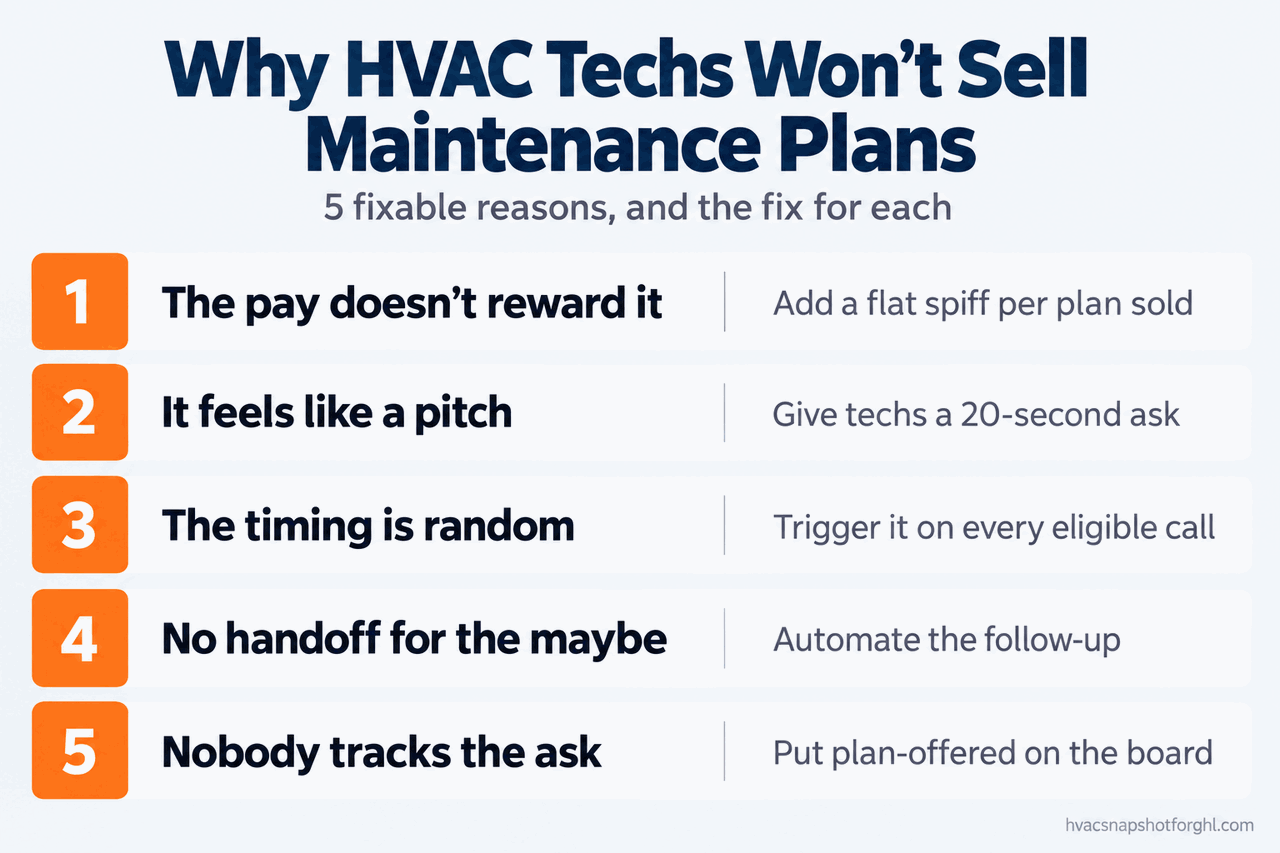
Before you can fix it, you have to be honest about why it happens. It is almost never laziness, and it is never because your techs don’t care. It’s five specific, fixable reasons.
One: the pay doesn’t reward it. Your tech gets paid the same whether he sells the plan or not. He is measured on calls closed and jobs finished, not memberships added. Asking for the plan takes time, risks an awkward “no,” and earns him nothing. People do what they’re paid to do. Right now you’re paying him to pack up and leave.
Two: it feels like a pitch, and good techs hate pitching. Your best tech got into this trade to fix things, not to sell. The second a membership ask sounds like a car-lot upsell, he won’t do it, because he’s protecting the trust he just built. He’d rather eat the lost revenue than feel like a salesman in somebody’s kitchen. That instinct is actually right. The fix is to make the ask not a pitch.
Three: the timing is wrong or random. A plan sells itself at one moment: right after the tech delivered good news or fixed the problem, with the customer standing there relieved. Miss that window and the ask lands flat. Most techs either forget or bring it up at the worst time, like while they’re writing up a $1,400 repair the customer is already wincing at.
Four: there’s no handoff for the “maybe.” Half of customers won’t say yes on the spot. They want to think, ask a spouse, or see it in writing. If the only path is “the tech closes it right now,” every maybe becomes a no. Nobody follows up, and the warm lead dies in the driveway.
Five: nobody tracks whether the ask happened. If you can’t see which calls got a plan offer and which didn’t, you’re managing a ghost. You think your guys are offering it. They think they are too. The dispatch board says nothing. What gets measured gets done, and right now this isn’t measured.
The 6-part system that gets techs to sell
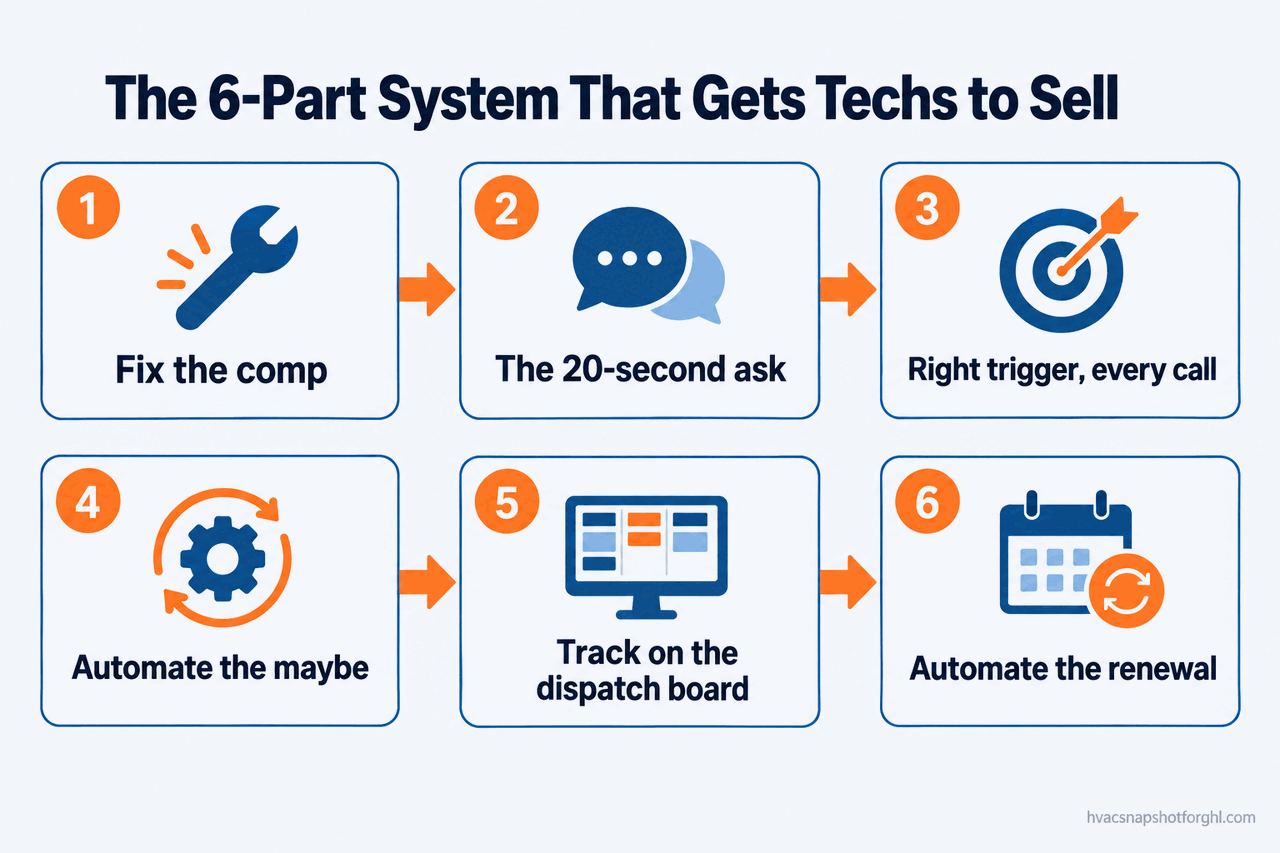
Here’s the build. Six parts, each one aimed at one of the five reasons above, each with how to set it up and how it breaks so you can head off the usual failures. None of it depends on turning your techs into closers.
Part 1: Fix the comp first
Nothing else matters until the pay rewards the behavior. Put a flat spiff on every plan sold, say $25 to $50, and pay it fast, ideally on the next check, not quarterly. Flat beats percentage here because it’s simple and it works on the tech who hates selling: he doesn’t have to do math or feel like a commissioned salesman, he just knows every plan is fifty bucks in his pocket. For reference, HVAC sales commissions commonly run 4% to 8% of the sale (ServiceTitan), but for plans a clean flat spiff is easier to run and easier for the tech to trust.
How it breaks: you make the spiff contingent on the customer not canceling for 90 days, or you bury it in a complicated tier. The tech stops trusting he’ll actually get paid, and the whole thing dies. Keep it dead simple: plan sold, spiff paid, this check. The industry veterans who’ve run tech sales programs for decades say the same thing: a small, fast, flat reward for generating the sale beats a big complicated one (Contracting Business).
Part 2: Give them the 20-second ask, not a pitch
Take the selling off the tech’s shoulders. His job is one honest sentence tied to what he just did, not a presentation. Something like: “Everything checks out, but this unit’s getting up there. Our maintenance plan gets you two visits a year, priority scheduling in a heat wave, and 15% off repairs. Want me to text you the details?” That’s it. He’s not closing. He’s planting and handing off.
How it breaks: you hand them a script that sounds like a script. Techs can smell corporate language and so can customers. Let each tech say it in his own words, drill it twice at a Tuesday morning huddle, and tie it to the specific unit he’s looking at. “This 14-year-old system” lands. “Our premium membership offering” does not.
Part 3: Fire the ask at the right trigger, every time
Don’t leave the timing to memory. Make a rule: the plan ask happens on every tune-up, every repair over a set dollar amount, and every call on a system older than 10 years. Put it on the ticket as a required field so the job can’t be closed until the tech marks the plan offered, sold, or declined. Now the trigger is the system’s job, not the tech’s willpower.
How it breaks: the required field becomes a box people click without doing the ask. Spot-check it. When you ride along or review recorded calls, you’ll find out fast who’s really offering and who’s just clicking. That’s a coaching conversation, not a gotcha.
Part 4: Hand the “maybe” to an automated follow-up
This is the part almost every shop is missing, and it’s where most plans are actually won. When the customer says “let me think about it,” the tech marks it maybe and the office takes over automatically. A text goes out within the hour with the plan details and a one-tap signup link. If no response, a second text in two days, a short email on day four, and a live call from the office on day seven. The same muscle that reworks a stalled replacement quote closes a stalled plan.
How it breaks: the follow-up is manual, so it never happens on a busy week. If a human has to remember to send it, it dies. This has to be automated the moment the tech taps “maybe,” which is exactly what a workflow in a system like GoHighLevel does, and it has to stop the instant the customer signs up or opts out.
Part 5: Put “plan offered” on the dispatch board
You can’t manage what you can’t see. Every ticket gets a status: plan sold, offered and declined, or not eligible. Now you have a real number: your attach rate, the percentage of eligible calls that got an offer and the percentage that closed. Review it weekly by tech. The guy at 10% and the guy at 45% are having very different conversations in those living rooms, and now you know which is which.
How it breaks: you track it but never look at it. A number nobody reviews changes nothing. Put attach rate on the same weekly report as revenue and callbacks, and talk about it in the same meeting. If you’re not sure where your other jobs are leaking either, run a full lead-leak audit while you’re at it.
Part 6: Automate the renewal so the base compounds
A plan you sell once and forget is a plan you rent. The whole value is in renewal: a base that compounds year over year instead of leaking out the bottom. Set up automatic renewal reminders 30 and 7 days before expiry, auto-charge the card on file where the customer agreed, and a win-back sequence for the ones who lapse. A healthy program should clear an 80%+ renewal rate (FieldEdge), and strong shops run closer to 86% (Contracting Business).
How it breaks: you let renewals run on memory and spreadsheets. A card expires, a reminder never goes out, and a member quietly lapses. At scale, a few points of renewal is the difference between a base that grows and one that treads water. This is the least glamorous part of the system and the one that makes you the most money over three years.
The steal-this script pack
Here’s the actual copy. Steal it, change the numbers to match your plan, and put it to work. Keep the tech’s part short and human, and let the automation carry the follow-up.
If you want the full plan document itself, not just the outreach, we broke down the tiers, pricing, and inclusions in the maintenance-agreement template, and the no-pushy way to pitch it in a separate piece.
Run it for three different shops
The system is the same. How you staff it changes with your size. Here’s the honest version for three real shops.
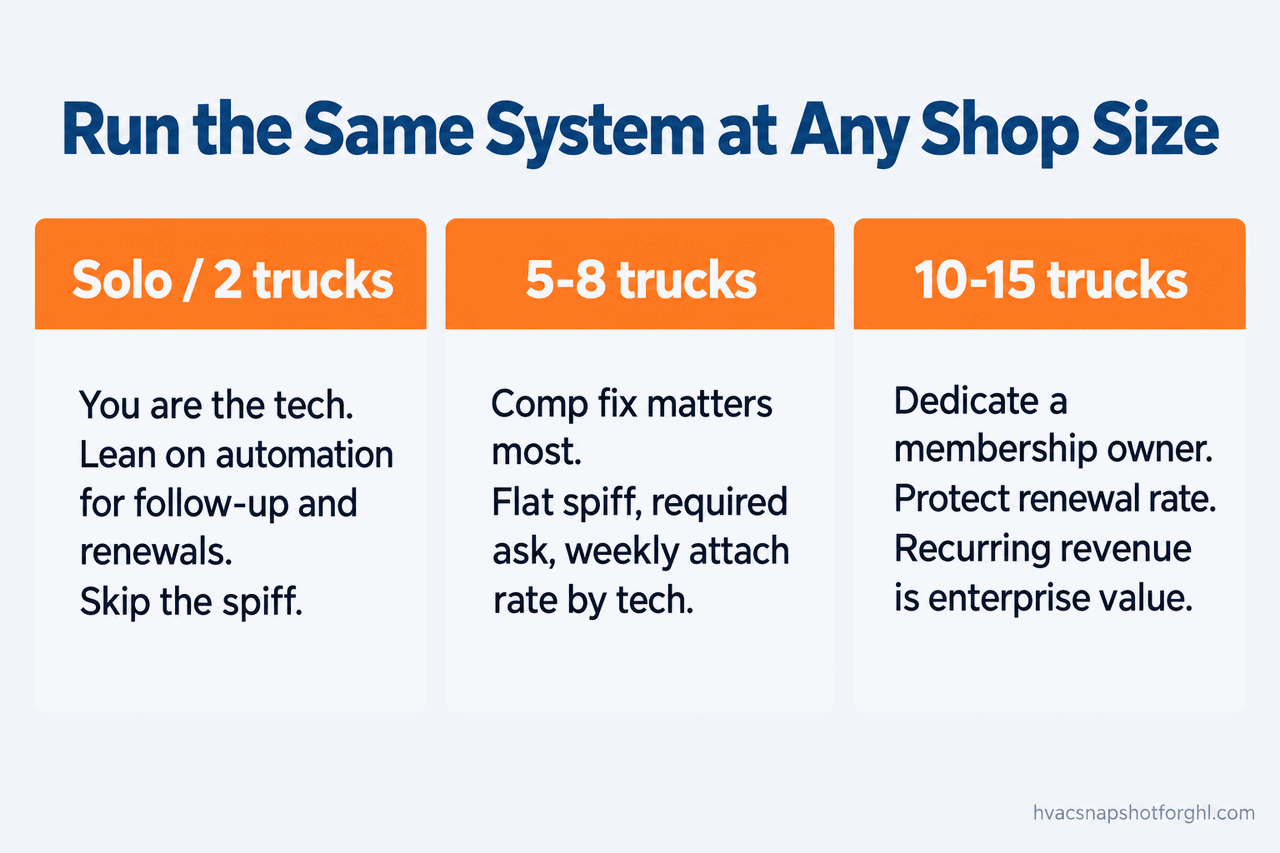
The solo operator or two-truck shop. You are the tech, so the ask is on you, and the good news is you have the trust already. Your weak spot is the follow-up and the renewal, because you’re on a roof all day and there’s no office. This is where automation earns its keep: the moment you tap “maybe” on your phone, the texts and emails run themselves, and renewals auto-remind without you touching a spreadsheet. Skip the spiff, you’re paying yourself, and spend the saved effort on making the automated follow-up airtight. Your realistic first goal: get a plan in front of every tune-up and every older system, and let the sequence close the maybes while you sleep.
The 5-to-8 truck shop. This is where the comp fix matters most. You’ve got techs with different personalities, and without a spiff your top guy sells plans and the rest don’t. Put the flat spiff in, make “plan offered” a required ticket field, and start reviewing attach rate by tech every week. You’ll find a 3x spread between your best and worst, and most of that gap closes with two coaching conversations and the knowledge that it’s being watched. Your office person owns the maybe follow-up and the renewals. This is the size where a built system like a GoHighLevel snapshot pays back fastest, because you’re big enough to leak real money and small enough that nobody’s job is “membership coordinator.”
The 10-to-15 truck shop. You can afford a dedicated membership owner now, someone who lives in the renewal data and the lapsed-member win-backs. Your risk flips: with volume, a 3-point dip in renewal rate is tens of thousands of dollars, so the back half of the system matters more than the front. Automate ruthlessly, review attach rate and renewal rate as core KPIs next to revenue and callbacks, and remember the endgame. If you ever sell, buyers pay a premium for recurring revenue. M&A advisors peg small shops around 2x owner earnings while private-equity platform deals run far higher on EBITDA, with a large recurring base worth a meaningful multiple bump (ServiceMag). Your membership base is not just cash flow. It’s enterprise value, and it’s part of how you stand up to the roll-up across town.
Keep the texts legal: TCPA and 10DLC
The follow-up sequence is the engine, and it runs on text. That means TCPA and A2P 10DLC rules apply, and getting them wrong is expensive, so build consent in from day one. Capture express written consent at signup and on the form the tech’s link points to, honor STOP instantly, and register your texting through 10DLC before you send a single automated message. We cover the full ruleset in the plain-English TCPA and 10DLC guide; here’s the cost reality.
Objections, answered straight
“My guys are techs, not salespeople. I don’t want them turning into closers.” Good, because this system doesn’t ask them to. The tech’s whole job is one honest sentence and a tap. The closing happens in the automated follow-up and the office call. You’re not making your techs into salesmen. You’re taking the selling off them entirely and leaving them with a 20-second ask tied to work they just did.
“Won’t customers find the texts annoying?” Not if the sequence is relevant and short, and it stops the second they sign up or say no. A member who said “maybe” in their own kitchen is expecting to hear from you. The annoying version is seven generic blasts that ignore the reply. The version here answers the specific thing they were deciding and quits the moment they act. And every text carries an opt-out, which is both the law and good manners.
“I already pay for ServiceTitan or Housecall Pro. Why do I need anything else?” Your field-service software is great at the ticket, the dispatch, and the invoice. Where most shops still leak is the marketing-side follow-up: the automated maybe sequence, the renewal win-backs, the review requests, the reactivation of a dead list. That’s the gap a system like ours fills, and it sits alongside your FSM rather than replacing it. Housecall Pro says its users have signed up over 2 million service-plan customers (Housecall Pro), which tells you the demand is real; the question is whether your follow-up is good enough to capture your share.
“Do I need to be technical to run this?” No. The point of a done-for-you build is that the workflows, the triggers, and the sequences come installed and wired to your plan. You change the plan price and the discount, and it runs. If you’d rather not touch any of it, that’s the whole reason the snapshot exists.
“We’re slammed in summer. When would we even set this up?” Now, in the shoulder season, which is exactly why you’re reading this in October. Build it while the phones are quiet so it’s running before the next rush. The plans you sell this fall are the priority-scheduling promises that keep your best customers loyal when July hits. For the bigger picture on why a busy summer still leaves the bank account thin, that’s its own fight, and recurring revenue is a big part of the answer.
Frequently asked questions
Why won't my HVAC techs sell maintenance plans?
Almost always for five fixable reasons: the pay doesn't reward it, the ask feels like a pushy pitch, the timing is random, there's no follow-up for the customers who say maybe, and nobody tracks whether the ask happened. It's a systems problem, not a people problem. Fix the comp, give them a 20-second ask, trigger it on every eligible call, automate the maybe follow-up, and track attach rate on the dispatch board.
How should I pay techs to sell maintenance plans?
A small flat spiff per plan sold, around $25 to $50, paid fast on the next check, works better than a percentage or a complicated tier. It's simple, it's trustworthy, and it works on techs who hate selling. HVAC sales commissions commonly run 4% to 8% of a sale, but for memberships a clean flat reward is easier to run and easier for the tech to believe he'll actually get.
What's the right moment for a tech to bring up the plan?
Right after delivering good news or finishing the fix, with the customer standing there relieved and trusting. Make it a rule on every tune-up, every repair over a set dollar amount, and every system older than 10 years, and require the tech to mark the ticket plan offered, sold, or declined before closing the job.
What should a maintenance plan include and cost?
A typical residential HVAC maintenance plan runs about $150 to $300 a year per Angi and HomeAdvisor cost data, with premium multi-visit plans up to around $500. Standard inclusions are two tune-up visits a year (cooling in spring, heating in fall), priority scheduling, and a repair discount, often 15%. Price it to the value, not just a discount.
What's a good maintenance-plan renewal rate?
Aim to clear 80% or higher. FieldEdge and Service Nation benchmarks put a healthy program at an 80%+ renewal rate, and strong shops run closer to 86% per Contracting Business. The way you hit it is automation: renewal reminders 30 and 7 days out, auto-charge where the customer agreed, and a win-back sequence for lapses.
Is it legal to text customers about maintenance plans?
Yes, if you follow TCPA and A2P 10DLC. Get express written consent at signup, register your texting through 10DLC before sending automated messages, honor STOP instantly, and keep the sequence relevant. Registration fees are set by The Campaign Registry and carriers, roughly a few dollars to about $48 one-time plus a small monthly campaign fee and about $0.003 per message segment, and they change, so verify when you register.