
A new hire shows up Monday with a certification card and tells you he is “fully licensed and certified.” You are about to put his name on a service van and let him pull refrigerant off your distributor account. Before you do, you need to know what that card is, what it does not cover, and whether your shop itself is legal to run the job. Two separate questions, and most owners blur them together.
Here is the short version. An EPA Section 608 certification is a federal credential that lets a technician buy and handle refrigerant. It is the same in all 50 states and it never expires. A state HVAC license is a different thing: it lets your business pull permits and run jobs, and it varies wildly, some states have a statewide license, some leave it to cities, and a handful have none. You almost certainly need both. This post lays out what each one is, who in your shop needs which, and how to turn “licensed and certified” from a line on a card into a trust signal that wins jobs.
On this page
- Two credentials people keep mixing up
- EPA 608 in plain terms
- The four 608 types and who needs which
- State HVAC licensing, and why it is a patchwork
- Three shops, three ways this lands
- Where this belongs in your marketing
- How this breaks, and what it costs you
- Steal this: trust-signal copy you can use today
- Objections and honest answers
- Frequently asked questions
Two credentials people keep mixing up
Walk any trade counter and you will hear “licensed and certified” used like one word. They are two different things, set by two levels of government.
EPA Section 608 certification is federal. It comes out of the Clean Air Act, the EPA runs it, and its whole job is refrigerant. Technicians who “maintain, service, repair, or dispose” of equipment that could release refrigerant must be 608 certified (EPA). It travels with the technician, it is identical in Phoenix and in Portland, and it does not expire.
A state HVAC license is set by your state, and sometimes your city. It is about the business, not the refrigerant: it lets you legally contract for work, pull a mechanical permit, and advertise as a contractor. The exam, fees, renewal clock, and even whether a statewide license exists at all depend on where you operate.
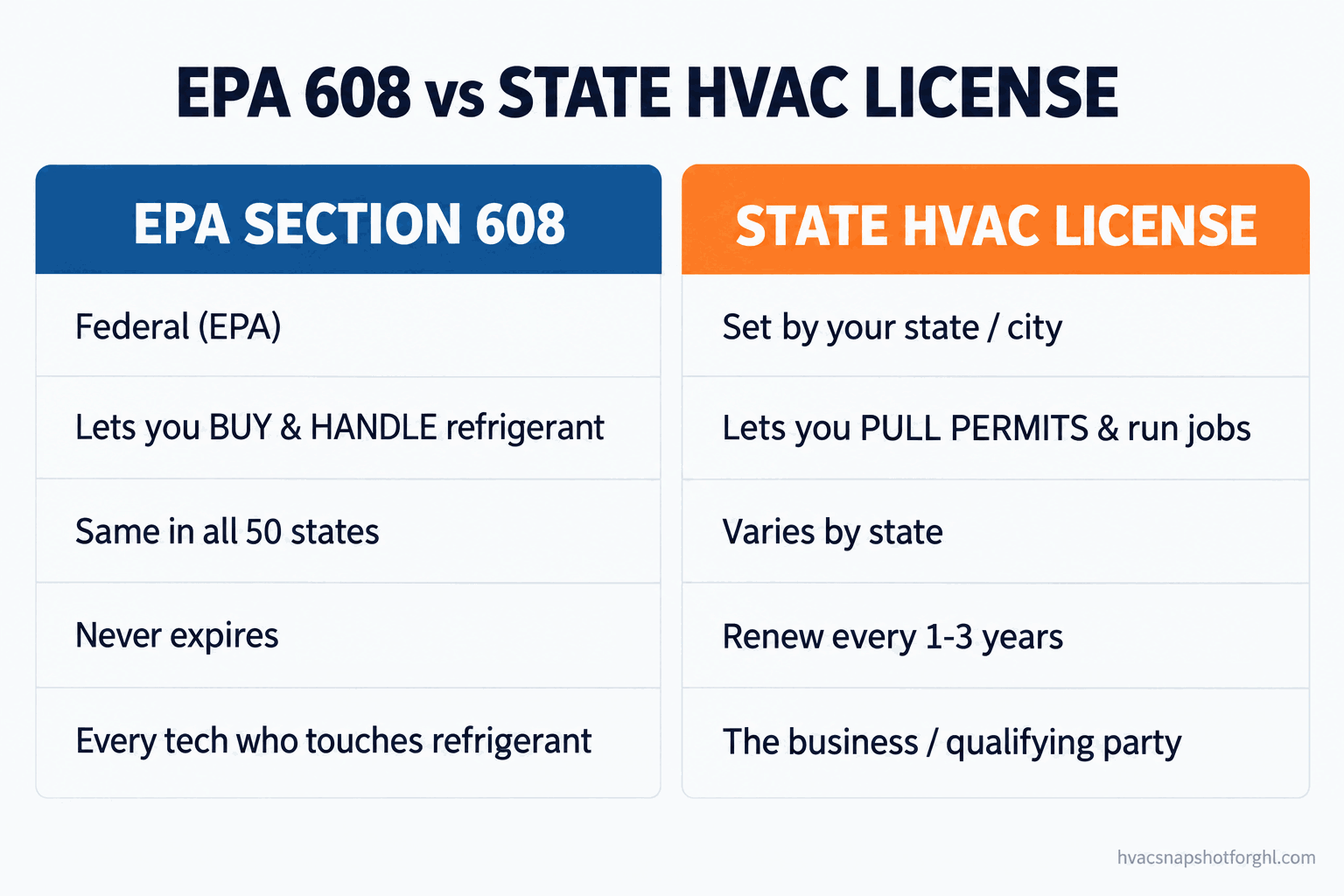
The simplest way to hold it: 608 is the ticket to touch the refrigerant, the state license is the ticket to run the job.
EPA Section 608 vs a state HVAC license
| Question | EPA Section 608 | State HVAC license |
|---|---|---|
| Who sets it | Federal (EPA, Clean Air Act) | Each state, sometimes the city |
| What it lets you do | Buy and handle refrigerant | Contract, pull permits, run jobs |
| Who needs it | Every tech handling refrigerant | The business / qualifying party |
| Does it expire | No, never | Usually yes, renew on a 1-3 yr clock |
| Same in every state | Yes, identical nationwide | No, it is a patchwork |
| Issued as a card by | A private EPA-approved program | The state board or agency |
EPA 608 in plain terms
Section 608 exists because refrigerant is a regulated substance. Venting it is illegal, and the EPA controls who gets to buy and handle it. The restriction has teeth: only Section 608 certified technicians can purchase refrigerants intended for stationary refrigeration and air-conditioning equipment (EPA). No card, no refrigerant on your distributor account. That is why every working HVAC tech ends up with one.
A few things owners routinely get wrong:
- The EPA does not print the card. The agency sets the rules and approves the testing programs, but the card comes from an EPA-approved organization that administers the exam. A card is only as good as the program behind it, so ask for a copy to keep on file.
- The core section is the gatekeeper. Every candidate takes Core plus at least one type section, and to earn Universal the EPA requires the core test be taken as a proctored exam (EPA). An open-book Type I pass is not the same as a proctored Universal.
- It covers today’s refrigerants. Since 2018 the rules extend to HFCs and newer substitutes, not only ozone-depleting refrigerants (EPA), which matters now that the industry is moving to R-454B and R-32.
One more point that trips up shops mid-transition: the new low-GWP blends (R-454B and R-32) are rated A2L, and your 608 card still lets you buy and handle them, but A2L safety training is a separate thing your techs need first. The full breakdown is in what the R-454B switch means for your AC quotes.
The four 608 types and who needs which
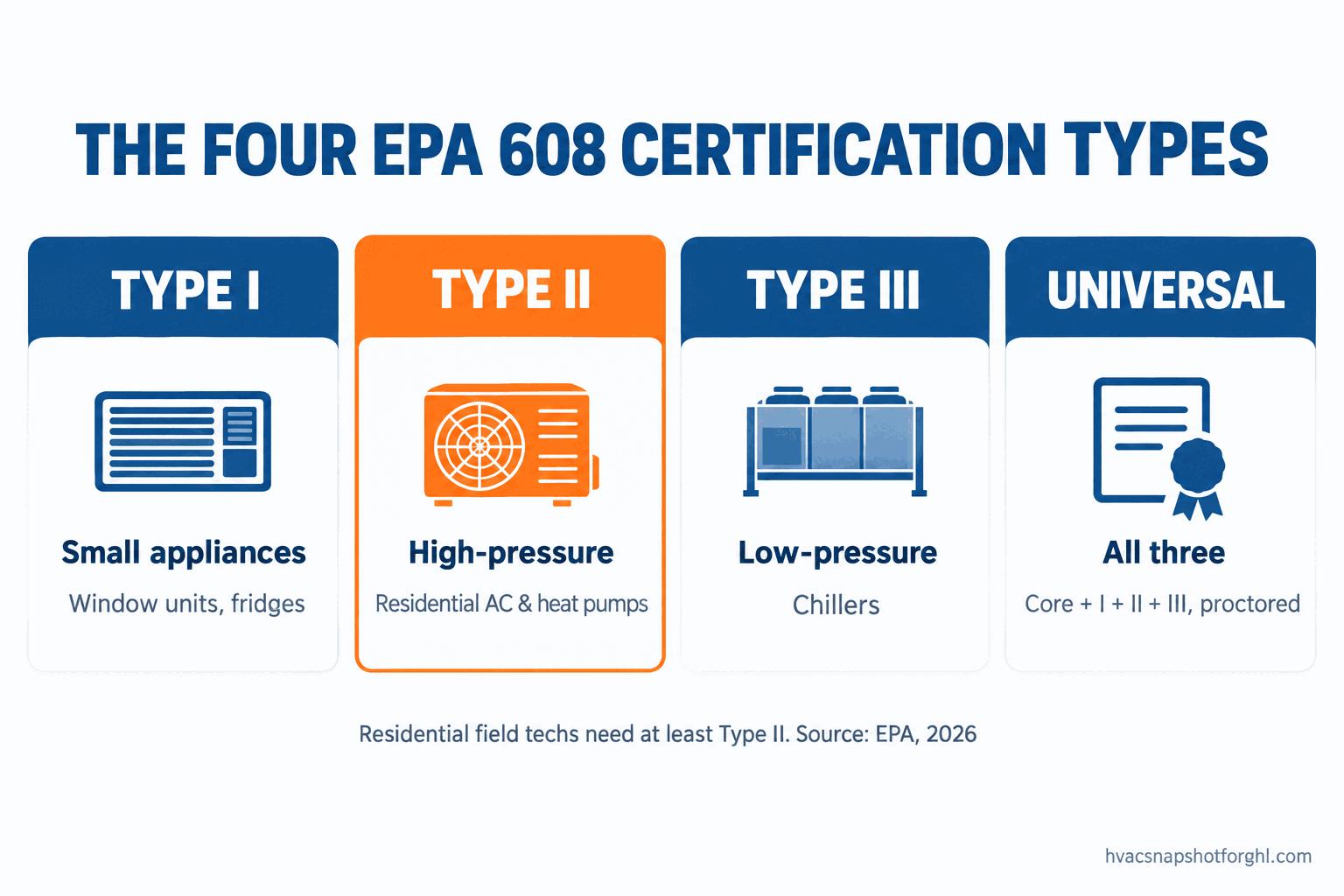
The EPA breaks certification into four buckets. The names are boring and the distinction is not. Match the type to the equipment your crew actually touches (EPA).
- Type I, small appliances. Factory-sealed systems with a small charge: window units, household refrigerators. The lightest exam, often open-book. Rarely enough on its own for a service shop.
- Type II, high-pressure. The one that matters for you. It covers residential central AC and heat pumps, so if your tech is recovering refrigerant off a backyard split system, this is the credential the work demands.
- Type III, low-pressure. Chillers and other low-pressure equipment. Light-commercial shops may need it; a straight residential shop usually does not.
- Universal. The tech passed Core, Type I, II, and III. The gold standard on a resume, because it covers anything and means they sat a proctored exam.
Bottom line: field techs who touch refrigerant should carry at least Type II, and Universal is the better hire. “EPA Universal” tells you more than “EPA certified,” which could mean an open-book Type I pass.
State HVAC licensing, and why it is a patchwork
Here is where it stops being federal and starts being a map. Whether your business needs a license, what it is called, and what it costs depend on your state, and sometimes your city.
Most states license HVAC contractors at the state level, each with its own board, and the labels vary a lot:
- California. The Contractors State License Board issues the C-20 HVAC license, required for any project valued at $500 or more in labor and materials (CSLB).
- Texas. The Department of Licensing and Regulation issues a Class A or B Air Conditioning and Refrigeration license (TDLR).
- Florida. The DBPR issues Class A or B licenses, each either Certified (statewide) or Registered (local).
- Arizona. The Registrar of Contractors issues a C-39 refrigeration/HVAC license.
Then there are states with no statewide HVAC license at all. Roughly 15 of them leave it to cities and counties, among them Colorado, Illinois, Indiana, Kansas, Missouri, New York, Pennsylvania, and Wyoming (Workyard, 2026). “No state license” does not mean “no rules.” The rules usually live at the city or county level, and a shop working across a metro line can need two different local licenses for the same job. A couple of states, like Minnesota and Wisconsin, use registration instead of a license exam.
Some states also gate licensing by project value: Tennessee requires a Mechanical Contractor license over $25,000, Mississippi draws the line at residential jobs over $10,000 or commercial over $50,000, and North Dakota has no statewide HVAC license but may require a general contractor license over $2,000 (Workyard, 2026).
How US states regulate HVAC contractors, approximate counts. Guides disagree on a handful of states, so this is a rough shape. Source: Workyard, 2026. Always confirm against your own state board.
The takeaway is not “memorize all 50 states,” it is “do not assume.” The guides openly disagree on states like Ohio and Michigan, which tells you the only reliable answer is your own state board’s website.
Three shops, three ways this lands
The same rules land very differently depending on how many trucks you run.
The solo operator. You are the license and the 608 card. The state license is almost certainly held in your name as the qualifying party, so if you take a month off with a back injury, the business’s ability to pull permits can go with you. Keep your license renewal on a calendar reminder, your Universal card copy in the truck, and your license number on your website and estimates. For a one-truck shop, the credential is also the whole trust story.
The 5-tech shop. Now you are managing other people’s credentials. Every tech who touches refrigerant needs their own 608, with a copy of each card on file and the type noted. The state license usually still hangs on one qualifying individual, often you, which is a single point of failure: if that person leaves, some states give you a grace window to name a new qualifier and some do not. This is the size where a missing renewal quietly becomes a problem nobody noticed until a permit gets denied.
The 12-truck shop. Now you have a compliance surface, not a checklist: multiple certified techs, renewals on different clocks, maybe operations in more than one city or state, and a marketing engine making claims about all of it. You need one place that tracks every tech’s 608 type and every license’s renewal date, and a rule that no ad claims a credential the file cannot back up. The roll-ups buying shops in your market run this tightly, because a licensing slip at scale is a lawsuit, not a warning letter.
Where this belongs in your marketing
Here is the part the licensing guides skip. Your credentials are not just a legal box to tick. They are among the cheapest, most durable trust signals you own, and most shops waste them.
Think about what the homeowner is afraid of. They are letting a stranger cut into a system they do not understand, and the yard is full of guys with magnet signs. “Licensed and EPA certified, license #C20-xxxxxx” on your website, estimate, and review-request text separates you from the handyman with a borrowed gauge set. Put your license number where people look: the site footer, the signature block of your automated review requests, and the first line of your Facebook ad copy.
There is a second, sharper edge that gets shops in trouble. The marketing itself is regulated, separately from the work. The moment you text a customer, you are inside the TCPA and the A2P 10DLC rules the carriers enforce. You need documented opt-in before you text, a working STOP keyword, and your business registered for 10DLC so messages deliver instead of getting filtered. Registration is cheap, a small one-time brand fee plus a few dollars per campaign per month through The Campaign Registry, with a tiny per-message carrier surcharge (Twilio). Getting it wrong is not, because the TCPA carries statutory damages per message (FCC). We break it down in the TCPA and 10DLC guide for HVAC shops, and the same logic applies to an AI receptionist handling after-hours calls.
How this breaks, and what it costs you
Compliance is boring right up until it is expensive. Where shops get hurt:
You let an uncertified tech buy refrigerant. The sales restriction is federal and the distributor is on the hook too, so accounts get flagged, and an uncertified person recovering refrigerant is a violation waiting to happen. Fix: no tech touches the distributor account until a copy of their 608 card is on file.
Your qualifying party walks out. In a multi-truck shop the state license often rests on one named individual. If that person quits with no second qualifier lined up, your ability to pull permits can freeze overnight in some states. Fix: know your state’s rule on replacing a qualifier before you need it, and at scale, get a second person qualified.
You advertise a credential you cannot back up. “Licensed and insured” in an ad when the license lapsed last quarter is a misrepresentation, and in a state with an active board it is the kind of thing a competitor reports. Fix: one file, every license and card with its expiration, and a rule that marketing never claims more than the file proves.
You cross a city line and assume your state license covers you. In the no-statewide states especially, the license that works in one county can mean nothing in the next. Fix: check local requirements before you run ads into a new service area, not after.
You text customers without consent or 10DLC registration. This is not about your HVAC credentials at all, but it is the failure most likely to cost you money: the TCPA allows statutory damages per message, and carriers quietly filter unregistered traffic so your texts never arrive (FCC). Fix: documented opt-in, STOP honored automatically, and your brand registered before the first campaign.
Steal this: trust-signal copy you can use today
Credentials only win jobs if the customer sees them. Here is copy you can lift, with slots for your real numbers. Never claim a license or certification you do not hold.
Website footer / estimate header:
Licensed HVAC contractor, [STATE] license #[NUMBER]. EPA Section 608 certified technicians. Fully insured. Serving [CITY] since [YEAR].
First line of a Facebook or Google ad:
[CITY]’s licensed, EPA-certified AC repair, [STATE] license #[NUMBER]. Same-day service, upfront pricing, no surprise fees.
Review-request text (sent after a completed job, to a customer who opted in):
Hi [NAME], thanks for trusting [SHOP] with your [system] today. Your tech [TECH] is EPA 608 certified and we’re a licensed [STATE] contractor (#[NUMBER]). If we earned it, a quick Google review helps a lot: [LINK]. Reply STOP to opt out.
SMS opt-in line on your booking form (this is what keeps you TCPA-compliant):
By entering your number you agree to receive service and appointment texts from [SHOP]. Msg & data rates may apply. Reply STOP to cancel, HELP for help.
New-hire intake checklist (keep in the file for every field tech):
Copy of EPA 608 card (note the type: I / II / III / Universal). A2L safety training on record if they handle R-454B / R-32. State or local license copy if they hold one. Renewal dates logged.
That last one is not glamorous, but it is the single document that stops every failure mode above. One file, every credential, every expiration date.
Objections and honest answers
“My guys have been doing this for 20 years, why does a card matter?” The EPA and your state board only recognize credentials, not experience. A 20-year tech without a current 608 still cannot legally buy refrigerant, and a lapsed license still cannot pull a permit. The card is not an insult to the experience, it is the paperwork that lets it work legally.
“I’m in a no-license state, so I’m off the hook, right?” No. “No statewide license” almost always means the rule moved to the city or county, and the 608 requirement is federal and applies everywhere regardless. Fewer boxes, not zero boxes.
“Do I really need to put my license number in my ads?” You do not have to, but it is close to free and it converts. A visible license number is a verifiable signal that you are the real contractor and not a fly-by-night. Shops that hide it leave trust on the table.
“Isn’t all this compliance stuff going to slow down my marketing?” It slows you down once, at setup, then runs in the background. Registering for 10DLC and wiring up a consent-captured opt-in is a one-time job, and afterward your texts deliver better than unregistered competitors’ do.
Frequently asked questions
HVAC licensing and EPA 608: common questions
Is EPA 608 certification the same as an HVAC license?
No. EPA Section 608 is a federal credential that lets a technician buy and handle refrigerant, identical in all 50 states. An HVAC license is set by your state (and sometimes your city) and lets your business contract and pull permits. Most shops need both: the 608 to touch the refrigerant, the state license to run the job.
Does EPA 608 certification expire?
No. The EPA states that Section 608 Technician Certification credentials do not expire, so once a technician passes it is good for life. A state HVAC license is different and usually renews on a one-to-three-year clock.
Which EPA 608 type does a residential HVAC tech need?
Type II (high-pressure) covers residential central air conditioners and heat pumps, so it is the minimum for a field tech recovering refrigerant on split systems. Universal (Core plus Type I, II and III) is stronger because it covers any equipment and signals a proctored exam. Type I alone (small appliances) is usually not enough for a service shop.
Can an uncertified technician buy refrigerant?
No. The EPA refrigerant sales restriction allows only Section 608 certified technicians to buy refrigerant for stationary refrigeration and air-conditioning equipment. Distributors verify certification, so an uncertified tech cannot legally stock refrigerant on your account.
Do I need an HVAC license if my state does not have one?
Probably, just not a state one. Roughly 15 states have no statewide HVAC license and push it to cities and counties, so you may still need a local license or registration. The federal EPA 608 requirement applies everywhere. Confirm with your state board and your local jurisdiction.
Do my credentials affect how I can advertise?
In two ways. Your license and 608 are strong trust signals to display in ads, on your site, and in review requests, but never claim a credential you do not hold. Separately, the channel is regulated: texting customers falls under TCPA and A2P 10DLC rules requiring documented consent, a working STOP keyword, and brand registration, independent of your HVAC license.
What does it cost to register for 10DLC so my texts deliver?
Costs are set by The Campaign Registry and passed through by your provider: a small one-time brand registration fee plus a few dollars per campaign per month, with a tiny per-message carrier surcharge. It is cheap next to TCPA statutory damages, which apply per message sent without consent.
The two credentials are not interchangeable, and the marketing rules sit on top of both. Get the file right once, say the credentials loudly where customers look, and keep the channel compliant. If you want those trust signals and consent-captured, 10DLC-ready outreach wired up for you, that is what our done-for-you HVAC system installs.