
You just hired your sixth tech. Good problem. Then the software invoice lands bigger again, because the tool you run your shop on charges per technician, and every truck you add is a permanent raise on a bill that has nothing to do with whether that truck is busy. That is the per-seat trap, the biggest hidden force in what HVAC software costs you.
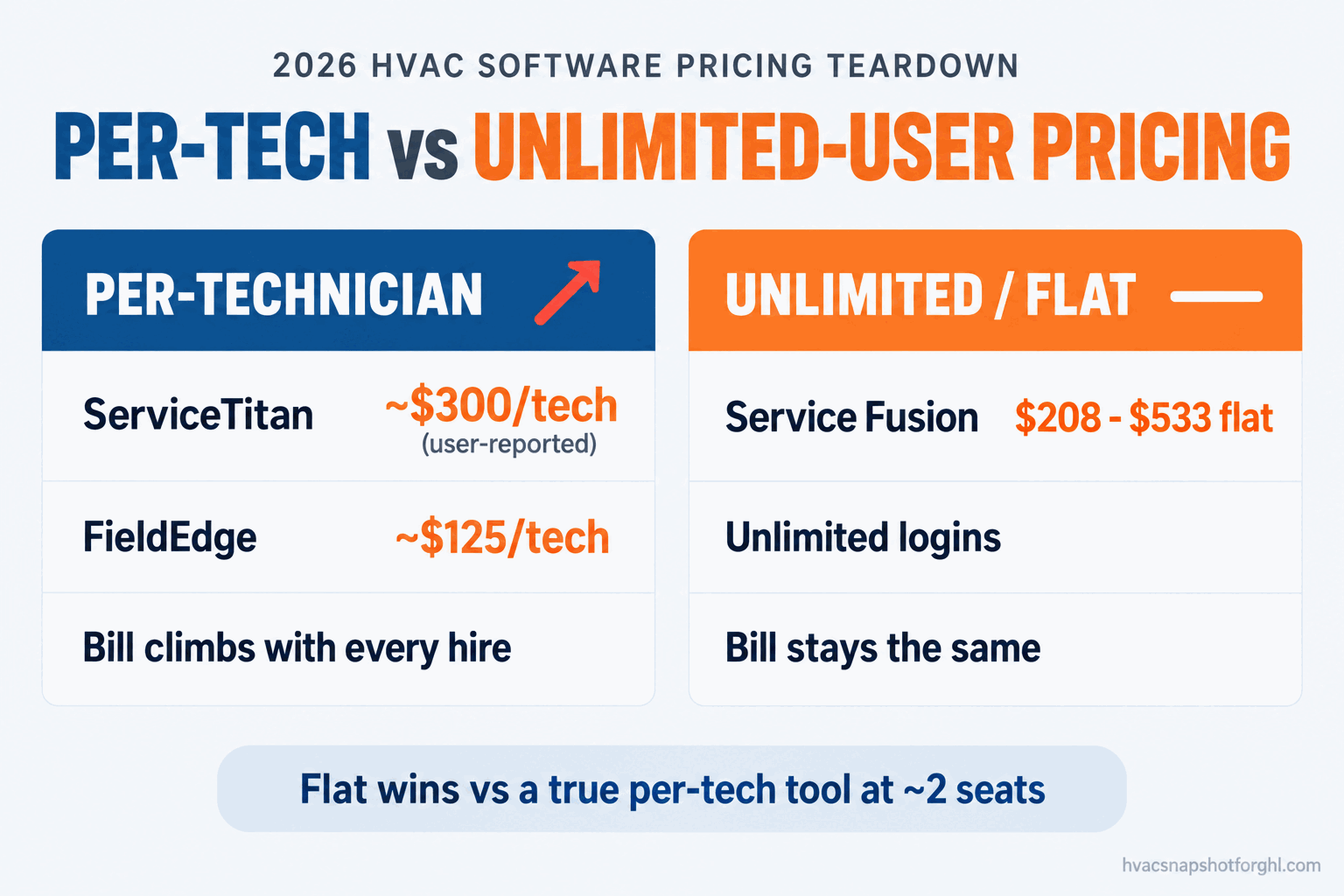
Here is the short version. Per-technician pricing (ServiceTitan, FieldEdge) charges for every login, so your bill scales straight up with headcount. Unlimited-user pricing (Service Fusion) charges a flat company rate no matter how many logins you hand out. The flat model beats a true per-tech platform almost immediately, around two technicians. But it does not beat the tiered tools with cheap add-on seats (Housecall Pro at $35 a seat, Jobber at $29) until you are a big shop, roughly 15 to 20 logins. The “unlimited user” headline is a hedge against per-tech pricing, not a free win. This teardown shows the real numbers and the exact seat count where each model flips.
On this page
- The only two pricing models that matter
- What each model actually costs in 2026
- The break-even math, in plain numbers
- Count logins, not trucks: the mistake that flips the math
- Three scenarios: solo, 5 techs, 12 techs
- Where each model quietly breaks
- The costs that never show up on the pricing page
- The 10DLC bill every texting shop pays
- The questions to ask before you sign anything
- Objections and honest answers
- The leak no pricing model fixes
- Frequently asked questions
The only two pricing models that matter
Strip the branding off every field service tool and two ways of charging you remain.
Per-seat pricing. You pay for each login. Call it per-technician or per-user, or bury it inside tiers with a per-head fee above a set seat count. Either way, your invoice tracks your headcount: hire a tech, the bill goes up. ServiceTitan and FieldEdge are the pure version. Housecall Pro and Jobber are the tiered version, which behaves like per-seat once you outgrow your plan.
Flat or unlimited-user pricing. You pay one company-level rate and hand out as many logins as you want. Office manager, three CSRs, nine field techs, the apprentice who started Tuesday, all for the same price. Service Fusion is the clearest HVAC example, unlimited users on every tier (Service Fusion). Successware, now owned by ServiceTitan, reads the same way, though it does not publish a clear per-seat figure, so treat it as company-level but unconfirmed.
That is the whole decision. Not “which tool,” but “which model fits the way my shop grows.” Everything else is features. The model decides whether your software bill is a fixed cost or a tax on hiring.
What each model actually costs in 2026
Two notes. The published tools (Service Fusion, Jobber, Housecall Pro) list rates openly, so those are solid; the demo-gated tools (ServiceTitan, FieldEdge) publish nothing, so every number for them is user-reported and your quote may differ. The table uses annual billing, below the higher month-to-month rate most vendors also quote.
Per-seat vs flat pricing in HVAC software (2026)
| Tool | Model | Entry price / mo | What climbs the bill |
|---|---|---|---|
| ServiceTitan | Per technician | ~$245-$500/tech (user-reported) | Every tech seat + $5k-$50k setup |
| FieldEdge by Xplor | Per seat | ~$125/tech + ~$100/office (user-reported) | Every tech + every office login |
| Housecall Pro | Tiered per user | $59 (Basic, 1 user) | +$35 per extra user over tier |
| Jobber | Tiered per user | $39 (Core, 1 user) | +$29 per extra user over tier |
| Service Fusion | Flat / unlimited | $208 (Starter, unlimited) | Nothing per user, tier upgrades only |
On the published tools, the add-on seat is the number that matters: Housecall Pro charges $35 per extra user over its tier, Jobber $29, and Service Fusion charges nothing at all (Housecall Pro; Jobber; Service Fusion).
One model charges nothing to add a person. The other charges roughly $300 a head, before the five-figure implementation fee. That gap is the entire argument.
The break-even math, in plain numbers
The math is a line and a flat line. A per-seat tool costs the per-seat rate times the number of seats, so it climbs as you hire. A flat tool costs the same every month. The break-even is where the climbing line crosses the flat one: break-even seats = flat monthly price divided by the per-seat rate.
Against a true per-technician platform it is brutal. ServiceTitan at a user-reported $300 per tech, Service Fusion Pro at a flat $533: divide and you break even at 1.78 seats. Put two techs on ServiceTitan and you already pay more than Service Fusion charges for unlimited users, before the $5,000-and-up implementation fee (Projul, 2026).
But the math flips against the tiered tools with cheap add-on seats. Housecall Pro Max covers eight users for $299, then $35 a head, so it does not reach $533 until about fifteen logins. Jobber Grow covers fifteen seats for $399, then $29 a head, so it does not cross $533 until roughly twenty. Against those two, flat pricing loses for a long time, because their marginal seat is nearly free next to ServiceTitan’s.
So the real rule is not “unlimited is cheaper.” It is this: flat/unlimited is a shield against pure per-tech pricing, and a loser against cheap-seat tiers until you get big. Which model wins depends entirely on how many logins you need, and that is where most owners get the count wrong.
Count logins, not trucks: the mistake that flips the math
Ask an owner how big the shop is and they say “five trucks.” Ask how many people log into the software and the answer is almost always higher. Five field techs, plus the office manager who books jobs, two CSRs on the phone in summer, the dispatcher, the apprentice. That five-truck shop is a nine or ten seat shop, and on a per-user tool you pay for all ten.
This is the quiet reason flat pricing pulls ahead sooner than the chart suggests. The break-even is not “when you hire your fifteenth tech.” It is “when your total login count, techs plus office plus CSRs plus apprentices, crosses the line.” A shop with six techs and five office and phone staff is already at eleven seats, deep in the zone where Housecall Pro’s extra-seat fees and Jobber’s $29 heads start stacking up.
For scale: there are roughly 120,000 heating and air-conditioning contracting businesses against about 624,000 employees, around five people per business on average, and that average is dragged down by a mountain of true solos (IBISWorld, 2026; BLS OEWS 49-9021). A 2-to-15 truck shop is already well above that, and its login count is higher still once the office is in the tool. Count every login before you price anything.
Three scenarios: solo, 5 techs, 12 techs
Run the decision at three sizes and the answer changes at each one. Figures use annual billing for the published tools and label the user-reported ones.
Solo operator, 1 tech, maybe 1 office login. Per-seat wins in a walk. Jobber Core is $39, Housecall Pro Basic $59. Service Fusion’s cheapest unlimited plan is $208, so you pay for 50 logins you do not have, and ServiceTitan at a user-reported $300-plus is not a conversation. Verdict: never buy flat/unlimited as a solo.
Five-tech shop, about 8 logins. The muddy middle, where most readers live. Housecall Pro Max covers eight users for $299, Jobber Grow lands near $299 for ten, Service Fusion Plus is $325 unlimited. Within a rounding error of each other, so the model stops mattering and features decide. ServiceTitan, user-reported near $1,500 a month plus a five-figure setup, is a different weight class (Projul, 2026). Verdict: price is a wash among the published tools. Buy on fit.
Twelve-tech shop, about 17 logins. Now flat earns its keep. Housecall Pro Max with nine extra seats at $35 climbs to about $614, Jobber Grow runs about $457, and Service Fusion Pro is still $533, flat, however many CSRs you add. The unlimited rate finally beats Housecall Pro and holds that price as you hire. Verdict: past roughly 15 logins, flat/unlimited stops being overpriced and becomes the cheaper, predictable choice.
Where each model quietly breaks
Every pricing model has a failure mode. Here is how each one bites, and what to do about it.
Per-tech breaks when you grow. A tool that charges per technician turns every good hire into a worse software bill. Staff up for summer, headcount jumps 40 percent, and your cost jumps with it even though those seats sit idle by winter. Fix it by asking, before you sign, whether seats can be deactivated in slow months without losing data. Most per-tech contracts say no.
Per-tech breaks on the exit. ServiceTitan is reported to run annual contracts with 15 to 20 percent renewal increases, so the number you signed is a floor, not a ceiling (Projul, 2026). Your rate creeps up, your customer history lives inside the tool, and leaving means a messy export. Fix it by getting the renewal cap and export terms in writing on day one.
Flat/unlimited breaks when you are small. The model assumes you have logins to fill. A two-person shop on a $208-to-$533 plan is paying a big fixed number whether it books 10 jobs or 100. Fix it by not buying flat pricing until your login count clears the break-even, usually past ten.
Tiered pricing breaks at the seams. Housecall Pro and Jobber look cheap until you cross a plan boundary. Add one CSR, tip over your included seats, and every head is $29 or $35, or you are forced up a whole tier for one feature. Fix it by pricing the tier above the one you want, because you will land there sooner than the salesperson suggests.
The costs that never show up on the pricing page
The seat price is the part everyone quotes. It is not the part that surprises you later.
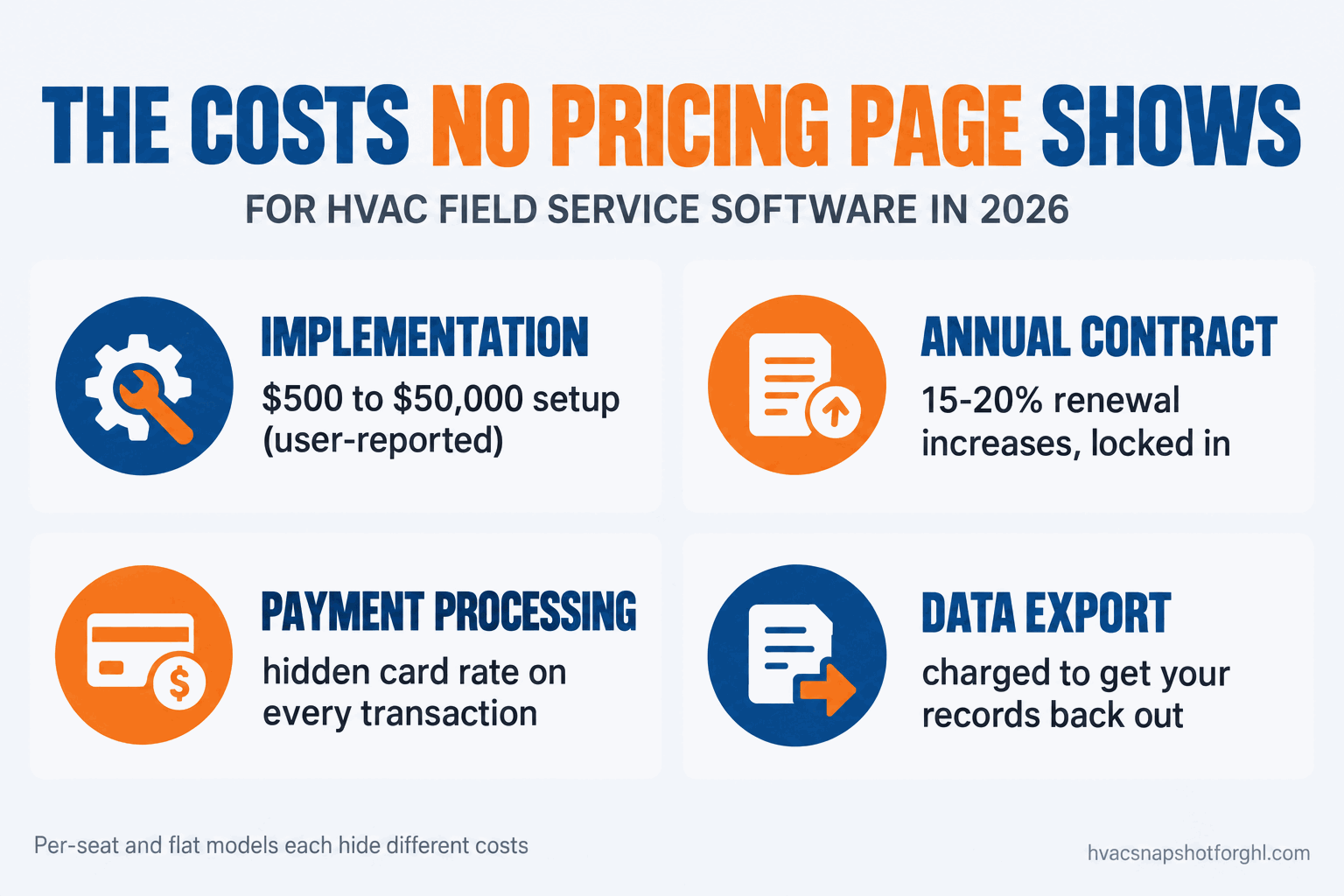
Implementation and onboarding. ServiceTitan is user-reported at $5,000 to $50,000 to get live, FieldEdge at $500 to $2,000 (Projul, 2026). The real cost is the calendar: a rollout that slips past cooling season while you pay for a tool nobody is using yet.
Payment processing. Most of these platforms want to run your card payments, and the rate rarely appears next to the subscription. On a shop doing a few hundred thousand in card volume, a half-point difference can dwarf the software fee. Make the rep put it in writing.
The contract term. Per-tech platforms lean on annual terms, so a mid-year change of heart costs you the rest of the year. The published tools mostly offer month-to-month, a real, un-priced advantage worth weighing against the sticker gap.
The 10DLC bill every texting shop pays
One cost is the same whichever model you pick: if your software texts customers, and it should, you pay to register under A2P 10DLC, the carrier system that keeps business texts out of the spam filter. It is not optional.
Budget it as a small, separate line. Registration is a modest one-time fee, campaigns run roughly $2 to $10 a month each through The Campaign Registry, and carriers add about $0.003 per text (The Campaign Registry). Those are illustrative figures, not a quote, so confirm with your provider. The deeper point is compliance: every number here assumes you have real consent to text, and the TCPA penalties for getting that wrong dwarf the registration fee. We cover it in our plain-English 10DLC and TCPA guide for HVAC contractors. Whatever platform you buy, make sure it handles 10DLC registration and consent tracking.
The questions to ask before you sign anything
Read these, word for word, to any rep before you give them a credit card. The answers tell you more than the demo does.
If a rep will not answer question one or two with a plain number, you have already learned the most important thing about the price. Then run your own count: list every login, multiply by the per-seat rate, add the flat plan, and compare the two totals at the headcount you will have next summer, not today. For every tool’s full all-in cost, see our small-shop HVAC software pricing teardown and the best ServiceTitan alternatives for a small shop.
Objections and honest answers
“Unlimited users has to be cheaper, it is in the name.” Only past the break-even. Below roughly ten logins, a flat plan means paying for seats you do not have. The name is a promise about when you are big, not the present. Count your logins and do the division first.
“I already pay for ServiceTitan. Am I overpaying?” Maybe. If you are a large shop using its payroll and reporting depth daily, the per-tech price can pencil out. If you are a 5-truck shop using a fraction of it, you are paying enterprise rates for a mid-market need, and a published or flat tool would cut the bill hard. Our ServiceTitan alternatives guide runs the comparison.
“Switching tools is a nightmare, so price does not matter.” Switching is real work, but “it is hard to leave” is the leverage the expensive tool counts on. A $1,000-a-month gap is $12,000 a year, which funds a lot of migration pain. The cost of staying compounds every month you wait.
“Do I need the expensive one to look professional?” No. Customers never see your back-office software. They see how fast you answer, how clean the quote is, and whether the tech shows up in the window. None of that requires the priciest platform. It requires the phone getting answered.
The leak no pricing model fixes
Back to the sixth truck and the bigger invoice. Here is what the whole pricing debate misses. You can agonize over per-tech versus unlimited, shave a few hundred dollars a month, and still bleed ten times that out the front, because the phone rang during a July heat wave and nobody picked up. Field software manages a job after you book it. It does not book the job.
The most expensive line in your shop is not the software seat. It is the missed call that went to the competitor with a call center. Whatever model you land on, make sure something, an answering service, a missed-call text-back, an AI receptionist, catches the calls your office cannot. That is where a 5-truck shop finds the money to stop caring about a $35 seat fee. We break down where those calls leak in our HVAC lead leak audit and the summer call rush playbook.
Price the software honestly. Then go fix the phone.
Frequently asked questions
What is the difference between per-technician and unlimited-user pricing?
Per-technician (or per-user) pricing charges you for each person who logs into the software, so the bill rises every time you hire. Unlimited-user pricing, also called flat pricing, charges one company-level rate no matter how many logins you hand out. ServiceTitan and FieldEdge use the per-seat model; Service Fusion uses the flat model.
At how many technicians does unlimited-user pricing become cheaper?
It depends which tool you compare against. Against a true per-technician platform like ServiceTitan (user-reported near $300 per tech), a flat $533 plan wins at about two techs. Against tiered tools with cheap add-on seats, Housecall Pro at $35 and Jobber at $29, flat pricing does not win until roughly 15 to 20 total logins. Count office and CSR logins, not just trucks.
How much does Service Fusion cost for unlimited users in 2026?
Service Fusion publishes three flat tiers with unlimited users: Starter at $208, Plus at $325, and Pro at $533 per month on annual billing, with higher month-to-month rates. There is no per-user fee on any tier (Service Fusion pricing).
Why does ServiceTitan hide its price?
ServiceTitan is demo-gated with no public price list, which lets the sales team anchor on value before you anchor on cost. Contractors report roughly $245 to $500 per technician per month plus a $5,000 to $50,000 implementation fee on an annual contract, user-reported, not vendor-published (Projul, 2026). ServiceTitan went public on Nasdaq as TTAN in December 2024.
Is a flat-rate HVAC tool worth it for a small shop?
Usually not until you have the logins to fill it. A solo or two-person shop on a flat plan pays for seats it does not have, so a per-seat tool like Jobber Core or Housecall Pro Basic is far cheaper. Flat pricing starts paying off once your total login count, techs plus office plus CSRs, crosses roughly ten to fifteen.