
The rep was good. Forty minutes into the FieldEdge demo you watched the QuickBooks sync update in real time, the dispatch board fill up, the flat-rate book price out a capacitor job, and you thought, yeah, I could run my shop on this. Then you asked the only question that mattered. What does it cost. And the answer was a soft “let’s build you a custom quote,” which is sales for “you can’t see the price yet.”
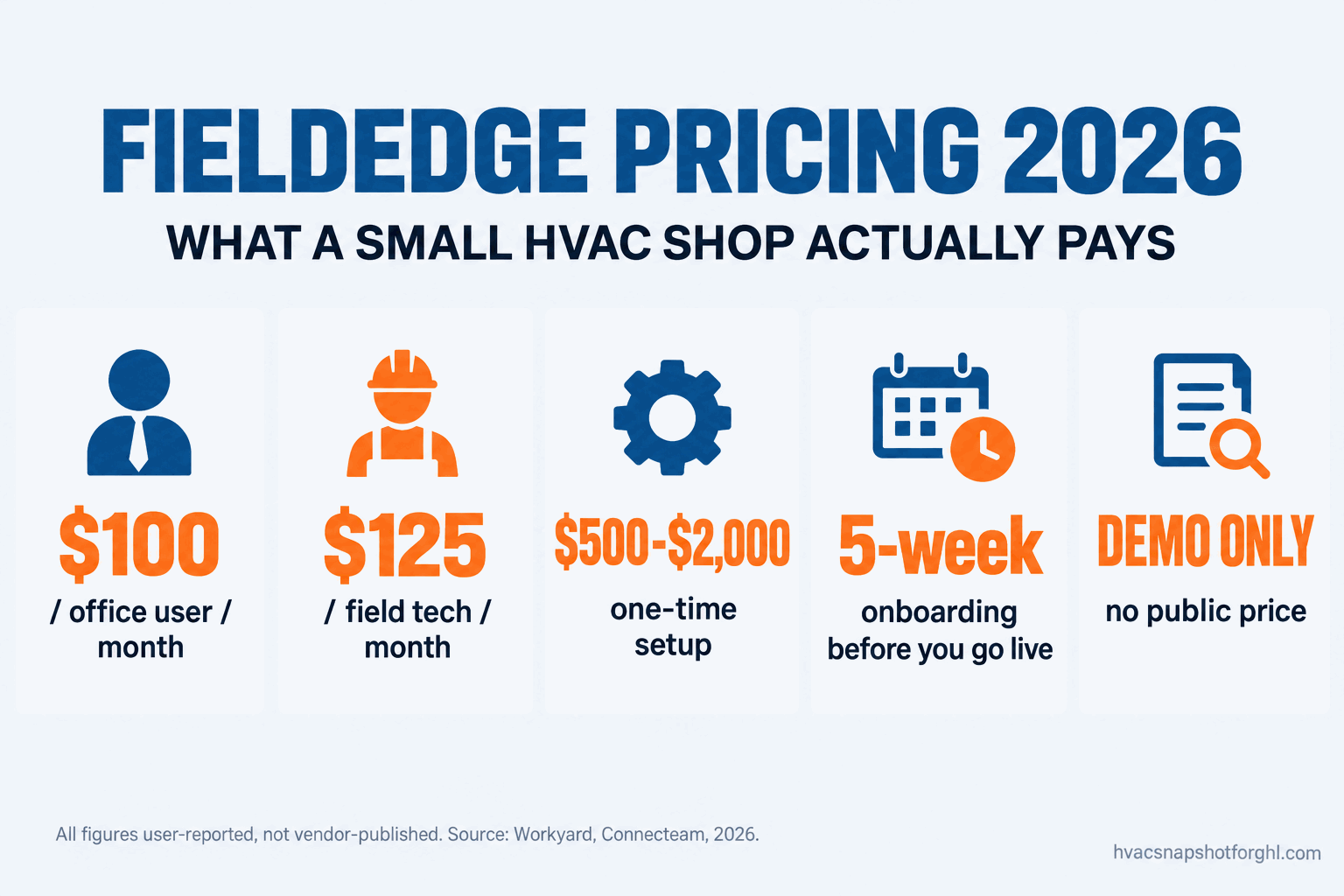
Here is the short version, so you do not have to sit through the pitch. FieldEdge does not publish a price. Contractors who bought it report roughly $100 per office user and $125 per field technician per month, plus a $500 to $2,000 setup fee and a five-week onboarding, on a per-seat model that climbs with every truck you add (Workyard; Connecteam). That lands it between the published-price tools and ServiceTitan. This teardown shows the real number and what to ask before you book the demo.
On this page
- Why FieldEdge will not just tell you the price
- What FieldEdge actually is, and who it is built for
- The real FieldEdge price, as contractors report it
- The costs that never show up on a pricing page
- Per-tech pricing: how the bill behaves as you add trucks
- Three scenarios: solo, 5 techs, 12 techs
- FieldEdge vs the published-price field
- The questions to ask before you book the demo
- The leak FieldEdge cannot fix
- The 10DLC bill every texting shop pays
- Objections and honest answers
- Frequently asked questions
Why FieldEdge will not just tell you the price
Software companies hide pricing to anchor the conversation on value before you anchor it on cost. See “$125 a tech” on a web page and you multiply by your truck count and flinch. See the dispatch board first and the flinch comes later, after you are sold.
FieldEdge plays this the same way ServiceTitan does. There is no public price list and no free trial, so you cannot poke at it and back into the number (Field Service Guide). One reviewer who asked flat out was told the rep “declined to give specific pricing information about each plan” (Connecteam). That does not make it a bad tool. It makes it a tool you have to pry a quote out of, so this post does the prying for you.
What FieldEdge actually is, and who it is built for
FieldEdge is a field service platform aimed squarely at HVAC, plumbing, and electrical contractors. In 2021 it became part of Xplor Technologies, the payments and software group, hence the “FieldEdge by Xplor” branding (HVAC Today).
Its real strength is accounting: real-time, two-way integration with both QuickBooks Desktop and QuickBooks Online (HVAC Today). If your bookkeeper lives in QuickBooks Desktop, that is a genuine reason to look at it over a tool that only talks to QuickBooks Online. It also folds in a flat-rate pricebook, FieldEdge Flat Rate (formerly Coolfront), and after a 2022 acquisition added HVACBizPro-style good-better-best proposals.
So who is it for. A residential shop with a few trucks that runs its books in QuickBooks and wants the office and accounting tied together without re-keying invoices. The question is never whether FieldEdge can run a shop. It is whether the price and the per-seat model underneath it fit the way you grow.
The real FieldEdge price, as contractors report it
Because FieldEdge publishes nothing, every number here comes from third-party review sites and contractors who reported what they pay. These are user-reported, and your quote may differ.
The most consistent reported figure is about $100 per office user and $125 per field technician per month, cited across several independent write-ups (Workyard; Connecteam). Broader ranges show up too, from $100 to $200 per user (Field Service Guide) up to $100 to $300 at the top end (ITQlick). On top of the subscription, expect a one-time setup fee of roughly $500 to $2,000 (Connecteam).
Run the math for a typical small shop. Five field techs at $125 plus two office users at $100 is about $825 a month, or roughly $9,900 a year before add-ons, matching the team-size examples reviewers report (Workyard). Put that next to ServiceTitan, which contractors report at $245 to $500 per technician per month plus a $5,000 and up implementation fee on a 12-month contract (Projul, 2026). FieldEdge lands in the middle.
The costs that never show up on a pricing page
The seat price is the part everyone quotes. It is not the part that surprises you. These line items land after you sign.
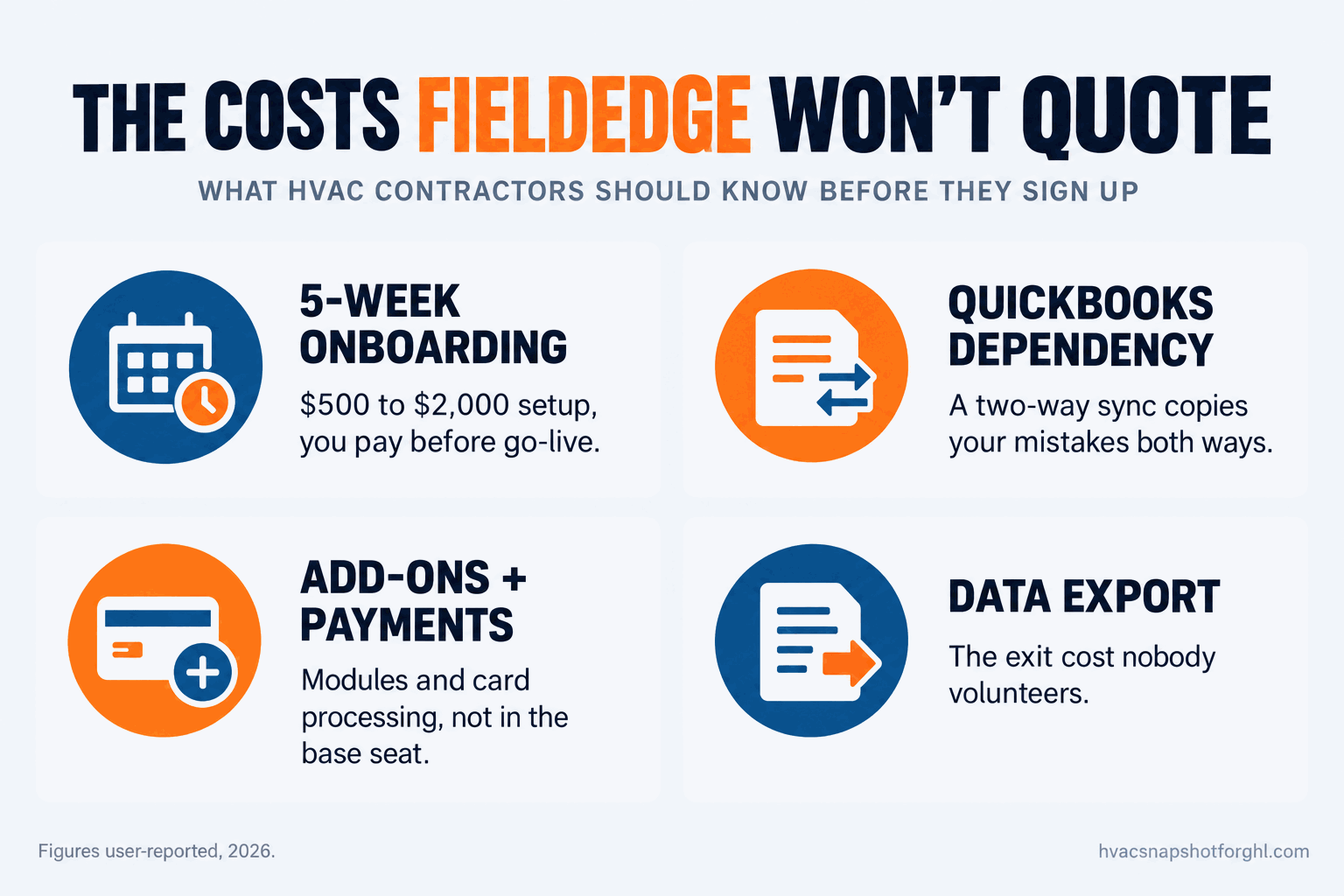
The setup and the five-week ramp. That $500 to $2,000 is not optional, and the real cost is the calendar. Reviewers describe a mandatory onboarding of around five weeks before the subscription even starts, and some report a rollout that stretched far longer (Workyard; Capterra). How it breaks: you sign in March to go live for cooling season, and the queue pushes your real launch into May while you pay for a tool nobody is using. Fix it by nailing the go-live date into the contract.
The QuickBooks dependency. The accounting sync is the reason to buy FieldEdge, and the thing that bites you if your books are messy. A two-way sync faithfully copies your mistakes in both directions. Older reviews of the flat-rate product flagged double entry and payment status not carrying over cleanly (Capterra). How it breaks: a QuickBooks item list full of duplicate SKUs gets mirrored, and now two systems are wrong instead of one. Fix it by cleaning your item list before the import, not after.
Add-ons and payments. Flat-rate books, proposals, and premium modules are not always in the base seat, and FieldEdge sits under a payments company, so expect card processing in the pitch, a cost that never appears next to the seat price. Fix it by making the rep itemize every add-on and the processing rate.
Getting your data back out. The hardest cost to see is the exit. A tool that owns your customer history and equipment records has the upper hand at renewal. How it breaks: two years in, you want to leave, and the export is a tangle of CSVs with no clean way to move equipment-to-customer links. Fix it by asking what a full data export includes before you sign.
Per-tech pricing: how the bill behaves as you add trucks
The most important thing to understand about FieldEdge has nothing to do with features. It is the shape of the bill. FieldEdge charges per seat. Every field tech you hire adds about $125 a month, forever. Fine at three trucks, a different conversation at twelve. The alternative model, used by Service Fusion, charges a flat rate per company with unlimited users, around $208, $325, and $533 a month across its tiers on annual billing (Capterra, 2026). Under a flat model, hiring your eighth tech costs nothing in software. Under FieldEdge, it costs another $1,500 a year.
Watch what that does as you grow. A five-tech shop is around $9,900 a year. A twelve-tech shop, at roughly twelve field seats plus three office seats, is near $21,600 a year on the reported rates. The feature set did not change, the headcount did.
None of this makes per-seat wrong. It makes it a bet on your hiring plan. Holding steady at three or four trucks, per-seat is cheap and simple. Hiring hard, run the flat-model math before you lock in. We walk the whole per-tech versus flat question in the pricing teardown.
Three scenarios: solo, 5 techs, 12 techs
Solo operator, one truck. Overkill and overpriced. You are paying enterprise-style seat rates and a multi-week onboarding for a shop that needs scheduling, invoicing, and a clean QuickBooks sync. Reported cost is roughly $2,700 a year, and published month-to-month tools do the job for a third of that. FieldEdge only makes sense solo if the QuickBooks Desktop sync saves your bookkeeper hours a week.
Five techs. FieldEdge’s sweet spot, and where you should negotiate hardest. Around $9,900 a year buys trade-specific dispatch, a flat-rate book, and tight accounting. The catch: published-price tools cover a five-tech shop for $2,400 to $3,900 a year. So the real question is whether the QuickBooks sync is worth the roughly $6,000 annual premium. For a shop drowning in double entry, maybe. For most, honestly, no.
Twelve techs. Now the per-seat model works against you. Near $21,600 a year, you are paying ServiceTitan-adjacent money without ServiceTitan’s depth, while Service Fusion Pro covers the same headcount for around $6,400 a year with unlimited users (Capterra, 2026). FieldEdge is defensible here only if the accounting integration is load-bearing. The pattern holds: per-seat tools punish growth, flat tools reward it.
FieldEdge vs the published-price field
FieldEdge and ServiceTitan are the only common small-shop picks that hide their price. The lineup at a glance:
FieldEdge vs common small-shop HVAC software (2026)
| Platform | Published price? | Pricing model | Reported / published starting cost |
|---|---|---|---|
| FieldEdge by Xplor | No, demo only | Per seat (office + tech) | ~$100 office / ~$125 tech per mo + setup |
| ServiceTitan | No, demo only | Per technician | ~$245-$500/tech/mo + $5K+ setup |
| Housecall Pro | Yes | Per user, tiered | $59-$299/mo |
| Jobber | Yes | Per user, tiered | $49-$599/mo |
| Service Fusion | Yes | Flat, unlimited users | ~$208-$533/mo |
The honest read: FieldEdge competes on accounting depth, not price transparency. If QuickBooks Desktop integration is your dealbreaker, it earns a spot on the list. If not, the published-price tools let you see the number today. For the full head-to-head, see the best ServiceTitan alternatives.
The questions to ask before you book the demo
Do not walk into a FieldEdge demo without these. Email them to the rep and ask for the answers in writing before you spend an hour watching a dispatch board fill up.
Get those eight answered in an email and you have done more diligence than most shops do before signing, and you find out fast whether the rep is straight with you.
The leak FieldEdge cannot fix
Here is the part no field service demo will tell you, and it matters more than which platform you pick. FieldEdge, ServiceTitan, all of them manage a job you already booked. They do not book it. For most small shops, the money does not leak inside the software. It leaks upstream, at the phone.
Picture a July afternoon. Your tech is on a rooftop, your office line rings, and it rolls to voicemail. That caller does not leave a message. They tap the next shop on Google, and the install is theirs. No dispatch board recovers a call nobody answered, and the best accounting sync cannot invoice a job you never got.
This is where a small shop should spend its first automation dollar, before it upgrades field software: making sure every call gets answered or texted back inside a minute, day or night. That is a different category of tool, and the one that actually moves revenue.
The 10DLC bill every texting shop pays
One cost shows up no matter which platform you choose, because the phone carriers set it, not the vendor. The moment you send business texts in the US, reminders, “tech is on the way,” review requests, you are in A2P 10DLC territory and pay registration and per-message fees on top of the subscription.
The pieces are small but real: a one-time registration (low-volume sole proprietors pay around $24.50, versus roughly $71.91 for standard high-volume), a per-campaign monthly fee typically $2 to $10, and a per-message carrier surcharge starting around $0.003 per segment and rising in 2026 (Twilio 10DLC pricing). Same bill whether you text through FieldEdge, ServiceTitan, or a custom build. The part that actually bites is compliance: texting without proper consent and a clean opt-out is a TCPA exposure whose penalties dwarf the carrier fees. We break it down, with the exact consent wording, in the HVAC TCPA and 10DLC guide.
Objections and honest answers
“The QuickBooks integration is worth it, though.” For some shops, genuinely yes. If your bookkeeper runs QuickBooks Desktop and you are drowning in double entry, FieldEdge’s real-time two-way sync can save real hours (HVAC Today). Just price that against the roughly $6,000 annual premium at five techs. If it saves five hours a week, it may pay for itself. If it saves one, it does not.
“I already sat through the demo and liked it.” Good tools demo well, that is the point. Liking the product is not the same as the price fitting your shop. Send the eight pre-demo questions anyway and run the real number against your headcount today and next year. The demo sells features. The contract bills seats.
“Switching software is a nightmare, I would rather just commit.” Fair, and that is exactly why the data-export question matters before you sign, not after. The nightmare is not switching, it is being locked in because leaving means losing your equipment history. Ask what the exit looks like up front and you keep the upper hand.
The bottom line
FieldEdge is a capable, HVAC-focused platform with a real strength in QuickBooks accounting, wrapped in a pricing model you have to pry open. User-reported rates put it around $100 per office user and $125 per field tech a month, plus setup, between the published-price tools and ServiceTitan. It is a reasonable buy for a QuickBooks-heavy shop at four or five trucks that negotiates hard, overpriced for a solo operator, and punishing on a twelve-truck shop with per-seat creep.
Whichever way you go, the field software is not where most of your money leaks. Get the eight questions answered, pick the tool that fits how you grow, and spend your first automation dollar on the phone.
FieldEdge pricing, common questions
How much does FieldEdge cost in 2026?
FieldEdge does not publish pricing, so every figure is user-reported. Contractors report roughly $100 per office user and $125 per field technician per month, plus a $500 to $2,000 setup fee and a five-week onboarding (Workyard; Connecteam). A 5-tech shop lands around $9,900 a year before add-ons.
Why does FieldEdge hide its pricing?
Like ServiceTitan, FieldEdge is demo-gated so the sales conversation anchors on value before cost. There is no free trial. Ask for the per-office and per-tech rate, setup fee, and contract length in writing before you evaluate it.
Is FieldEdge cheaper than ServiceTitan?
Yes, on user-reported figures. FieldEdge runs about $9,900 a year for a 5-tech shop, while ServiceTitan is reported at $245 to $500 per technician per month plus a $5,000-and-up implementation fee, roughly $19,500 a year for the same shop (Projul, 2026).
Does FieldEdge integrate with QuickBooks?
Yes, and it is FieldEdge's main selling point: real-time, two-way integration with both QuickBooks Desktop and QuickBooks Online (HVAC Today). If your books live in QuickBooks Desktop, that is a genuine reason to consider it over tools that only sync with QuickBooks Online.
Will FieldEdge stop my missed calls?
No. FieldEdge manages jobs you already booked; it does not answer your phone after hours. The biggest leak in most small shops is the unanswered call, which no field service tool fixes. Our lead leak audit shows where those jobs go.
About the author
Tony Escalante is an HVAC Operations and Dispatch Strategist based in Phoenix, AZ. He spent a decade running the service board for a multi-truck residential cooling shop before moving into systems work. He writes about turning chaotic summer call volume into bookable, trackable jobs, and why the phone, not the wrench, is where most HVAC revenue leaks.
Related posts
- What HVAC Software Really Costs in 2026: A Small-Shop Pricing Teardown
- The Best ServiceTitan Alternatives for a Small HVAC Shop (2026)
- The HVAC Lead Leak Audit: Where a Small Shop Loses Jobs
- Custom Software for HVAC Companies: When to Build vs Buy
- 10DLC + TCPA for HVAC Contractors: A Plain-English Guide