

A tech pulls up to a maintenance call at 9:10, a $89 cooling tune-up the office booked three weeks ago. He pops the panel, hoses off the condenser, glances at the gauges, writes “system operating normally” on the ticket, and is back in the truck by 9:35. On paper that is a clean visit. In reality he just drove past a capacitor reading 28% low, a condensate float one storm away from flooding a hallway, and an 11-year-old system the homeowner told him she “keeps thinking about replacing.” No photos. No readings. No follow-up. You paid for the truck roll, paid the tech, and walked away from the easiest sale in the trade.
That is the quiet leak in most shops. The tune-up is the cheapest lead you will ever get, because the customer already let you in the door and already trusts you enough to hand you the house. What you do inside that 45 minutes decides whether it stays an $89 ticket or becomes a $420 capacitor-and-contactor repair, a maintenance plan, or a replacement quote that closes in February. The thing that decides it is not talent. It is whether every tech runs the same checklist, writes down the same readings, and leaves behind the same proof.
This is that checklist. The spring AC visit and the fall furnace visit, the readings that actually mean something, the exact text you send after, and the part nobody writes down, which is how each step breaks and what to do about it.
On this page
- What is an HVAC tune-up checklist, and why a standard one makes you money?
- What a sloppy tune-up actually costs you
- The spring AC tune-up checklist
- The fall furnace tune-up checklist
- Turn the checklist into booked work
- The steal-this message pack
- Run the checklist in three different shops
- Staying legal: the texts that bring tune-ups back
- Objections, answered straight
- Frequently asked questions
What is an HVAC tune-up checklist, and why a standard one makes you money?
An HVAC tune-up checklist is the fixed list of checks, measurements, and photos every tech runs on a maintenance visit, in the same order, so the system gets inspected the same way whether you sent your best tech or your newest one. It is not the loose “clean the coil and check the gauges” routine that lives in a veteran’s head. It is a written standard, tied to the job, that produces the same readings and the same proof on every single call.
The reason it matters is plain once you think about where tune-up revenue actually comes from. A maintenance visit rarely pays on the $89 ticket. It pays on what the tech finds: a weak capacitor, a cracked contactor, a system low on charge, a heat exchanger showing its age, a homeowner who is tired of the summer breakdowns. Those findings are the product. A standard checklist is what makes sure your techs actually look for them instead of eyeballing the unit and calling it fine.
It does three jobs at once. It protects your name, because every customer gets the same thorough visit and nobody gets a 20-minute drive-by. It protects you on callbacks, because a documented inspection is your record of what the system looked like the day you were there. And it feeds your sales pipeline, because a photo of a bulging capacitor and a written reading sells the repair far better than a tech saying “you might want to get that looked at.” If your techs will not sell, the checklist is usually a bigger lever than a sales script, which is why we dug into why HVAC techs do not sell maintenance plans and what to do about it.
What a sloppy tune-up actually costs you
Owners wave this off until they see the field data. In the largest study of its kind, Proctor Engineering Group pulled diagnostic data from more than 80,000 residential air conditioners through its CheckMe! program and found more than two-thirds running with an incorrect refrigerant charge and more than half with insufficient evaporator airflow, leaving the typical unit operating 10% to 35% below its design efficiency (Proctor Engineering / SMUD). That study is from 2006, so treat it as a landmark rather than this week’s number, but two decades on the dashboard, nobody in the field thinks the problem got better. Every one of those systems is a tune-up where the tech either did not check charge and airflow or checked and did nothing.
The efficiency numbers are not just the homeowner’s problem. They are your sales evidence. When ENERGY STAR says a dirty blower or airflow problem “can cut efficiency by up to 15 percent” and the Department of Energy says a neglected filter adds 5% to 15% to the power bill, that is a documented, government-sourced reason for the customer to let you fix it (ENERGY STAR, DOE). A tech who measures a 9°F temperature split instead of the 16°F to 22°F a healthy system should hit is not guessing. He has a number, and a number closes work.
Now run your own math. Say you book 200 tune-ups a season and your techs are finding billable work on only 1 in 5 because half of them are doing drive-bys. Bump the find rate to 2 in 5 with a standard checklist, at a modest $300 average repair, and that is 40 more repairs, or roughly $12,000 of work you already had standing in the driveway. You did not spend a dollar more on marketing. You just stopped leaving the house without looking.
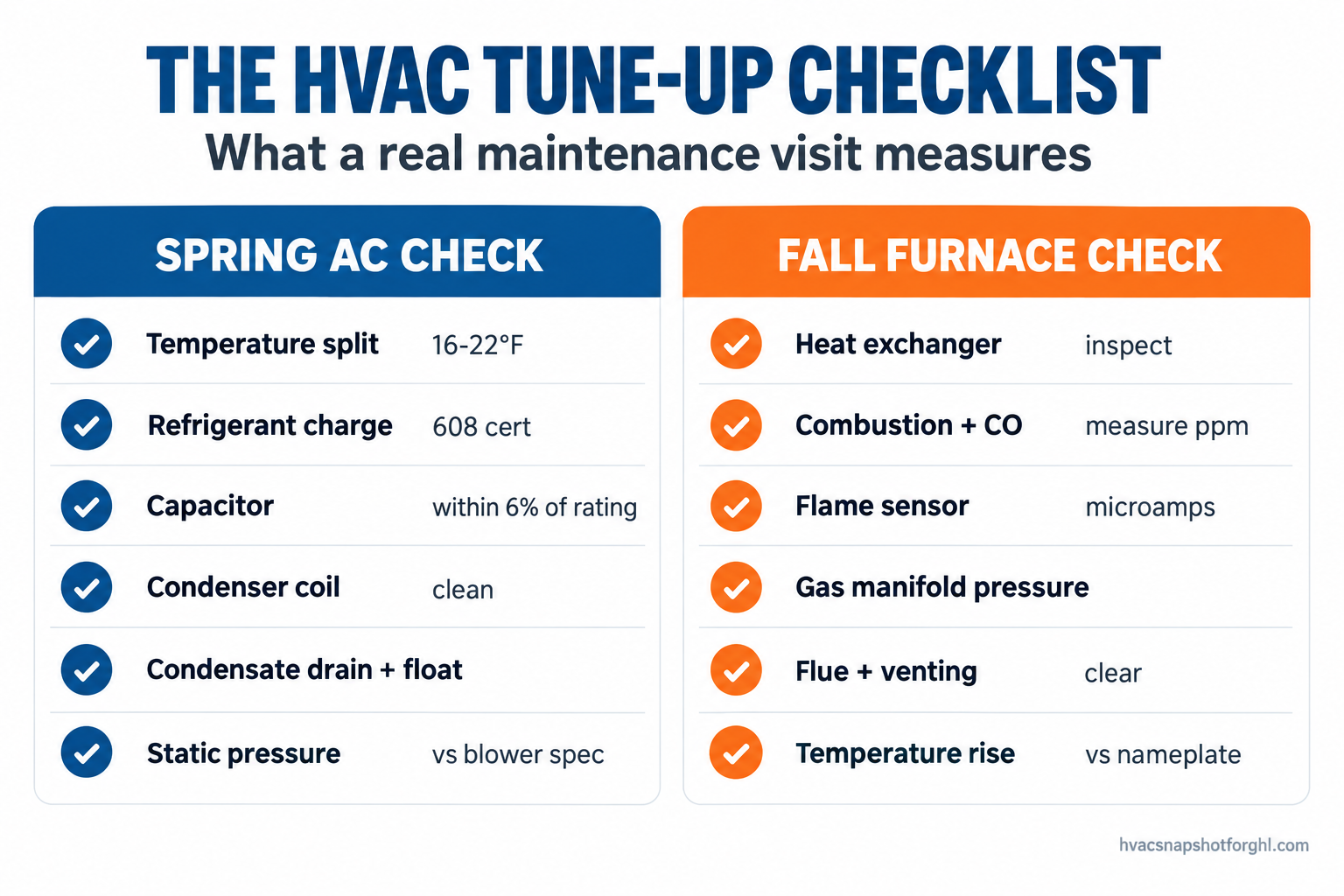
The spring AC tune-up checklist
This is the cooling-season visit. The goal is simple: confirm the system is safe and efficient, measure the things that fail, and write down a number for each one. Every item below is a check, a target reading, and the failure mode that turns it into a quote.
- Temperature split (supply vs return air). Measure the drop across the coil. A healthy system lands around 16°F to 22°F. How it breaks: a low split points at low charge, a dirty coil, or weak airflow, and a high split points at airflow starvation. Either way you now have a symptom to chase, not a shrug.
- Refrigerant charge (608 required). On a TXV system verify subcooling against the nameplate target, on a fixed-orifice system verify superheat. How it breaks: adding refrigerant to a system that is low without finding the leak is a callback waiting to happen. If it is low, the next conversation is leak search, not “topped it off.” Opening the system means a certified tech, no exceptions.
- Capacitor microfarads. Read the start and run capacitor and compare to the printed rating. Replace anything more than about 6% off. How it breaks: a weak capacitor is the single most common reason a condenser will not start on the first 95°F day of the year. Catch it in April and it is a planned $15 part. Miss it and it is a no-cool emergency in July.
- Contactor condition. Look for pitting and burning on the points. How it breaks: a pitted contactor chatters, welds shut, or drops out under load, and it takes the compressor with it when it fails hard.
- Amp draw on compressor and condenser fan. Measure actual amps against the RLA and FLA on the data plate. How it breaks: high amps mean a motor working too hard, usually from a dirty coil, failing bearings, or charge problems, and it is your early warning before a burnout.
- Condenser coil. Clean it and check for bent or flattened fins. How it breaks: a packed coil cannot reject heat, so head pressure climbs, efficiency drops, and the compressor runs hot. This is the airflow problem ENERGY STAR is talking about.
- Condensate drain and float switch. Flush the line and test the safety float. How it breaks: a clogged drain floods a closet, a ceiling, or a finished basement, and a dead float switch means nothing stops it. This is the item that saves you a drywall claim.
- Total external static pressure. Put a manometer on the supply and return and compare to the blower’s rating. How it breaks: high static is a strangled duct system, and it quietly kills comfort and equipment life no matter how perfect the charge is.
- Electrical connections and voltage. Tighten every lug and check voltage at the unit. How it breaks: a loose connection builds heat, melts insulation, and shows up as an intermittent fault nobody can find.
- Filter. Inspect, and change or tell the owner to. How it breaks: the cheapest fix in the trade and the one most often skipped, worth that documented 5% to 15% on the power bill.
Most of these take seconds once the panel is off. What takes discipline is writing the number down every time. A capacitor “looked okay” is worthless. A capacitor reading “32.1 µF on a 45 µF rating” sells itself.
The fall furnace tune-up checklist
The heating visit carries more safety weight, because a furnace that fails wrong does not just stop working, it can make people sick. The combustion checks here are not optional polish. They are the reason a homeowner should want a tech in the house every fall.
- Heat exchanger inspection. Inspect visually and, where equipped, back it up with a combustion analysis. How it breaks: a cracked heat exchanger can leak carbon monoxide into the living space. This is a red-tag condition and a straight replacement conversation, and it is the single most important thing on the list.
- Combustion analysis and CO. Measure flue CO, oxygen, and efficiency, and check for ambient CO in the space. How it breaks: high CO means incomplete combustion from a dirty burner, bad gas pressure, or a venting problem. A number on a meter is what separates a professional from a guy with a lighter.
- Flame sensor. Clean it and read the microamp signal, typically a few microamps on a healthy flame. How it breaks: a dirty sensor drops below the threshold and the board shuts the furnace down on the coldest night, which is your classic 2 a.m. no-heat call that a $0 cleaning in October would have prevented.
- Burners and flame pattern. Inspect for rust, debris, and an even blue flame. How it breaks: a lazy or yellow flame means poor combustion and soot, and it drives the CO problem above.
- Gas manifold pressure. Measure it against the nameplate spec. How it breaks: overfired or underfired furnaces run hot or short-cycle, stress the heat exchanger, and waste fuel.
- Inducer motor and pressure switch. Confirm the inducer runs and the pressure switch proves. How it breaks: a failing inducer or a stuck switch locks the furnace out, another dead-of-winter callback.
- Flue and venting. Inspect the vent run and termination for blockage, corrosion, and proper slope. How it breaks: a blocked or disconnected flue pushes combustion gases back into the house.
- Temperature rise. Measure the rise across the heat exchanger and compare to the nameplate range. How it breaks: a rise outside spec points at airflow or firing-rate problems and shortens the exchanger’s life.
- Limit switches and safeties. Test that the safeties actually trip and recover. How it breaks: a bypassed or failed safety is both a liability and a danger.
- Blower amp draw and wheel. Read blower amps and clean the wheel. How it breaks: a caked blower wheel moves less air every year until comfort and efficiency are gone and nobody noticed it happen.
- Filter and thermostat. Same as cooling, plus confirm the thermostat is calling and reading correctly.
A furnace visit with a printed combustion report and a photo of the burner compartment is worth far more than the $89 you charged for it, because it is proof you did the one job that keeps a family safe. That is also your strongest answer to a price shopper, which is the same logic we laid out for handling HVAC price-shopper calls.
Turn the checklist into booked work
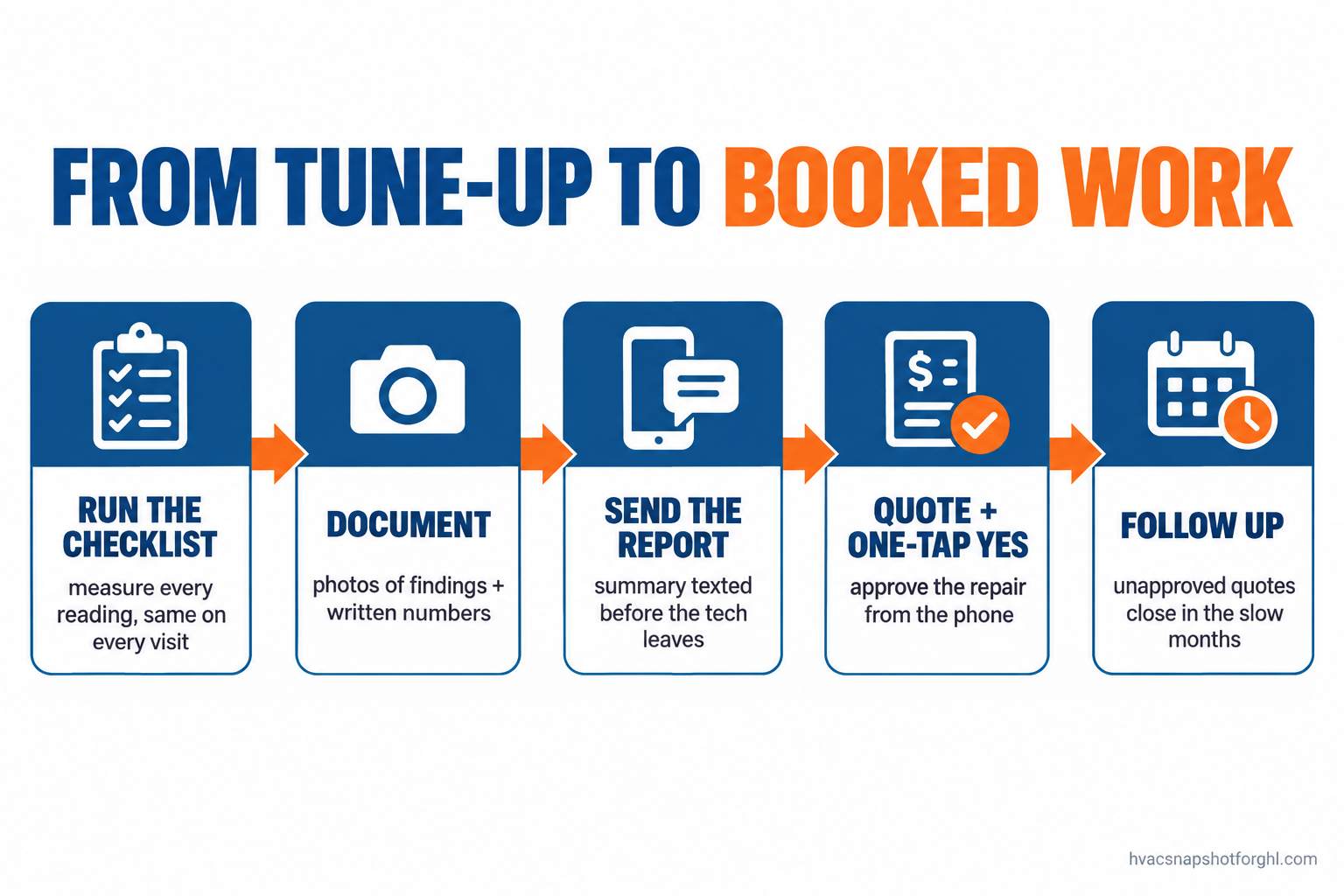
Here is where most shops leave the money. The tech runs a solid visit, finds three real things, mentions them at the door, the homeowner says “let me think about it,” and nothing happens. The fix is not a harder close. It is proof and follow-up.
Three habits do the heavy lifting. First, photos of every finding, taken on the spot: the low capacitor reading on the meter, the pitted contactor, the rusted burner, the 11-year-old data plate. Second, the readings written down as numbers, not adjectives, so the customer sees “measured” instead of “salesman.” Third, a findings summary that goes to the customer in writing before the tech leaves the neighborhood, with the recommended repair and a one-tap way to approve it. A system that is in good shape still gets a summary, because “everything checked out, here is your report” is exactly what earns the maintenance plan and the next rebook. The written agreement that locks that in is worth building once and reusing, and we broke down the pieces in the HVAC maintenance agreement template.
The repairs the customer does not approve today are not dead. They are a follow-up sequence: the capacitor they passed on in spring, the aging system you flagged, the duct fix they want to do “next year.” Dropped into a simple automated follow-up, those become booked jobs in the slow months instead of forgotten notes on a dead ticket.
The steal-this message pack
This is the copy you can paste in today. Keep the confirmations plain and transactional. Keep the seasonal rebook offers marketing, which means they need written consent and an opt-out, covered in the next section. Swap the brackets for your shop.
1. Day-before confirmation (transactional).
Hi [First name], this is [Shop] confirming your AC tune-up tomorrow between [window]. Reply C to confirm or call [number] to reschedule. Thanks!
2. Tech en route (transactional).
[First name], your [Shop] tech [Tech name] is on the way, about [X] minutes out. See you soon.
3. All-clear summary, system healthy (after the visit).
[First name], your system checked out well today. Temperature split 19°F, capacitor and electrical in spec, coil cleaned, drain clear. Full report with photos: [link]. We recommend a fall furnace check to keep it covered. Want us to pencil it in?
4. Findings + recommended repair (after the visit, with a photo).
[First name], thanks for having us out. We found your run capacitor reading 32 µF on a 45 µF rating, which is why the unit has been slow to start. Photo and your full report here: [link]. Repair is [$X] and we can handle it on the spot next visit or now. Reply YES to approve.
5. Maintenance plan offer at the visit.
[First name], since the system is due for seasonal care twice a year, our maintenance plan covers both tune-ups, priority scheduling, and [X]% off repairs for [$X]/year. Want me to set it up before I head out?
6. Seasonal rebook (marketing, needs consent + opt-out).
[Shop]: Heating season is here, [First name]. Your furnace is due for its safety and efficiency check. Book your fall tune-up: [link]. Reply STOP to opt out.
The difference between message 4 and a tech mumbling “your capacitor’s a little weak” is the photo, the number, and the one-tap yes. That is the whole game. For the exact consent wording that keeps message 6 legal, see our guide to SMS consent and opt-in language.
Run the checklist in three different shops
The checklist does not change. How you enforce it does, and it depends on how many trucks you are trying to keep honest.
The solo operator or two-truck shop. You are probably one of the techs, so the risk is not a lazy employee, it is a busy you skipping steps to make the next call. Your win is a printed or phone-based checklist you cannot close out without a reading in every field, plus the findings summary texted before you leave. Standardizing yourself feels silly until the month you forget to flag a dying system and lose the replacement to the shop that did not. Start here, because the discipline is cheaper to build at two trucks than at ten.
The mid-size shop, four to seven trucks. This is where drive-bys hide. You cannot ride along on every call, so you manage by exception: a digital checklist that timestamps and requires photos, a quick daily look at which tune-ups produced findings and which produced “all normal” on a 12-year-old system (that pattern is your tell), and a spiff on approved repairs so the tech wants to find the work. Pair the checklist with a reason to sell, because the tool and the incentive together beat either one alone, which is the whole argument in selling HVAC maintenance plans.
The large shop, eight-plus trucks. Now it is a system, not a habit. Every visit produces a structured report, photos are mandatory before the ticket closes, and unapproved quotes flow automatically into a follow-up campaign so nothing depends on a tech remembering. Your managers coach off the data: find rate per tech, average ticket per tune-up, plan conversion per tech. The off-season is when those stored quotes become revenue, which is exactly the move in the HVAC off-season playbook.
Staying legal: the texts that bring tune-ups back
The checklist lives on the right side of the law. The texts that bring customers back are where shops get tripped up, so keep two rules straight.
First, know which message is which. Appointment confirmations and “tech en route” texts are transactional, so they ride on ordinary express consent. The seasonal “book your fall tune-up” blast is marketing, and under the TCPA marketing texts to a mobile number require prior express written consent, which the rules define as a signed, written agreement from the customer (FDIC / FCC). In plain terms: capture a checkbox and clear opt-in language when you book the job, and put STOP on every marketing text. This is general information, not legal advice, so run your exact setup past counsel.
Second, budget the plumbing. Business texting in the US runs through A2P 10DLC registration, and the fees are small but real: through a provider like Twilio, campaign registration runs about $2 per month for a sole-proprietor campaign and about $10 per month for a standard one, plus a per-message carrier fee that currently runs roughly $0.003 to $0.005 per segment depending on the carrier (Twilio). That is pennies against a single recovered tune-up.
One more line that belongs on every furnace ticket: the refrigerant and combustion work is regulated whether or not you ever send a text. Anyone touching refrigerant needs an EPA Section 608 certification (EPA), and the equipment you are quoting is shifting to low-GWP refrigerant such as R-454B, which carries a global warming potential of 466 versus 2,088 for the R-410A it replaces (Carrier). New systems manufactured on or after January 1, 2025 must use a refrigerant at or below a 700 GWP limit, though equipment and components made before that date can still be installed (EPA). That changes the replacement conversation your tune-up is setting up, which we unpacked in the R-454B refrigerant change and your HVAC quotes.
Objections, answered straight
“My techs already know how to do a tune-up. I don’t need a checklist.” Your best tech does. Your newest one does not, and your busy one skips steps under pressure. A checklist is not an insult to the veteran, it is the floor for everyone, and it is the only way the customer gets the same visit no matter who you dispatched. It also protects the shop on a callback: a documented inspection is your proof of what the system looked like the day you were there.
“A full checklist takes too long. I’ll do fewer calls.” The measuring takes a few minutes once the panel is off, and the writing is a phone tap per field. What actually eats your day is the no-cool callback in July for the capacitor you drove past in April, and the hour your office spends chasing a quote the customer never got in writing. A standard visit runs slightly longer and prevents the expensive version.
“Customers think the upsell is a scam.” They think a vague upsell is a scam. “You should probably replace that” sounds like a pitch. A photo of their actual capacitor reading 28% low, next to the spec, with a government source on what airflow and charge problems cost them, is not a pitch, it is evidence. Proof is the antidote to the scam feeling, and it is why documentation sells where talk does not.
“I don’t want to nag people with texts.” A findings report is not a nag, it is a service the customer asked for by letting you in. The only message that needs restraint is the seasonal marketing blast, and the fix there is consent and an easy opt-out, not silence. Done right, the rebook text is the reason they do not forget you until the system dies.
Frequently asked questions
What should be on an HVAC tune-up checklist?
For a cooling visit: temperature split, refrigerant charge via subcooling or superheat, capacitor microfarads, contactor condition, compressor and fan amp draw, condenser coil cleaning, condensate drain and float, total external static pressure, electrical connections, and the filter. For a heating visit: heat exchanger inspection, combustion analysis and CO, flame sensor microamps, burners, gas manifold pressure, inducer and pressure switch, flue and venting, temperature rise, safeties, blower amps, filter, and thermostat. Every item should produce a written reading, not just a checkmark.
How long should a proper AC or furnace tune-up take?
A thorough visit that includes real measurements and photos typically runs 45 to 75 minutes depending on access and system condition. A 20-minute visit is a drive-by, and it is where shops leave repair and replacement revenue on the table.
Do my techs need a certification to check refrigerant charge?
Yes. Any technician who opens the sealed system to check or adjust refrigerant must hold a valid EPA Section 608 certification. It is federally required and it is also required to purchase most refrigerants. A 608 certification does not expire.
How does a tune-up checklist actually increase revenue?
It raises the find rate. A standardized, documented visit surfaces weak capacitors, dirty coils, charge problems, aging equipment, and safety issues that a quick look misses, then turns each finding into a photo and a written quote. Repairs the customer does not approve on the spot feed an automated follow-up and close in the slower months.
Can I text customers to rebook their seasonal tune-up?
Yes, with consent. A seasonal tune-up reminder is marketing under the TCPA, so you need prior express written consent and a clear opt-out (STOP) on the message. Appointment confirmations and en-route texts are transactional and ride on ordinary express consent. This is general information, not legal advice.
Should I give the customer a copy of the checklist results?
Always. A findings summary with photos and readings, sent in writing before the tech leaves, is what turns a service call into trust and a sale. Even a clean bill of health should go to the customer, because that report is what earns the maintenance plan and the next rebook.
Back to that 9:10 tune-up. Run the same call with a checklist and it looks different. The tech measures the capacitor at 32 µF on a 45 µF rating, photographs it, flags the condensate float, notes the 11-year-old system, and before he is three streets away the homeowner has a report on her phone: a confirmed repair she taps to approve, and a replacement quote that lands back in her inbox in February when the system finally quits. Same truck roll. Same $89. The difference is that this time you actually looked, you wrote it down, and you left proof. That is the whole job, and it is the cheapest growth lever in your shop.