

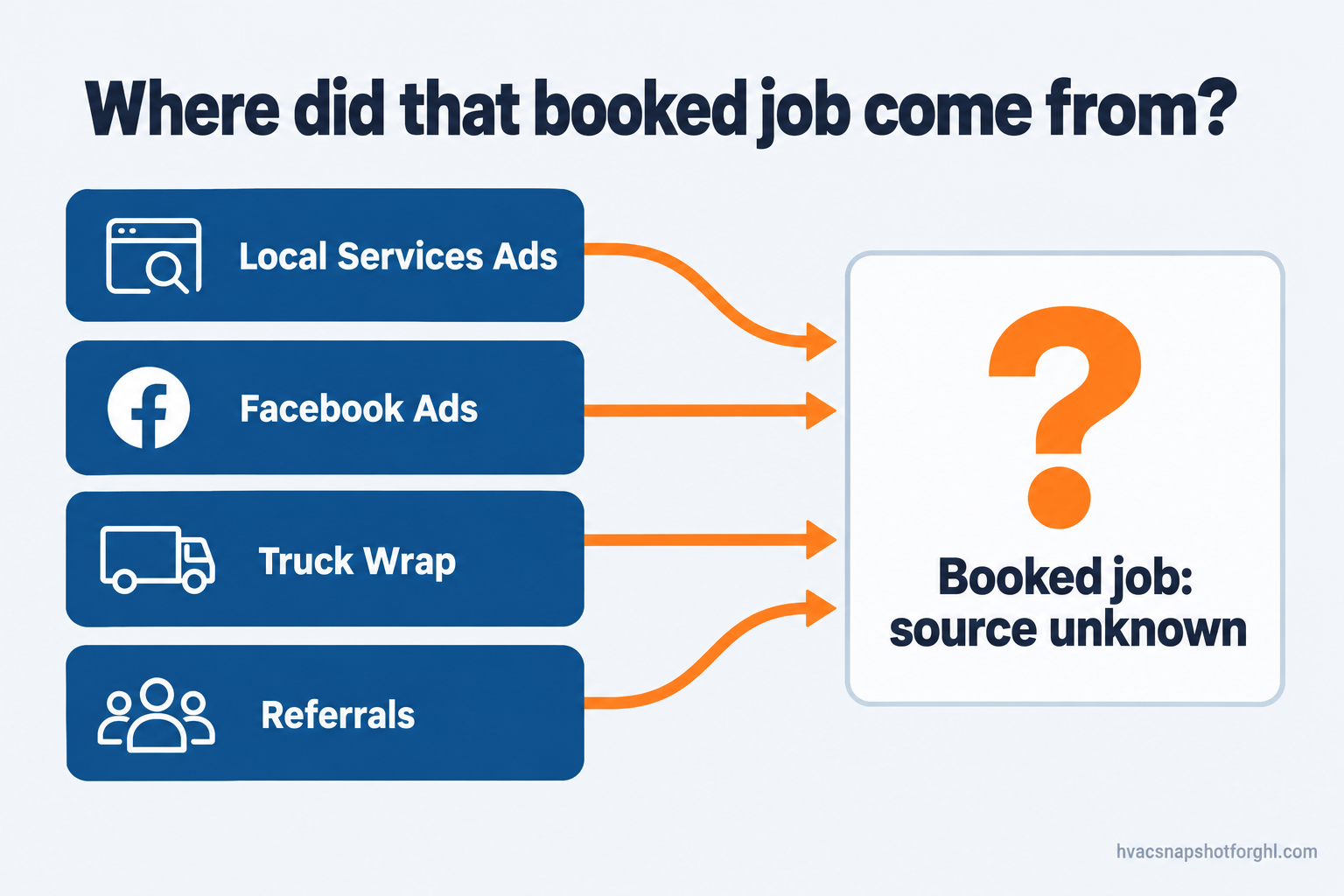
A homeowner books a full AC changeout with you on Tuesday. Nice ticket, clean install, the kind of job that pays for a slow week. Then your partner asks the one question you can’t answer: where did that job come from? The truck wrap? The Local Services Ads you turned back on in May? The Facebook campaign your nephew runs? The Google reviews? The yard sign the crew left at the last job two streets over? You shrug. It came from somewhere. It booked. Who cares.
Here’s who cares: the private-equity roll-up across town that just bought two of your competitors. They know their cost per booked job on every channel down to the dollar, so they pour money into what works and starve what doesn’t. You’re guessing. They’re not. The real gap isn’t the size of the budget, it’s that you can’t see what your money is doing, so half of it is wasted and you can’t tell which half. This piece is the fix: a plain, seven-stage system that tracks every lead from the first ring to the closed ticket, so you finally know which ads book jobs and which just burn cash.
On this page
- Why you can’t tell which HVAC ads work
- What lead tracking actually means (it’s not a dashboard)
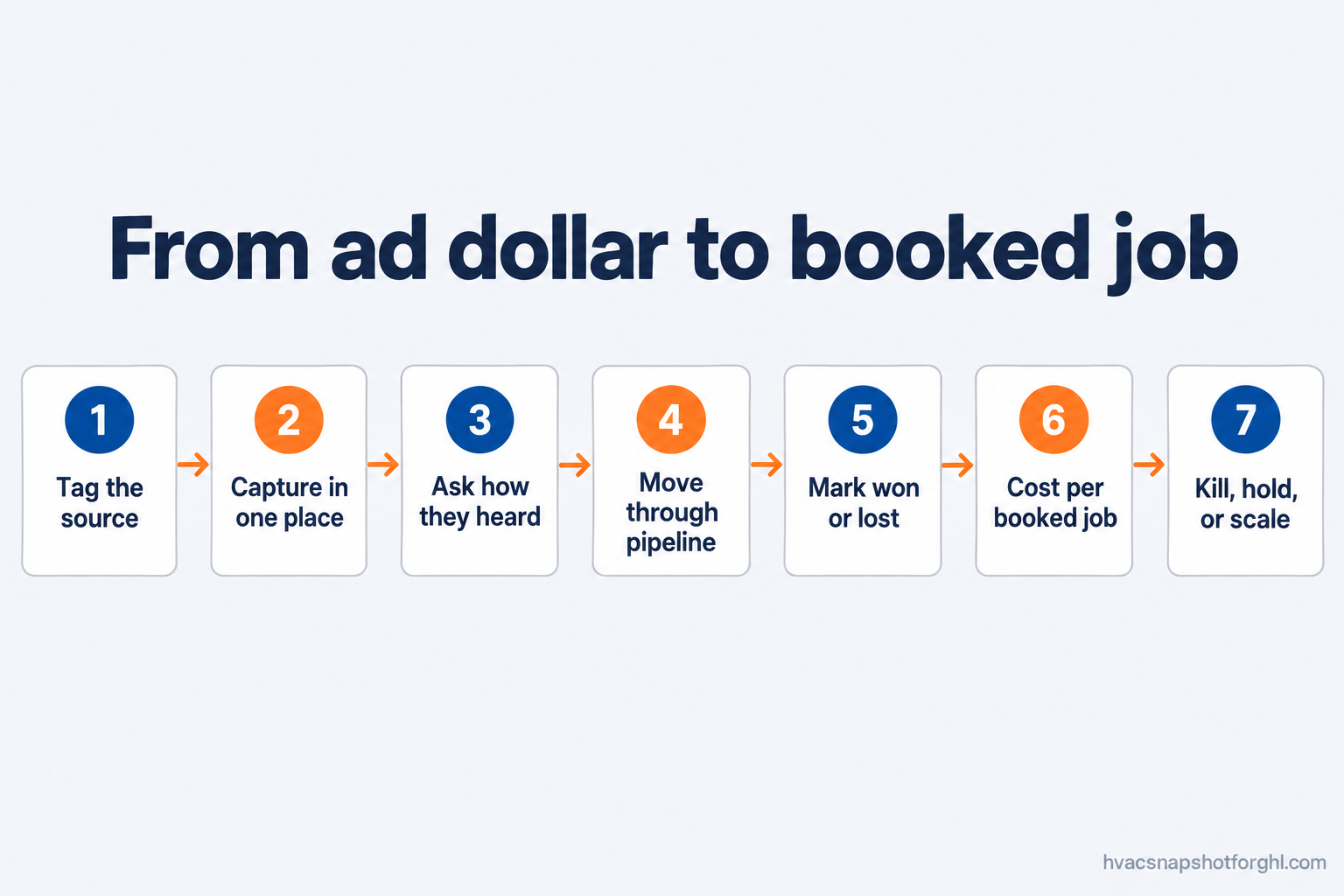
- The 7 stages from ad dollar to booked job
- The steal-this copy and scripts
- Run it for three different shops
- The legal part: call recording and 10DLC
- Objections, answered straight
- Frequently asked questions
Why you can’t tell which HVAC ads work
There’s an old line in advertising, usually attributed to department-store pioneer John Wanamaker: “Half the money I spend on advertising is wasted; the trouble is I don’t know which half.” A hundred years later that’s still the exact problem in a 2 to 15 truck HVAC shop, except the numbers are bigger and the channels multiplied.
Start with what a lead costs you now. HVAC is one of the pricier trades to buy a lead in. WebFX pegs the industry-average HVAC cost per lead at around $153, and flags anything above $150 as a sign a campaign is running hot (WebFX, 2025). You pay in that range every time the phone rings, whether the call turns into a job or a tire-kicker.
Now here’s what makes being blind so expensive: your buyers don’t fill out a form and wait when the AC quits in July. They call. Invoca’s home-services data found 62% of customers called a business during their purchase journey, and marketers consistently report that phone calls convert at higher rates and larger order values than web leads, with one widely cited BIA/Kelsey figure putting calls at 10 to 15 times more revenue than web leads (Invoca, 2025). The phone is where your money is. It is also where your tracking dies, and the leak is bigger than most owners think: Invoca’s 2026 benchmark data found roughly 41% of calls to home-services businesses never reach a live person (Invoca, 2026). Paid for, rung, missed, gone, with no record of what it even was.
Now here’s the trap. Most owners track cost per lead, if they track anything, and stop there. Cost per lead is the price of a phone ringing. It tells you nothing about whether that call booked, ran, and paid. A channel that delivers $150 leads but books half of them at a $9,000 average ticket is a money printer. A channel that delivers $40 leads that never book is a drain. On a cost-per-lead report they can look the same, or the cheap one looks better. The number that actually runs your business is cost per booked job: what you spent on a channel divided by the jobs it actually put on the board.
You can’t calculate that without tracking the lead the whole way down. And the place it breaks first is the phone, which we just saw is most of your volume. When a call rings your cell or the shop line, nothing on it says the caller found you through LSA, the yard sign, or a three-year-old review. The source dies the second you say hello. Multiply that across a summer of calls and you’ve got a marketing budget you’re flying completely blind on.
What lead tracking actually means (it’s not a dashboard)
When people hear “tracking” they picture a wall of charts they’ll never look at. That’s not this. Lead tracking is one discipline: every lead that comes in gets stamped with where it came from, and that stamp follows it until the job is won or lost. That’s it. The charts are a byproduct. The work is the stamping and the follow-through.
Field-service software like ServiceTitan, Housecall Pro, or FieldEdge is good at managing a job once it exists: scheduling, dispatching, invoicing. What most shops never set up is the layer in front of that, the part that catches the lead, tags its source, and tracks it to a decision. That’s a CRM job, and it’s the difference between a system of record for jobs you already won and a system that tells you how to win more.
Done right, tracking answers four questions you probably can’t answer today:
- How many leads did each channel bring me last month?
- How many of those actually booked?
- What did those jobs bill?
- So what did a booked job from that channel really cost me?
Answer those and the guessing stops. You stop arguing with your spouse about whether the Facebook spend is worth it and start reading it off a screen.
The 7 stages from ad dollar to booked job
This is the whole system, start to finish. Each stage is simple on its own, and the power is in not skipping one: a chain with one broken link tracks nothing. Under each stage is the way it breaks in real shops, so you can skip the mistakes the rest of us already made.
Stage 1: Give every channel its own phone number and link
You can’t tell channels apart if they all point at the same number. So you split them. Local Services Ads already reports its own leads inside Google, and it charges per valid lead rather than per click, so Google logs every call and message it sends you (Google Local Services Ads Help). For everything else, you use tracking numbers: a unique forwarding number on the truck wrap, another in the Facebook ads, another on the Google Business Profile, another on the website. All of them ring your real line, but the system knows which number the caller dialed, so it knows the source. For web forms and chat, you tag the source with a UTM parameter on the link, so a click from your email shows up stamped “email.”
How it breaks: you buy one tracking number, slap it everywhere, and learn nothing. Or you swap your real number for a tracking number on your Google Business Profile, which wrecks your local ranking because your name, address, and phone no longer match across the web. Use tracking numbers as a forwarding layer, keep your real number consistent on your listings, and let the software log which line each call hit.
Stage 2: Land every lead in one place
A tracking number is useless if the calls, forms, and chats pile up in five different inboxes nobody reconciles. Stage two is one destination. Every call, web form, Facebook lead, chat message, and LSA lead flows into a single CRM, each one carrying its source tag. Now you have one list where every row says what it is and where it came from.
How it breaks: calls go to your cell, forms to a shared Gmail, Facebook leads sit inside Facebook until someone remembers to check, and the chat lives on the website. Five islands, no map, nothing counted. If you fix only one stage this year, fix this one. The source tag means nothing until all the leads sit in the same bucket.
Stage 3: Ask “how’d you hear about us” as a backstop
Tracking numbers and UTMs catch most of it, but not all. Word of mouth carries no tracking number. A customer who saw your truck, Googled your name, then called the number on your website gets tagged “website” when the truth is “truck plus reputation.” So you add a human backstop: your CSR or your AI receptionist asks every new caller, “quick question, how’d you hear about us?” and logs the answer. It’s not perfect, people misremember, but across a few hundred calls it catches the offline sources the software can’t see.
How it breaks: you make it optional, so it gets asked on slow days and skipped during the heat wave, exactly when volume is highest. Build the question into the intake script so it’s asked every time, and make the CRM field required so a lead can’t be saved without it.
Stage 4: Move the lead through a pipeline
A lead isn’t a job yet. It’s a maybe. The pipeline is the set of stages it moves through: new, contacted, estimate booked, estimate ran, won, lost. Every lead sits in exactly one stage, and it carries its source the whole way. This is the stage most shops are missing entirely, and it’s the one that turns “we got 60 calls” into “we got 60 calls, 22 booked, 14 ran, 9 won.”
How it breaks: you let leads rot in “new” because nobody owns moving them, or you only log the jobs that won, so your win rate looks like 100% and the lost-lead pile is invisible. Log the losses too. They’re half the lesson. A channel that brings 30 leads and loses 28 is telling you something loud.
Stage 5: Mark it won or lost, with the dollar amount
Here’s where cost per booked job becomes real. When a job wins, you mark it won and attach what it billed. When it loses, you mark it lost and, if you can, why. Now every booked job carries two things: the source that brought it and the revenue it produced. That’s the raw material for the only report that matters.
How it breaks: you track the booking but never the revenue, so you can tell which channel books the most jobs but not which books the most money. The channel that books ten $400 service calls looks better than the one that books two $11,000 changeouts, until you add the dollars. Attach revenue to every won job or you’ll optimize for volume and wonder why you’re busy and broke. We wrote a whole piece on that exact trap, why a small HVAC shop can be busy all summer and broke by fall.
Stage 6: Read one report, cost per booked job by channel
Now the system pays you back. One report: for each channel, what you spent, how many jobs it booked, what those jobs billed, and the cost per booked job. Not cost per lead. Cost per booked job. For the first time you can line your channels up side by side and see which dollar works hardest. And the ranking almost always surprises people, because the channel with the cheapest leads is often the most expensive place to buy an actual job.
How it breaks: you build a dashboard with 30 numbers and read none of them. Pick the handful that change a decision, cost per booked job and total revenue per channel, and ignore the vanity metrics. Impressions and clicks don’t pay for diesel.
Stage 7: Kill, hold, or scale
The report is only worth something if you act on it. Three moves. Kill the channels with a brutal cost per booked job that aren’t carrying their weight. Hold the ones that are fine but not stars. Pour more into the one or two that book cheap, profitable jobs. Then re-read it next month, because seasons move. The channel that crushes it in July heat is not the one that saves you in a dead February, which is its own off-season problem worth planning for.
How it breaks: you look at one slow month and torch a channel that was fine, or you never revisit the report so last summer’s winner keeps eating budget through a quiet winter. Decisions are monthly, not once-and-done, and never off a single bad week.
The steal-this copy and scripts
The system runs on a few small pieces of language used the same way every time. Here they are. Swap in your shop name and put them to work.
The intake question (every new caller, every time):
“Thanks for calling [Shop Name], this is [Name]. Before we get you booked, quick question so I can help you faster: how’d you hear about us today?”
Log the answer. It takes four seconds and it’s the backstop for every offline source you can’t track automatically.
The call-recording disclosure (if you record calls):
“Just so you know, this call may be recorded for quality and training. How can we help today?”
Say it at the top of every recorded call. More on why this line is not optional in the legal section below.
The missed-call text-back (fires automatically within a minute of a missed call, source tag already attached):
“Hi, this is [Shop Name], sorry we missed you just now. Was this about getting a system looked at or a quote? Reply here and we’ll get you on the schedule. You can also call us back at [number].”
A missed call with no record is a lead you paid for and threw away. The auto-text catches it and keeps the source tag alive, so even the calls you couldn’t pick up still show up in the pipeline. If the phone is your biggest leak, and for most shops it is, start with why the first five minutes decide who wins the job.
The web-form confirmation (fires on form submit, source already stamped from the UTM):
“Got it, [First Name]. We’ve got your request for [service]. A real person from [Shop Name] will reach out within the hour to get you scheduled. If it’s an emergency, call us now at [number].”
The won/lost tagging rule (the SOP for whoever runs the board):
“No job closes until it’s marked won or lost in the CRM. Won gets the final invoice amount attached. Lost gets a one-word reason: price, timing, competitor, or no-show. No exceptions, including the busy days.”
That last rule is the whole game. The data is only as honest as your worst day of logging.
Run it for three different shops
The same seven stages, but what you reach for depends on your size. Here’s how it actually shapes up at three different scales.
Lead tracking at three shop sizes
| Solo / 1-2 trucks | 5-truck shop | 10-15 trucks | |
|---|---|---|---|
| Channels running | LSA + word of mouth | LSA + Facebook + GBP + referrals | All of the above + paid search + email |
| Biggest blind spot | Calls to the owner's cell | Leads split across 4 inboxes | No one owns the numbers |
| First fix | One CRM + missed-call text-back | Tracking numbers + one pipeline | Revenue tagging + a real report |
| Who reads the report | The owner, Sunday night | Owner + office lead, weekly | A marketing coordinator, weekly |
Solo and one or two trucks. Your whole problem is that leads ring your cell and vanish. You don’t need a marketing department, you need one place for leads to land and a missed-call text-back so the calls you take on a ladder don’t disappear. Turn on LSA tracking, route every call and form into one CRM, ask “how’d you hear about us” yourself, and spend ten minutes Sunday night reading what booked. That alone puts you ahead of most shops your size.
Five-truck shop. You’re running four or five channels scattered across Facebook, a shared inbox, the LSA dashboard, and your office manager’s memory. Your fix is tracking numbers on each channel, one pipeline everyone works, and a weekly huddle where you and your office lead read the cost-per-booked-job report together. This is the size where tracking decides whether you can keep up with the shop down the street. For what a fair total marketing number looks like at your revenue, see how much HVAC contractors should spend on marketing.
Ten to fifteen trucks. More volume means more leaks you can’t see. Someone has to own the numbers, usually a marketing coordinator or a sharp office manager, and the revenue tagging has to be religious, because at your ticket sizes a small tracking error is real money. Here the report isn’t just about killing weak channels, it’s about defending margin against the roll-ups, who outspend you precisely because they know their numbers. You can’t outspend them. You can out-track them.
The legal part: call recording and 10DLC
Two rules keep this system clean. Ignore either one and the thing that was supposed to make you money turns into a liability.
Call recording consent. If you record calls for quality, training, or to double-check a source, you’re subject to wiretap law, and it varies by state. Most states are “one-party consent,” meaning one person on the call (you) can agree to record it. But about a dozen states require all-party consent, meaning everyone on the line has to know. The states commonly listed as all-party are California, Connecticut, Delaware, Florida, Illinois, Maryland, Massachusetts, Montana, Nevada, New Hampshire, Oregon, Pennsylvania, and Washington, though the exact count shifts because some states treat phone calls and in-person conversations differently (Kilpatrick Townsend, Wiretap Laws in the United States). This isn’t legal advice, so confirm your own state’s rule before you flip recording on. The safe play everywhere: open every recorded call with the disclosure line from the copy section above, and if you serve customers across a state line, follow the stricter state’s rule.
A2P 10DLC registration. The second a lead becomes a text, you’re in carrier territory. To send business texts from a regular 10-digit number, the carriers require you to register your brand and your campaign, on top of the TCPA rules the FCC enforces. The underlying registry fees are small: Twilio lists a one-time brand registration of about $4.50 plus a one-time campaign vetting fee of about $15 (Twilio, 2026). If you run your texting through GoHighLevel, the bundled one-time registration lands around $22.50 for a low-volume standard brand (about $64 for high-volume), plus a recurring campaign fee commonly $2 to $10 per month and a small per-message carrier surcharge that varies by carrier (GoHighLevel A2P fee schedule). Log consent with a timestamp when a customer gives you their number, keep a working opt-out in every text, and honor STOP instantly. Our plain-English TCPA and 10DLC guide for HVAC is the full checklist.
Objections, answered straight
“I already pay for ServiceTitan or Housecall Pro. Doesn’t it track this?” Those platforms manage jobs you already booked: scheduling, dispatch, invoicing. Most have some marketing module, but few shops set it up to tag sources at intake and run a true cost-per-booked-job report, and most owners use a fraction of what they pay for anyway. To see what you’re actually spending across your whole stack, our HVAC software pricing teardown lays out the real numbers.
“This sounds like a lot of work for my office.” The stamping is automatic once it’s set up. Tracking numbers tag the source, UTMs tag the forms, the CRM files it all in one place. The only human parts are asking “how’d you hear about us” and marking jobs won or lost with the dollar amount, which is just closing out a job properly. You’re not adding work, you’re adding one habit to work you already do.
“I’m a small shop. Isn’t this overkill?” It’s the opposite. The smaller you are, the more every wasted ad dollar hurts, because you don’t have the roll-up’s budget to absorb mistakes. A solo operator who knows his cost per booked job and funds the one channel that works will beat a bigger shop spraying money at five channels blind. Tracking is how a small shop spends like a smart one.
“What if it shows my favorite channel is a dud?” Then it just saved you money. The point is to stop paying on feel. Maybe the Facebook spend you’ve defended for two years books nothing, and the Google Business Profile you ignore books your best jobs for free. That’s not bad news. It’s the first time you get to move money toward what works.
Frequently asked questions
What is HVAC lead tracking?
Lead tracking is the practice of stamping every incoming lead with the marketing source it came from, then following that lead through your pipeline until the job is won or lost. For an HVAC shop it means knowing that a specific booked AC changeout came from Local Services Ads, a Facebook ad, your truck wrap, or a referral, so you can measure what each channel actually produces instead of guessing.
What's the difference between cost per lead and cost per booked job?
Cost per lead is what you pay for a phone to ring, a form to come in, or a chat to start. Cost per booked job is what you pay for a lead that actually turns into scheduled, billable work. A channel can have an expensive cost per lead but a cheap cost per booked job if those leads book and close well, which is why cost per booked job is the number that should drive your budget decisions.
How do I track which ad a phone call came from?
Give each channel its own tracking phone number that forwards to your real line. The call-tracking software records which number the caller dialed, so it knows the source, even though every number rings the same place. Local Services Ads reports its own calls inside Google. For calls you still can't trace, ask every new caller how they heard about you and log the answer.
Do I need call-tracking software, or can I just ask customers?
Use both. Asking how a caller heard about you is a useful backstop, especially for offline sources like word of mouth and truck wraps, but people misremember and the question gets skipped on busy days. Tracking numbers and UTM links capture the source automatically and consistently. The ask fills the gaps the software can't see; the software covers the gaps the ask misses.
Is it legal to record HVAC service calls for tracking?
It depends on your state. Most states allow recording with one party's consent, but about a dozen require all parties to consent. The safe approach everywhere is to disclose at the start of every recorded call that it may be recorded for quality and training. If you serve customers across state lines, follow the stricter state's rule, and confirm your own state's law with a current legal source before recording.
What does a lead-tracking system cost to run?
The main costs are a CRM with call tracking and the per-channel tracking numbers, plus A2P 10DLC registration if you text leads, which runs roughly $22.50 to $64 one-time through a platform like GoHighLevel, a small monthly campaign fee, and a per-message carrier surcharge. Against an HVAC cost per lead that often tops $150, the tracking pays for itself the first time it lets you cut one dead channel and move that money to a working one.
How long before lead tracking shows me anything useful?
You'll see clean source data within days of turning it on. Reliable cost-per-booked-job numbers take a bit longer, usually one to two months, because jobs take time to run and close, and you need enough volume per channel to trust the pattern. Start logging now so that by your next budget decision you're reading real numbers instead of guessing again.
It’s Tuesday again, another AC changeout just booked, and this time your partner asks the same question. You don’t shrug. You pull up the board: the lead came in as a call on the Local Services Ads number at 9:12, your CSR tagged it, it moved from new to estimate booked to won by Thursday, and it billed $9,400. You know exactly what that job cost you to get, and you know the channel that brought it is the one you’re putting next month’s money into. The roll-up across town still has a bigger budget than you. It no longer has better eyes. You can finally see which half of your advertising works, and you’re done paying for the half that doesn’t.