

It is a Thursday in July and your office manager wants to blast a “beat the heat, $89 tune-up” text to every customer in the database. Two thousand numbers, one tap. Is that okay? The honest answer: it depends on how those numbers got in, what each customer agreed to, and whether your shop is registered to send bulk texts at all. Get it right and the text books jobs. Get it wrong and one homeowner with a lawyer can turn it into a bill that wipes out a season of profit.
This is the post that gives you the exact wording, not just the warnings. To text an HVAC customer legally in 2026 you need the right kind of consent for the kind of message you are sending, a working STOP keyword, and your business registered for A2P 10DLC so the carriers actually deliver the text. Below is the opt-in language you can lift word for word, what changed in the rules in 2025 and 2026, and the three failure modes that cost shops real money. Not legal advice. For a specific situation, talk to a real lawyer.
On this page
- “Can I text them” is really two questions
- What counts as consent in 2026, and what changed
- Steal this: the exact opt-in language for every capture point
- A2P 10DLC: registering so the texts actually land
- Three shops, three consent setups
- How consent breaks, and what it costs you
- Objections and honest answers
- Frequently asked questions
“Can I text them” is really two questions
When you ask “can I text this customer,” you are stacking two separate rule sets on top of each other, and they are enforced by two different groups.
The first is the TCPA. Federal law, enforced by the FCC and, more painfully, by private lawsuits. It governs whether you are legally allowed to send the message at all, based on what the customer consented to, and it carries statutory damages per message (FCC).
The second is A2P 10DLC. Not a law, but a framework the carriers (Verizon, T-Mobile, AT&T) built to police business texting from regular 10-digit numbers. It governs whether your text physically gets delivered. Register and messages flow. Skip it and carriers throttle you to a trickle, then block you.
You have to clear both. A shop can be perfectly TCPA-compliant and still have most of its texts silently filtered because nobody registered for 10DLC, and a registered shop can still get sued for blasting marketing to people who never opted in. This post handles consent first (the legal side), then registration (the delivery side), because that is the order they bite you.
For the full background on both frameworks, we wrote the plain-English version in the TCPA and 10DLC guide for HVAC shops. This post is the build sheet that goes with it.
What counts as consent in 2026, and what changed
Most shops are working off bad information here, because the rules moved twice in two years and the advice online has not caught up. Start with the split that never changes: the kind of consent you need depends on the kind of message.
What consent each kind of text needs
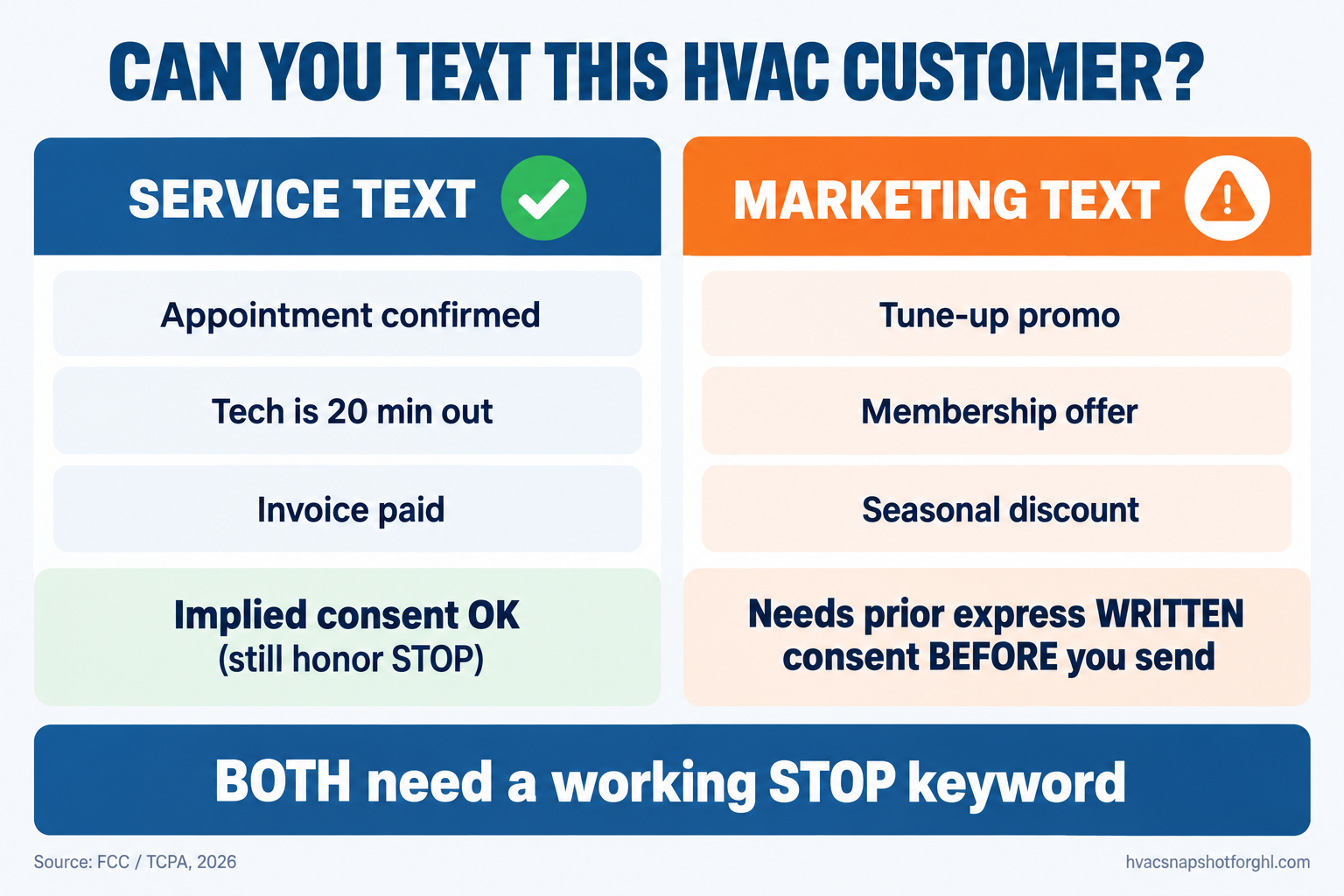
| Message type | Example | Consent you need |
|---|---|---|
| Transactional / service | Appointment confirmed, tech ETA, invoice paid, part is in | Implied consent from doing business with you is enough |
| Informational | Reschedule notice, dispatch delay, warranty reminder | Implied consent, but honor STOP |
| Marketing / promotional | Tune-up special, membership pitch, replacement offer, review request with an ask | Prior express written consent, captured before you send |
A service text, “Your tech Luis is 25 minutes out,” rides on the business relationship, and a homeowner who booked expects it. A marketing text, “Fall furnace tune-ups 20% off,” is different. For that you need prior express written consent: a clear statement agreed to in writing (a checked box, an e-signature, or a texted keyword) before the message goes out (FCC).
Now the two changes that matter for 2026.
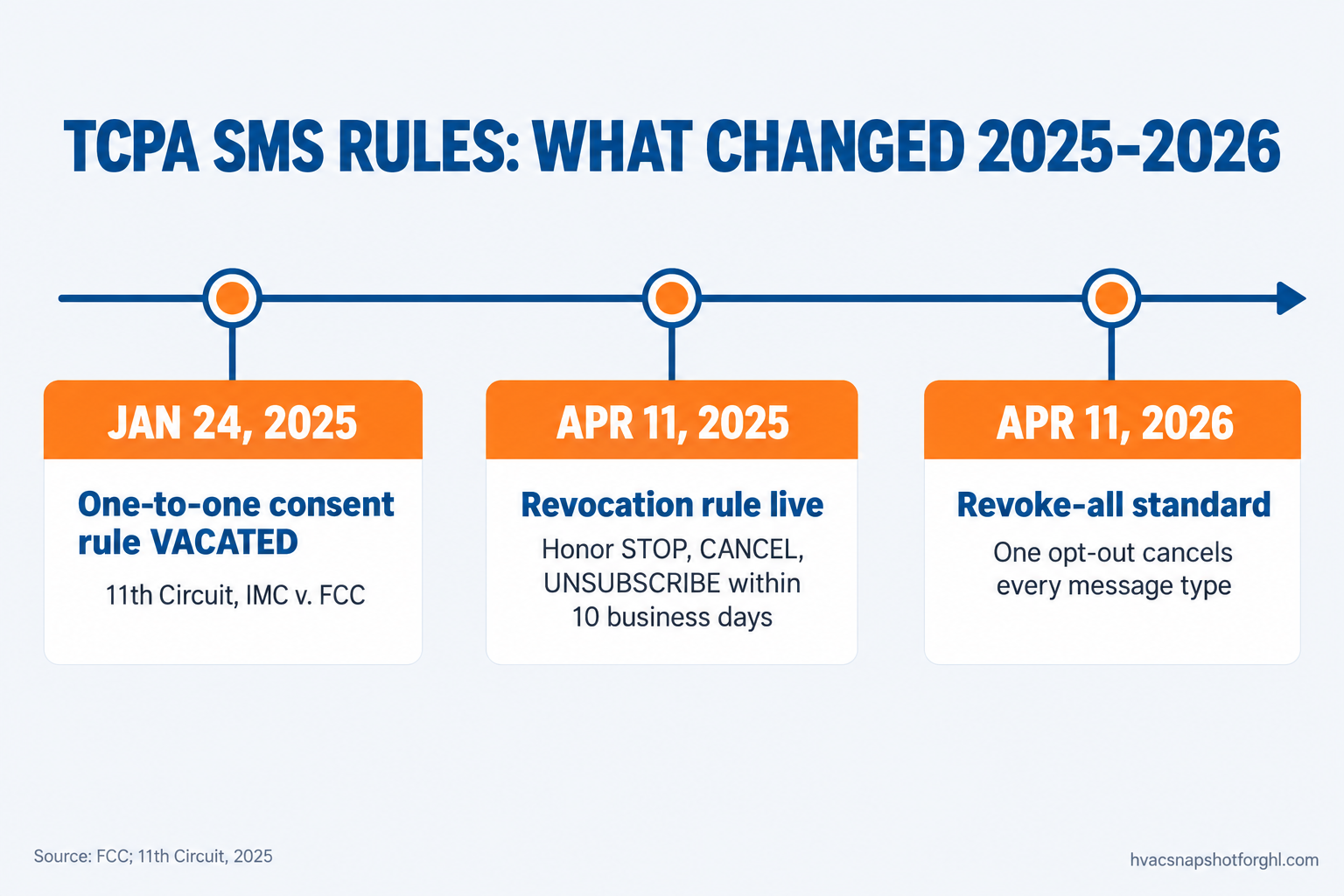
The one-to-one consent rule is gone. In late 2023 the FCC passed a rule that would have forced consent to one specific company at a time, killing the shared lead-form model. A lot of 2024 advice still treats it as live. It is not. On January 24, 2025 the Eleventh Circuit vacated that rule in IMC v. FCC, holding the FCC overstepped, and in April 2025 the FCC said it would not fight the ruling (Morrison Foerster, 2025). The consent standard did not get stricter the way the headlines warned. The ordinary prior-express-written-consent rule still applies, so you still need a clear opt-in, but the extra one-to-one hoop never took effect.
The revocation rule did take effect, and it is the one to prepare for. As of April 11, 2025 you must let customers revoke consent by any reasonable method, recognize the standard keywords (STOP, QUIT, END, REVOKE, OPT OUT, CANCEL, UNSUBSCRIBE), and process an opt-out within 10 business days, down from 30 (Manatt, 2025). You get one confirmation text after someone opts out, with no promotional content, within five minutes. The requirement that an opt-out from one message type cancels all your texts to that person was delayed by a waiver and applies from April 11, 2026 (Kelley Drye, 2025). Treat any STOP as a full opt-out now, because the “revoke all” standard is coming anyway.
One more rule quietly generating a wave of lawsuits: quiet hours. No marketing texts before 8 a.m. or after 9 p.m. in the recipient’s local time zone, under 47 C.F.R. 64.1200(c)(1) (Cornell LII). Plaintiff firms are filing class actions over a single after-9 p.m. promo, so set a quiet-hours window on every campaign, based on the customer’s zip, not your shop’s.
Steal this: the exact opt-in language for every capture point
Consent only counts if you captured it correctly, at the moment you got the number. Here is the wording for every place a number enters your shop. Swap the brackets for your details and keep the disclosures intact.
1. Website booking or contact form (the checkbox). Put this next to an unchecked box. Never pre-check it.
☐ Yes, text me. By checking this box I agree to receive service and appointment text messages from [SHOP] at the number provided, sent by autodialer. Consent is not a condition of purchase. Msg & data rates may apply. Msg frequency varies. Reply STOP to cancel, HELP for help.
2. Marketing opt-in (a separate box, because marketing needs its own yes).
☐ Send me seasonal offers and maintenance reminders by text from [SHOP]. Consent is not a condition of purchase. Msg & data rates may apply. Reply STOP to opt out anytime.
3. Verbal opt-in captured by a tech or the front desk (read it, log it).
“Can we text you appointment updates and the occasional service reminder? Reply STOP anytime to opt out.” (Then log the date, time, and that they said yes.)
4. Keyword opt-in for a yard sign, invoice, or ad.
Text TUNEUP to [NUMBER] for seasonal HVAC offers from [SHOP]. Msg & data rates may apply. Reply STOP to cancel, HELP for help. Consent is not a condition of purchase.
5. The double opt-in confirmation (your first auto-reply after any keyword or form opt-in).
[SHOP]: You’re subscribed to service and offer texts. Up to 6 msgs/mo. Msg & data rates may apply. Reply HELP for help, STOP to cancel.
6. The STOP auto-reply (fires instantly, then you go silent).
You’re unsubscribed from [SHOP] texts and will get no more messages. Reply to this number or call [PHONE] if you need service.
7. The HELP auto-reply (required, returns your identity and contact).
[SHOP] HVAC service. For help call [PHONE] or email [EMAIL]. Reply STOP to unsubscribe. Msg & data rates may apply.
Two things make or break this. First, the consent record: for every number, store what they agreed to, when, and how. If a demand letter ever arrives, that log is your defense. Second, the suppression list: a STOP has to apply everywhere automatically and stick. Do it by hand in a spreadsheet and you will miss one, and the one you miss is the one that sues you. This is what a CRM should enforce for you, which is the point of wiring missed-call text-back and follow-up through a system that logs consent instead of a personal phone.
A2P 10DLC: registering so the texts actually land
You can have perfect consent and still watch your texts disappear. Since 2023 carriers require every business texting consumers from a 10-digit number to register its brand and campaigns with The Campaign Registry. Unregistered traffic in 2026 is heavily filtered, so your Tuesday review-request run quietly delivers to a fraction of the list.
Registration is cheap, and if your system runs on GoHighLevel the fees are published. On HighLevel’s schedule, a sole-proprietor or low-volume brand is about $22.50 one-time, a high-volume standard brand about $64, each extra campaign adds a $15 vetting fee, and monthly campaign fees run from $1.50 to about $10 depending on use case (HighLevel). Other providers quote a similar range, plus a small per-message carrier surcharge near $0.003 (Reverbico, 2026).
A2P 10DLC monthly campaign fee by use case, in US dollars, on GoHighLevel’s pass-through schedule. Source: HighLevel A2P 10DLC fees.
Carriers reject campaigns that cannot show an opt-in path, so the number you text from, the consent language on your form, and the use case you register all have to match. Fix the form first, then register.
Three shops, three consent setups
The solo operator. You text from your personal cell and your “database” is your call history. This is the riskiest setup, because nothing is enforcing anything. You send a promo to everyone who ever called, including the price-shopper who never booked or agreed to marketing, with no record of consent for any of it. The fix is simple: register one sole-proprietor brand (about $22.50), put a consent checkbox on your booking form, and stop sending promos from your thumbs. Keep service and marketing texts separate from day one, because untangling them later is the hard part.
The 5-truck shop. Now an office manager sends blasts and techs collect numbers in the field, so consent is captured three ways with no single record. This is where the spreadsheet breaks. You need one system that captures the opt-in, stamps it with a date and method, and runs STOP suppression across every campaign automatically. Register a standard brand (about $64) and keep separate campaigns for customer care and marketing so a service text never gets filtered as promo. At this size a missed STOP is not a question of if, only which row.
The 15-truck shop. You are a lawsuit target now, because plaintiff firms scan for volume senders and a roll-up competitor would love to see you slip. You need a documented consent record per contact, automated suppression, quiet-hours windows keyed to the customer’s time zone, and a hard rule that marketing never goes to a number without a logged marketing opt-in. Treat it like the licensing file in the HVAC licensing and EPA 608 reference: one auditable source of truth, no human deciding case by case whether a number is safe to text.
How consent breaks, and what it costs you
Compliance is boring until a letter shows up. Where shops actually get hurt, and the fix for each:
You blast marketing to your whole call list. Someone called for a price in 2023, never booked, never opted in, and now gets your spring promo. That is marketing without prior express written consent: $500 a message, up to $1,500 if a court calls it willful (Klein Moynihan Turco). To 1,000 un-consented numbers that is six-figure exposure from one tap. Fix: marketing goes only to numbers with a logged opt-in, enforced by the system, not your office manager’s memory.
A STOP falls through the cracks. A customer texts STOP to the review campaign, then gets next month’s membership promo because that lived in a different tool. Post-April 2025 that is a revocation you failed to honor, and the “revoke all” standard makes it worse in 2026 (Manatt, 2025). Fix: one suppression list across every campaign, automatic and permanent.
You send after 9 p.m. You schedule a promo at 8 p.m. your time, but part of the list is a zone east, so it lands after 9 p.m. their time. Quiet-hours class actions are being filed over exactly this (Cornell LII). Fix: schedule marketing mid-day, on the customer’s local time.
You never registered for 10DLC. No lawsuit, just slow bleed. Your texts deliver at a fraction of the rate, your review requests stop working, and you blame the message when the problem is the plumbing. Fix: register before you rely on texting for anything.
Your consent language is missing a piece. No “msg & data rates may apply,” no STOP instruction, a pre-checked box, or consent bundled with “and our partners.” Each gap is a crack a lawyer pries open. Fix: use the exact language above, unchecked boxes, one company per opt-in.
Objections and honest answers
“I’ve texted customers for years and nothing happened.” Survivorship talking. Exposure is per message and it takes one recipient with a TCPA lawyer, and those lawyers advertise. “Nothing yet” is not a compliance program, it is a bet you re-place every time you hit send.
“They gave me their number, so I can text them, right?” For service updates, usually yes, that is implied consent. For marketing, no. A number on an invoice means they did business with you, not that they agreed to promos. Two different permissions, and marketing needs the written one.
“Won’t a consent checkbox kill my opt-in rate?” Barely. A customer booking a repair will check a box to get appointment texts, because they want the ETA. You lose a sliver of marketing opt-ins and you gain a list you can legally text, which is worth far more than a big list you cannot. One clean opt-in beats a thousand risky ones.
“My CRM handles all this, doesn’t it?” Maybe not. Plenty of tools let you import a list and blast it with zero consent checks, because the liability is yours, not theirs. Ask three things: does it log consent per contact, does STOP suppress across every campaign automatically, and can it enforce quiet hours by the customer’s time zone? If you cannot answer all three yes, you have a sending tool, not a compliance system.
“Can I just skip the marketing texts?” You can, and service-only texting is lower risk. But you would leave the cheapest rebooking channel on the table. Better to do it right once: capture consent at the point of contact, register, and let the system enforce the rules, the same way you wire up a quote follow-up sequence or maintenance-plan renewals to run without you babysitting them.
Frequently asked questions
HVAC SMS consent and opt-in: common questions
Do I need written consent to text an HVAC customer?
It depends on the message. Service and appointment texts (confirmations, tech ETA, invoice paid) run on implied consent from the business relationship, so a written opt-in is not required, though you must still honor STOP. Marketing texts (tune-up promos, membership offers, replacement pitches) need prior express written consent captured before you send, in the form of a checked box, an e-signature, or a texted keyword.
Is the FCC one-to-one consent rule still in effect in 2026?
No. The Eleventh Circuit vacated the FCC's one-to-one consent rule on January 24, 2025 in IMC v. FCC, and the FCC said in April 2025 it would not challenge the ruling. The stricter 2024 lead-form standard never took effect. The ordinary prior-express-written-consent requirement for marketing still applies.
What are the TCPA opt-out rules that changed in 2025?
As of April 11, 2025 you must let customers revoke consent by any reasonable method, recognize standard keywords like STOP, QUIT, CANCEL and UNSUBSCRIBE, and process an opt-out within 10 business days. You may send one confirmation text with no promotional content within five minutes. The requirement that one opt-out cancels all your message types was delayed to April 11, 2026, but the safe practice is to treat STOP as a full opt-out now.
What does it cost to text customers legally with 10DLC?
On GoHighLevel's published schedule, a sole-proprietor or low-volume brand is about $22.50 one-time and a standard brand about $64, each campaign adds a $15 vetting fee, and monthly fees range from $1.50 to about $10 by use case, plus a small per-message carrier surcharge near $0.003. Cheap next to TCPA damages of $500 to $1,500 per message.
What time of day can I send marketing texts?
Between 8 a.m. and 9 p.m. in the recipient's local time zone, under 47 C.F.R. 64.1200(c)(1). Base the window on the customer's zip code, not your shop's location, since quiet-hours class actions are being filed over single after-hours messages.
What happens if a customer texts STOP?
You must stop texting that number across every campaign, automatically and permanently, unless they explicitly opt back in, and process the opt-out within 10 business days. You may send one confirmation reply with no promotional content. A STOP that only unsubscribes one campaign is a gap that becomes a clear violation under the 2026 revoke-all standard.
Do I need 10DLC registration if I already have consent?
Yes. Consent is the legal requirement under the TCPA; A2P 10DLC is a separate carrier requirement that controls whether your texts get delivered. Without registration, carriers filter and throttle your messages regardless of consent.
Back to that Thursday in July. The right answer to your office manager is not “no,” it is “yes, to the people who opted in, from our registered number, before 9 p.m. their time, with STOP working.” That text books jobs and never shows up in a demand letter. Capture consent at the point of contact, register once, and let the system hold the line, the same plumbing behind an AI receptionist for after-hours calls and your seasonal text campaigns.