

You tried to take four days off in October. By Tuesday morning your phone had 19 missed calls, two techs texting “which part number again?”, a customer asking where their invoice went, and your wife at the office trying to cover the dispatch board she’s never run. By Wednesday you were answering calls from a lake cabin. You didn’t take time off. You just moved your office to a worse chair.
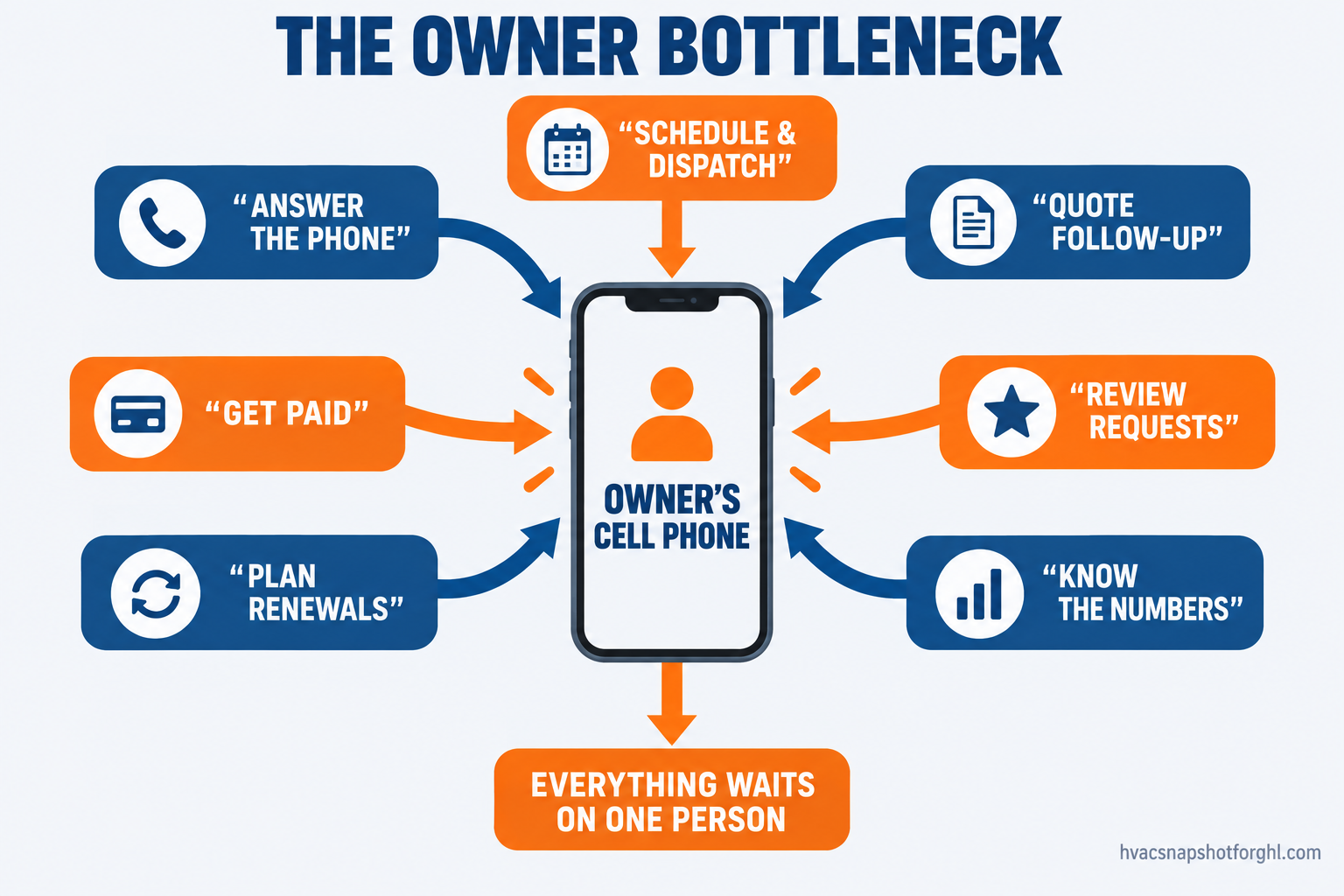
Here’s the thing almost nobody says out loud to the guy who built a 2 to 15 truck shop from the back of a service van: the business doesn’t actually run on your trucks. It runs on you. Every call, every schedule change, every “did we get paid for that one,” every review request, every maintenance renewal, all of it routes through your head and your cell phone. That’s not a work ethic problem. It’s a design problem, and it has a fix. This piece is the fix: the seven jobs that quietly funnel through you, how to hand each one to a system instead of a person, the exact message copy, and the way every stage breaks if you do it wrong.
On this page
- What is the owner bottleneck?
- What being the bottleneck actually costs you
- The 7 jobs that route through you (and how to hand each one off)
- The steal-this message copy
- Run it for three different shops
- The texting rules: TCPA and 10DLC
- Objections, answered straight
- Frequently asked questions
What is the owner bottleneck?
The owner bottleneck is the point where a business can’t move faster than one person can personally handle, because every job, decision, and follow-up still runs through the owner. In an HVAC shop it usually looks like this: you answer the phone, you set the schedule, you decide which quote gets chased, you check whether the ticket got billed, you ask for the review, you remember the renewal, and you’re the only one who knows what the week actually made. Take any of that away and the shop slows or stops.
It feels normal because it’s how you got here. When it was you and one truck, being the hub was efficient. You knew everything because you did everything. But the same habit that built the shop is now the ceiling on it. You can’t grow past what your own day can hold, you can’t get sick, and you definitely can’t leave. The business has a single point of failure, and it’s you.
The fix is not to hire your way out of it, at least not first. Most of what routes through you isn’t skilled work, it’s repeatable work: answering, confirming, reminding, following up, asking. That kind of work is exactly what a system does well and a busy owner does badly, because a system never gets pulled onto a roof mid-task. The move is to take each repeatable job, write down the standard once, and hand it to an automation that runs it the same way every time.
What being the bottleneck actually costs you
This isn’t a mindset lecture. Being the bottleneck has a dollar figure, and most of it hides in the calls you can’t get to.
Start with the phone, because that’s where the money leaks fastest. When you’re the only one who answers and you’re elbow deep in a condenser, the call doesn’t wait. CallRail’s 2025 survey of 1,000 consumers found 78% have abandoned a business after an unanswered call, 82% would call a competitor, and only 42% bother to leave a voicemail (CallRail). So the missed call doesn’t show up as a lost job on any report. It shows up as nothing, which is worse, because you can’t fix a leak you can’t see. Response speed is now the deciding factor: a Housecall Pro report found 97% of homeowners say response time influences which pro they hire (via CallRail, 2026).
Now put a price on it. HVAC shops already pay dearly for each lead: the average cost per lead for HVAC search ads runs about $92.76, higher than most trades (LocalIQ via CallRail). You’re spending real ad money to make the phone ring, then dropping the call because you’re the only one who can pick it up. That’s paying twice to lose once.
Then there’s the cost to you. A FreshBooks survey of North American owners found nearly 40% hadn’t taken a full week off in a year or more, only 15% fully disengage when they do get away, and a separate Clarify Capital survey found 81% check email on vacation (FreshBooks, Clarify Capital). That’s not a badge of honor. It’s a warning light. A shop that can’t run without you isn’t an asset you own, it’s a job you can’t quit, and it’s worth far less the day you try to sell it.
The 7 jobs that route through you (and how to hand each one off)
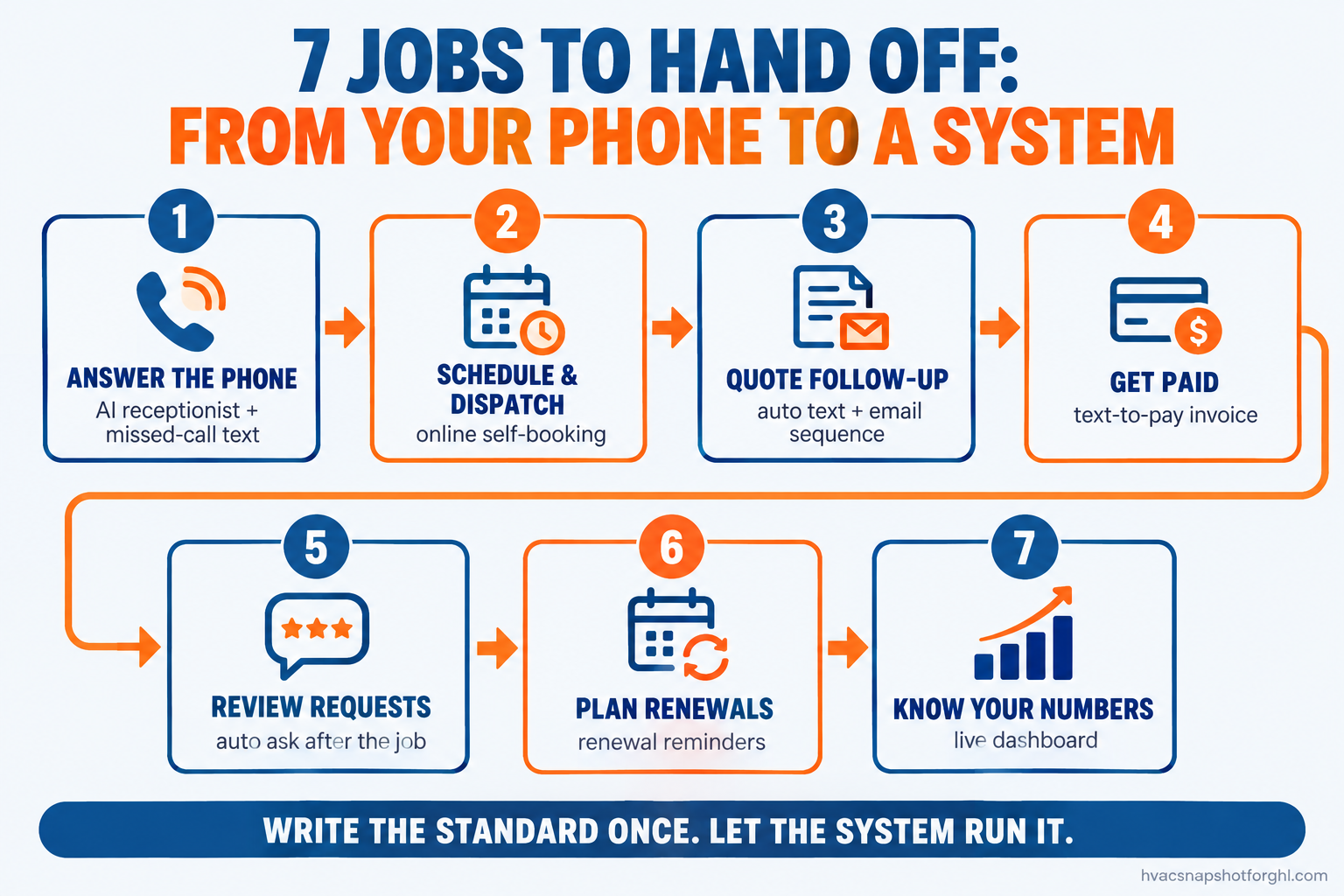
Here are the seven jobs that funnel through you on a normal week. For each one: what it looks like now, what to hand it to, and the part nobody writes down, how it breaks if you do it halfway.
Job 1: Answering the phone
Now: You pick up when you can, miss what you can’t, and the misses vanish without a trace. Nights and weekends, calls roll to a voicemail nobody checks until Monday.
Hand it to: A missed-call text-back that fires the instant you can’t pick up, plus an AI receptionist that answers 24/7, qualifies the caller, and books the job straight onto your calendar. The caller never hits a dead mailbox, and you never see the interruption. We break the math down in the after-hours missed-call piece.
How it breaks: you set up the text-back but point it at a number nobody monitors, so the homeowner texts back and gets silence, which is worse than voicemail. Make sure the reply thread lands somewhere a human or the AI actually works it. Speed only helps if the second step shows up too.
Job 2: Scheduling and dispatch
Now: Every appointment goes through you. A customer wants to move Thursday to Friday, you get the text, you juggle the board in your head, you text the tech. You are the calendar.
Hand it to: An online booking link customers use themselves, tied to real availability, with automatic confirmations and morning-of reminders so slots don’t evaporate into no-shows. The online booking playbook covers how to set the guardrails so customers can’t book nonsense.
How it breaks: you open the calendar wide with no rules, so someone books a two-hour diagnostic into a 30-minute slot across town. Set service durations, buffer time, and a cutoff for same-day, then let it run. The system should book the way you would, not book anything that moves.
Job 3: Chasing the quote
Now: Your tech leaves a $9,000 replacement quote, the homeowner says “let me think,” and that quote dies in your truck console because nobody followed up. You meant to. You were on three other calls.
Hand it to: An automatic follow-up sequence that texts and emails the homeowner on a schedule after the estimate, mixing a check-in, financing reminder, and a soft deadline. This is where financing matters: contractors who offer it close 49% of jobs versus 38% who don’t (ACHR News), especially since 48% of adults can’t cover a $2,000 expense from savings (Federal Reserve, 2024). The full cadence is in our quote follow-up system.
How it breaks: the sequence nags too hard, five texts in three days, and the homeowner opts out annoyed. Space it out, lead with help not pressure, and stop the sequence the second they book or reply. A follow-up that reads like a human checking in beats a machine-gun of reminders.
Job 4: Getting paid
Now: The job’s done, the ticket’s on a clipboard, and the invoice gets sent “when you get to it,” which during July means two weeks later, if at all. You’re the accounts-receivable department between service calls.
Hand it to: Text-to-pay that sends the invoice to the customer’s phone before your tech leaves the driveway, with a reminder sequence on anything unpaid. Money moves while the job is fresh and the customer is happy. See the same-day invoicing and text-to-pay walkthrough.
How it breaks: you automate the send but never the reminders, so unpaid invoices still pile up silently. The reminder cadence is the half that actually collects. Set two or three polite nudges and let them run until the balance clears.
Job 5: Asking for the review
Now: You know reviews matter, you ask for one when you remember, which is almost never, because you’re the only one who’d ask and you’re buried. Your best jobs leave no trace online.
Hand it to: An automatic review request that fires a few hours after the job closes, sends the happy customer straight to Google, and quietly routes an unhappy one to you first so you can fix it before it goes public. Our Google reviews system lays out the timing and the message.
How it breaks: you blast the review ask to every closed ticket including the callback you botched, and earn a one-star for your trouble. Gate it: only send to clean, completed jobs, and give the customer a private channel to vent before the public one.
Job 6: Maintenance-plan renewals
Now: You sold a bunch of agreements, and renewals depend on you remembering who’s up and chasing them. Some lapse. Recurring revenue leaks one forgotten renewal at a time.
Hand it to: A renewal automation that watches the dates, texts the member before expiry, and takes the card on file. This is the revenue that smooths out February, and it should never depend on your memory. The maintenance-agreement template includes the renewal language.
How it breaks: the renewal reminder goes out but there’s no easy way to pay or confirm, so the member means to renew and never does. Make the renewal one tap: a link, a stored card, a confirmation. Friction is where recurring revenue dies.
Job 7: Knowing your numbers
Now: The only place the week’s numbers live is your gut. How many calls came in, how many booked, what the average ticket was, which tech is selling, you feel it, you don’t see it. So nobody else can steer the ship, because the dashboard is inside your head.
Hand it to: A simple dashboard that shows calls, booked jobs, close rate, and revenue in one place, pulled automatically from your CRM. When the numbers live on a screen instead of in your head, someone else can watch them, and you can finally be out of the building. Start with the number that matters most: how many calls turn into booked jobs.
How it breaks: you build a dashboard with 40 metrics nobody reads. Pick the five that actually change decisions, put them where your team sees them daily, and ignore the rest. A number you don’t act on is just decoration.
The steal-this message copy
Half the reason these jobs stay stuck on you is that handing them off feels like you’d lose the personal touch. You won’t, if the automation talks the way you would. Here’s the copy. Swap in your shop name and run it.
Read those again. None of them sound like a robot, and none of them needed you to be sitting there when they went out. That’s the whole trick: the standard is yours, the sending is the system’s.
Run it for three different shops
The seven jobs are the same at every size. What changes is how much you automate versus delegate, and what you fix first.
| Solo / 1-2 trucks | 5-truck shop | 12-truck shop | |
|---|---|---|---|
| Who’s the bottleneck | You, for everything | You plus an overloaded office manager | You, for the decisions nobody else is trusted to make |
| Biggest leak | Missed calls while you work | Inconsistent follow-up and billing | No visibility, jobs handled a dozen ways |
| Fix first | Missed-call text-back + AI receptionist | Booking, quote follow-up, text-to-pay | Dashboard + routing + AI overflow |
| What stays human | You handle the money decisions | Office manager runs exceptions | Ops lead owns the numbers |
| Win to expect | Stop losing calls you can’t take | Office stops drowning, cash comes faster | You can leave for a week and nothing breaks |
Solo operator (1 to 2 trucks). You are every one of the seven jobs, so you can’t fix them all at once and shouldn’t try. Fix the phone first, because that’s the leak that pays for everything else. A missed-call text-back and an AI receptionist mean the calls you physically can’t take while you’re working stop going to a competitor. Once booked jobs start showing up from calls you used to miss, use that money to automate the next job down. One fix at a time, cash-funded.
Five-truck shop. You’ve hired help, usually an office manager or your spouse, and now they’re the bottleneck instead of you, drowning in scheduling, follow-up, and billing done by hand. Your move is to automate the repeatable pieces off their plate: self-booking, quote follow-up sequences, and text-to-pay. That frees your office person to handle the exceptions and the humans, which is what they’re actually good at, instead of retyping the same confirmation 30 times a day.
Twelve-truck shop. Your problem isn’t any single task, it’s that the whole operation still orbits you and nobody can see the full picture but you. You need the dashboard, real routing so calls and jobs flow without you touching them, and AI overflow so nothing drops during the summer surge. Done right, you stop being the hub and start being the owner, the person who reads the numbers and sets direction, not the one answering the phone at 7pm. This is also how you compete with the private-equity roll-ups buying up shops in your market: they run on systems, so you run on systems too.
The texting rules: TCPA and 10DLC
Almost every handoff above sends a text, which is exactly where shops get themselves in trouble. Two rules keep you clean.
First, consent, under the TCPA. The Telephone Consumer Protection Act, enforced by the FCC, governs business texting. When a customer gives you their number and agrees to get texts about their service, that’s your consent, log it with a timestamp. Keep each message tied to the service they asked about, put a clear opt-out in every one, and honor STOP instantly. Appointment, invoice, and renewal texts to a customer you’re already serving are about the safest texting there is, as long as you have and record that consent. Our TCPA and 10DLC guide for HVAC is the full checklist.
Second, A2P 10DLC registration. To send business texts from a regular 10-digit number, carriers require you to register your brand and campaign. Illustrative 2026 costs: a one-time registration around $24.50 for a sole proprietor or low-volume brand (about $71.91 for high-volume), a recurring campaign fee commonly $2 to $10 per month, and a carrier surcharge of roughly $0.003 per message (GoHighLevel A2P fee schedule).
Objections, answered straight
“If I’m not in the middle of everything, won’t quality slip?” It slips now, every time you’re too busy to get to something. The handoff doesn’t lower your standard, it writes your standard down and runs it the same way every time, even on the days you’d have dropped the ball. A system that follows up on every quote beats a great owner who follows up on the ones he remembers.
“I already pay for ServiceTitan or Housecall Pro. Doesn’t it do this?” Those platforms store your customers and can fire some reminders, but they don’t answer the phone when you can’t, they don’t run the after-hours intake, and most shops use a fraction of what they’re paying for. The missed-call answer and the done-for-you automations are a separate layer. If you want to see what you’re actually paying across all of it, our HVAC software pricing teardown lays out the real numbers.
“I’m not technical. I can barely work the one I’ve got.” That’s the point of a done-for-you install. You don’t build the workflows, you don’t wire up the triggers, and you don’t learn a new platform. Someone sets it up for your shop and hands you a system that already runs. Your job after that is to read a dashboard and answer the exceptions, not to configure anything.
“What if the AI books something wrong or says something dumb?” Fair worry, and the answer is guardrails. The AI qualifies and books inside the rules you set, service types, durations, and availability, and anything outside those rules routes to a human. You’re not replacing judgment, you’re handling the 80% of calls that are routine so you can put your attention on the 20% that need it.
Frequently asked questions
What does it mean to be the bottleneck in my HVAC business?
It means the business can't move faster than you can personally handle, because every job, decision, and follow-up routes through you. You answer the phone, set the schedule, chase the quotes, check the billing, and hold the numbers in your head. The moment you're unavailable, the shop slows or stops. It's a design problem, and it's fixable by handing repeatable work to systems.
How do I run my HVAC business without being there all the time?
Take the repeatable jobs off yourself one at a time: missed-call text-back and an AI receptionist for the phone, online self-booking for the schedule, automatic quote follow-up, text-to-pay for invoicing, a review engine, renewal automation for maintenance plans, and a dashboard so someone else can watch the numbers. Write your standard down once, then let the automation run it the same way every time.
What should I automate first in my HVAC shop?
The phone. Missed calls are the fastest, most invisible leak, because an unanswered call usually just disappears with no record. Set up a missed-call text-back and an AI receptionist that answers 24/7 and books jobs onto your calendar. That one fix often pays for the rest of the system, so fund the next handoff with the jobs it recovers.
Won't automating these jobs make my shop feel impersonal?
Not if the automation talks the way you would. The messages carry your shop's voice, fire at the right moment, and always give the customer a way to reach a human. Most homeowners prefer a fast, clear text to a call they have to chase. The system handles timing and consistency, which humans do badly when they're busy, and leaves the real conversations to you.
I already pay for field service software. Do I still need this?
Possibly, because most field service platforms store customers and fire basic reminders but don't answer the phone when you can't, don't run after-hours intake, and often go mostly unused. The missed-call answer and done-for-you automations are a separate layer that sits alongside what you have. Audit what you actually use before adding anything, since many shops pay for far more than they touch.
How long does it take to set up a system like this?
A done-for-you snapshot install goes live in about 24 hours, because the workflows, triggers, and message templates are prebuilt and just configured for your shop. The longer part is you deciding your standards: your booking rules, your follow-up timing, your service durations. Once those are set, the system runs them without you touching anything.
Is it legal to send all these automated texts to customers?
Yes, with consent and registration. Under the TCPA, log consent with a timestamp when a customer gives you their number and agrees to service texts, tie each message to that service, include an opt-out, and honor STOP immediately. Register your number for A2P 10DLC so carriers deliver the texts. Appointment, invoice, and renewal texts to an active customer are low-risk when you have consent and keep records.
It’s October again, and you’re actually at the lake this time. Your phone isn’t dead, it just isn’t the business anymore. The calls you’d have missed got answered and booked. The quotes got followed up. The invoices went out before the trucks left the driveways. The reviews came in, the renewals processed, and your ops lead watched the same dashboard you would have. Monday you’ll come back to a shop that ran fine without you, which is the first time it’s ever been worth what you think it is. The wrench was never the bottleneck. The phone was, and you finally handed it off.