

It’s 7:12am, it’s fourteen degrees out, and the first real freeze of the year landed overnight. Your phone has eleven missed calls before you’ve finished the coffee. A furnace that worked fine in October quit at 3am, and the woman who called is wearing a coat in her own kitchen. Three other people left voicemails. Two of them have already called the shop on the next billboard over, because when a house is cold nobody waits for a callback. By the time you’re dressed you’ve lost two installs you’ll never know you had.
Here’s the short version, the thing most shops learn the hard way after a decade of Januaries. The no-heat rush isn’t a weather problem, it’s a capacity-and-capture problem. The calls are coming whether you’re ready or not, they all arrive in the same forty-eight hours, and the shop that books them isn’t the one with the best techs. It’s the one that answers, triages, and schedules while the other guy’s phone rolls to voicemail. This playbook lays out the five stages of the heating-emergency season, the exact copy to steal, and how each stage breaks so you can fix it before the cold does it for you.
On this page
- What the no-heat rush actually is
- What a dropped no-heat call really costs you
- The five stages of the heating-emergency season
- The steal-this no-heat message pack
- Run it for three different shops
- Staying legal: TCPA and 10DLC
- Objections, answered straight
- Frequently asked questions
What the no-heat rush actually is
The no-heat rush is the compressed stretch of winter, usually the first hard freeze through the deep-cold weeks of January and February, when furnaces and heat pumps fail all at once and every one of those failures is an urgent, often safety-driven emergency call. It’s the heating-season twin of the summer AC rush, but it behaves worse, because a cold house in January is scarier to a homeowner than a warm house in July. People panic faster, they call more shops, and they book the first one that picks up.
What makes it brutal isn’t the total call count, it’s the timing. Demand doesn’t ramp up gently. It sits flat through a mild fall and then a cold front moves in and three days of calls arrive in one morning. Furnace repair searches spike hard the moment temperatures drop, with January the clear peak (WebFX / Stacker). Every shop in your market gets hit at the exact same hour, so the capacity you wish you had and the staff you can actually afford are furthest apart on the worst day of the year.
And unlike a lot of service work, a no-heat call can be a genuine safety issue. A cracked heat exchanger or a venting problem can leak carbon monoxide, which is why the CDC tells homeowners to have heating systems serviced every year by a qualified tech (CDC). That raises the stakes on how you handle the call. You’re not just booking a repair, you’re the shop a scared person reached in a hurry, and how you answer decides whether they trust you with the whole system.
What a dropped no-heat call really costs you
Start with the call you never booked. When a furnace quits in the cold, the homeowner doesn’t leave one voicemail and wait patiently. They work down the list. Speed to the answer is the whole game, and in the first minutes of a cold-house call the shop that responds first usually wins, which is exactly why the speed-to-lead math matters more in winter than any other season. Miss the call, and you’re not behind in line, you’re off the list.
Then stack on what the rush costs you even on the jobs you do book. You can’t hire your way through it. The trade is short roughly 110,000 technicians, and that gap is projected to get worse, not better (ServiceTitan). So the shop that tries to muscle through the surge with overtime pays for it twice: once in time-and-a-half, and again in burnout when the best tech you fought to hire quits in March because you ran him into the ground all winter. The overtime also lands on the customer. Reported after-hours and emergency HVAC rates commonly run $150 to $500 for the dispatch and 1.5 to 3 times the normal hourly rate (PipelineOn), which is fine if the premium covers real cost, and a problem if you’re eating it because your schedule is chaos.
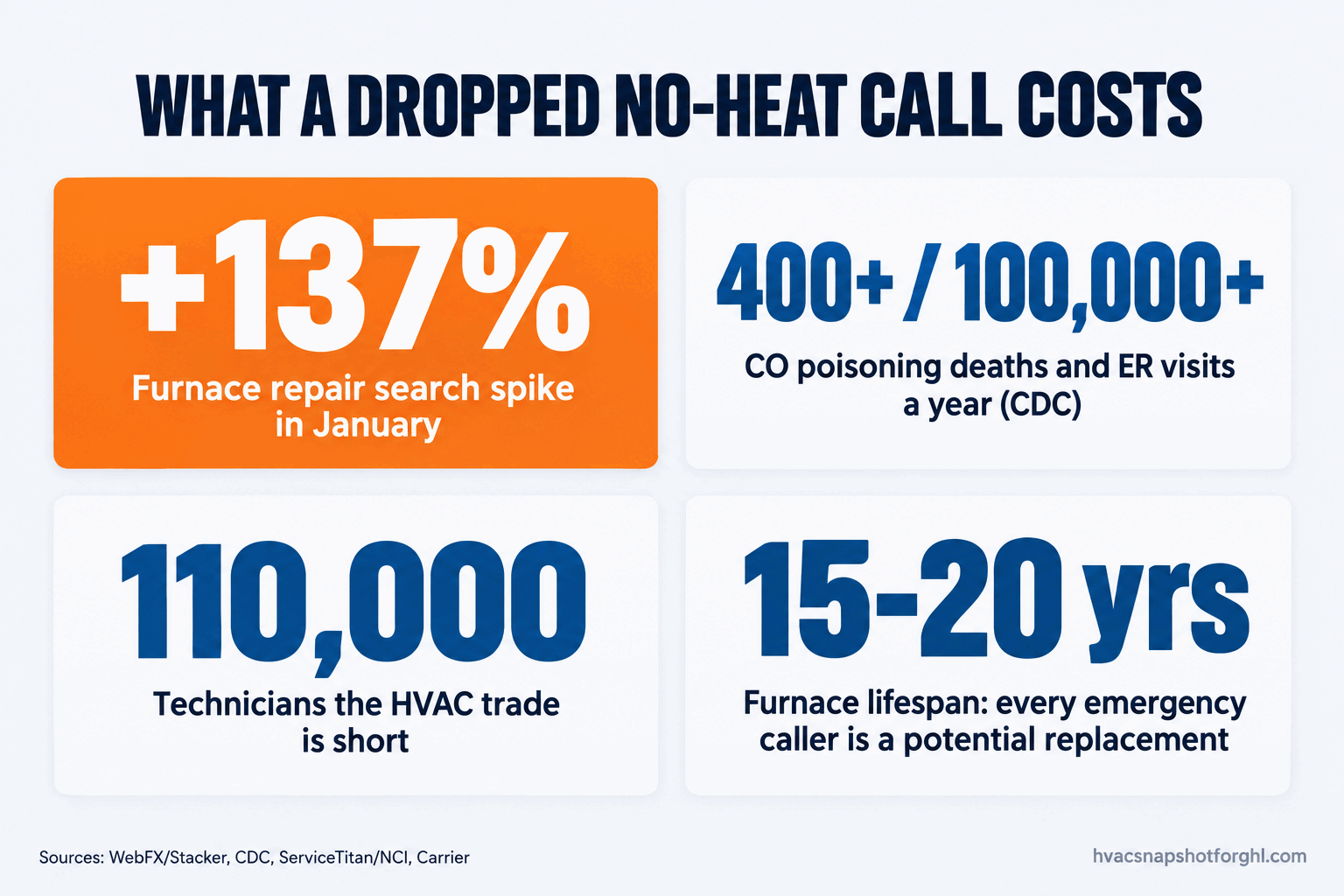
There’s a bigger number hiding behind the small one. A furnace runs 15 to 20 years before it needs replacing (Carrier), and the 3am no-heat caller with a seventeen-year-old unit isn’t a $280 repair, she’s a replacement conversation and a decade of service. There are about 118,433 HVAC contractor businesses in the country, most of them shops your size (IBISWorld, 2025), so the caller has options. Drop her, and you didn’t lose one repair. You handed a competitor the install, the maintenance plan, and every call that house makes for the next fifteen years.
The five stages of the heating-emergency season
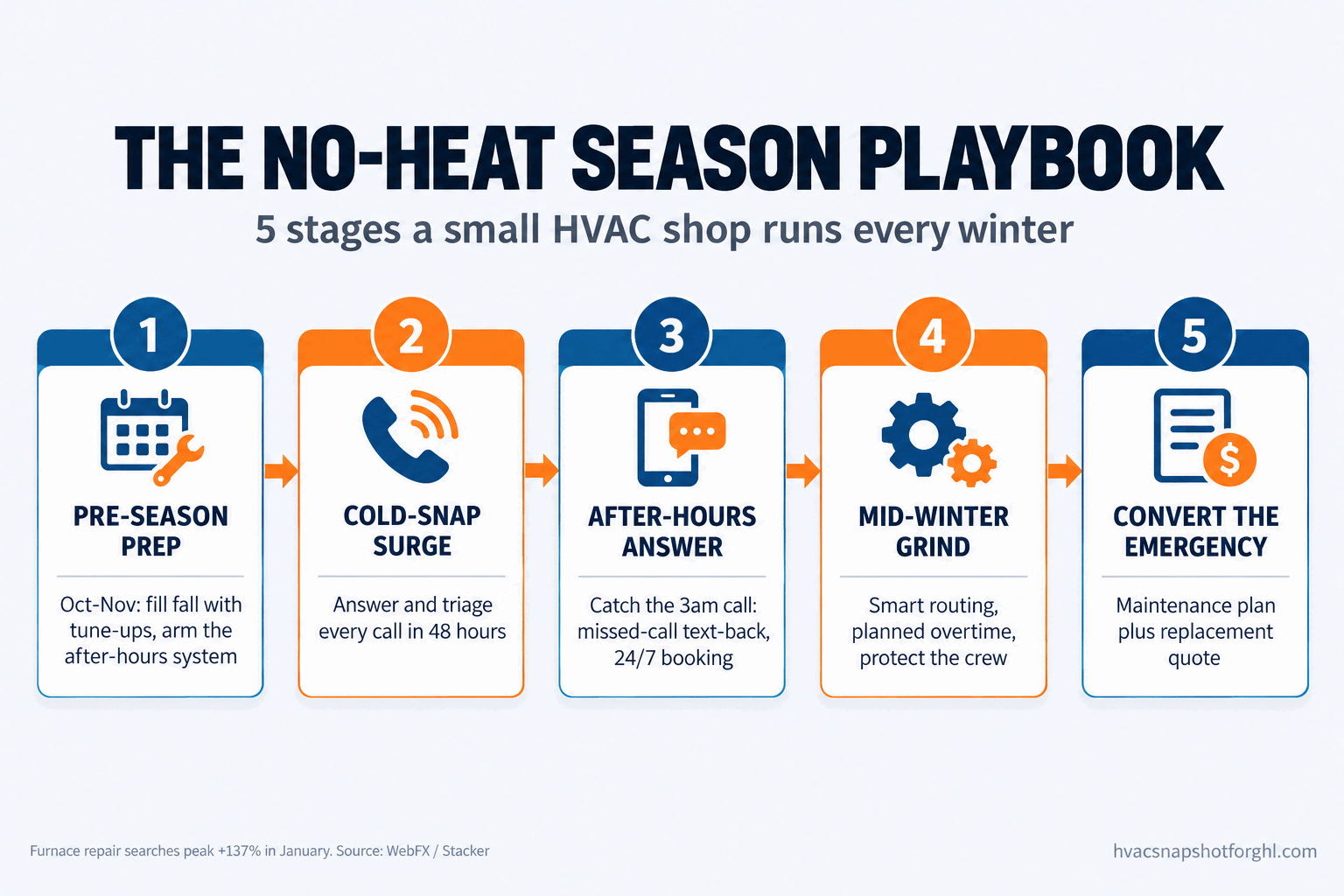
The shops that come out of winter with full trucks and a crew that doesn’t hate them treat the no-heat rush as five distinct jobs, not one long scramble. Each stage has its own failure point, and each failure is fixable before the season starts.
- 1Stage 1 · Oct–Nov
Pre-season prep
Load the schedule with tune-ups and get the after-hours system armed before the first freeze, not during it.
- 2Stage 2 · First freeze
The cold-snap surge
Answer and triage every call in the 48-hour spike so none of it rolls to a competitor's phone.
- 3Stage 3 · Nights & weekends
The after-hours answer
Capture the 3am no-heat call with missed-call text-back and a 24/7 booking path.
- 4Stage 4 · Deep winter
The mid-winter grind
Route jobs, manage overtime, and protect your techs so the crew survives January.
- 5Stage 5 · After the fix
Convert the emergency
Turn the panicked repair into a maintenance plan and, where it's due, a replacement quote.
Stage 1: Pre-season prep, before the first freeze
This is the stage that decides the other four, and it happens while the weather’s still mild. Two jobs. First, fill October and November with heating tune-ups so you catch the dying furnaces before they fail on the coldest night, which spreads the work out and turns would-be emergencies into scheduled visits. Second, arm the systems that catch the surge: the after-hours answer, the missed-call text-back, the online booking link, all tested and live before you need them. The CDC’s own advice to homeowners is to service heating systems yearly (CDC), so the tune-up push isn’t a hustle, it’s the safety message that actually lands in fall.
How it breaks: you mean to set up the after-hours flow but you’re still closing out AC season, so the first freeze arrives and your “system” is a cell phone on the nightstand. Fix it by doing the boring setup in September. A tune-up that finds a cracked heat exchanger in October is a planned replacement with a happy customer. The same crack found at 2am in January is an emergency, a scared family, and a rushed quote.
Stage 2: The cold-snap surge, answer and triage
When the front hits, the whole season’s pressure arrives in about forty-eight hours. The goal here is simple and hard: answer everything, and triage it fast. Not every no-heat call is equal. An elderly customer or a family with an infant in a fourteen-degree house is a same-day priority. A spare-bedroom unit that quit is a next-day booking. Triage is what lets you serve the urgent ones without pretending you can get to all eleven before noon.
How it breaks: the office is drowning, so calls go to voicemail and whoever does get through gets booked in the order they called instead of the order that matters. Fix it with a front-desk script and a booking system that captures the call even when nobody can pick up. The summer call-rush playbook covers the capture mechanics, and they matter more in winter because the stakes on a missed call are higher. Every call that hits voicemail in a cold snap is a job already dialing the next shop.
Stage 3: The after-hours answer, the 3am no-heat call
Furnaces don’t quit at 10am on a Tuesday. They quit overnight when the temperature bottoms out, which means the single biggest leak in the whole season is the after-hours call. A house loses heat at 3am, the homeowner calls, your line rolls to voicemail, and by 3:04 they’ve called someone else. This is where after-hours missed calls quietly cost a shop real money, and in the dead of winter it’s worse than any other time of year.
How it breaks: you rely on a plain voicemail, or you pay for a generic answering service that takes a message and reads from a script that doesn’t know your trade. Fix it with two things working together: an instant missed-call text-back so the caller gets a real response in seconds instead of silence, and an after-hours answer that can actually book or triage. An AI receptionist does this without a $45,000 night-shift CSR, which is the whole reason shops weigh an AI receptionist against an answering service. The point isn’t the tech, it’s that the cold-house caller gets an answer before they dial the competitor.
Stage 4: The mid-winter grind, protect the crew
The surge passes, but deep winter doesn’t. Now it’s six weeks of steady emergency load on a crew that’s already tired, and this is where shops lose their best people. You can’t add techs mid-season in a trade short 110,000 of them (ServiceTitan), so the job is to get more out of the capacity you have without burning it out. That means smart routing so a tech isn’t crossing town twice, honest overtime that’s planned instead of panicked, and taking the dispatch load off the owner so you’re not running the board at 11pm.
How it breaks: everything runs through you and your phone, jobs get double-booked, a tech drives forty minutes to a call another truck passed on the way, and by February the whole crew is fried. Fix it by moving dispatch and scheduling onto a system instead of your memory. When the booking, the tagging, and the routing happen automatically, you stop being the bottleneck and the grind becomes manageable instead of a slow-motion staffing crisis.
Stage 5: Convert the emergency into a relationship
The repair is the beginning, not the end. The customer who was cold and scared at 3am is, right now, the most grateful and most loyal they will ever be. That’s the moment to do two things. For the unit that’s fixable and young, offer the maintenance plan that keeps them from ever having this night again. For the one that’s fifteen-plus years old and limping, start the honest replacement conversation while the pain is fresh, then follow up properly instead of letting the quote go cold.
How it breaks: the tech fixes the furnace, hands over an invoice, and leaves, and the whole relationship ends there. No plan offered, no replacement quote, no follow-up. Fix it by building the ask into the job. A plan offer and a review request fire the day the job closes, and any replacement quote enters a follow-up sequence that closes estimates that go quiet instead of dying in a text thread. This is how a brutal January emergency becomes the steady recurring revenue that carries a shop through the slow season.
The steal-this no-heat message pack
Here’s the copy. Change the shop name, keep the structure. Every message has a clear next step and, where it’s an outbound text, a real opt-out.
The after-hours missed-call text-back (fires automatically the instant a call is missed outside hours):
This is Ace Comfort Heating. Sorry we missed you, we know a cold house can’t wait. Reply YES and we’ll get you in our emergency queue right now, or tap here to book the first open slot: [link]. If this is a gas smell or you feel sick or dizzy, leave the house and call 911.
The front-desk triage line (what the CSR or AI asks, in order):
“I’m sorry, that’s no fun in this weather, let’s get you taken care of. First, any smell of gas, or is anyone feeling dizzy, headachy, or sick? … Okay. Is anyone in the home elderly, or is there an infant or someone with a health condition? … And is the whole house cold or one area? Got it, here’s the soonest I can get a tech to you.”
The CO-safety line (said on every no-heat call, and it builds trust):
“One safety note while you wait: don’t use the oven or a gas range to heat the house, and if you’ve got a generator keep it outside and away from windows. Carbon monoxide is the real winter risk, so we’d rather you be cold for an hour than that.”
The same-day review request (fires when the ticket closes):
Thanks for trusting Ace Comfort tonight, glad we got your heat back on. If the tech did right by you, a quick Google review helps a local shop more than you know: [link]. Reply STOP to opt out.
The replacement-quote follow-up (for the aging unit, text two of a short sequence):
Hi Dana, Marcus from Ace Comfort. That furnace is seventeen years old and it’s telling you it’s tired, better to plan the replacement now than get caught on the next cold snap. Your quote’s good for 30 days and we have install slots this month. Want me to hold one? Reply STOP to opt out.
That pack is five touches that most shops handle with zero. The missed-call text alone is the difference between catching the 3am job and funding your competitor’s January.
Run it for three different shops
The five stages are the same for everyone, but where you spend your energy depends on your size. Don’t try to run the whole thing by hand at any size, automate the stages with the highest payback for where you are.
| What matters most | Solo / 1-2 trucks | 5-truck shop | 15-truck shop |
|---|---|---|---|
| Biggest leak | You can't answer and work at once | Calls scattered, no triage | Nobody owns after-hours |
| Automate first | Missed-call text-back + booking link | After-hours answer + triage tags | Routing + reporting + overflow |
| Overtime risk | You are the overtime | Crew burns out by February | Coordinator must own the board |
| Realistic win | Stop losing the 3am call | Smooth the whole surge | A managed, measured season |
Solo operator. You are the shop, so the moment you’re under a furnace you can’t answer the phone, and in a cold snap that’s every lost call. You don’t need a dispatch system, you need to stop the leak. A missed-call text-back and a self-booking link are the two highest-payback things you can turn on, because they catch the call you physically can’t take and let the customer book while you’re still on the last job.
Five-truck shop. Your calls land but they’re scattered, the office books them first-come instead of worst-first, and your crew is cooked by February. Get an after-hours answer that can triage, tag jobs by urgency and equipment, and route the urgent no-heat calls to whoever’s closest. This is the size where a real system ends the annual “we lost two guys over the winter” conversation.
Fifteen-truck shop. You generate hundreds of winter tickets and the opportunity is enormous, but only if someone owns the board. You need a coordinator running the after-hours overflow, routing so a tech isn’t crossing town twice, and reporting that shows booked-versus-missed by hour so you can see the leak before it costs you a season. At your size the no-heat rush should be a number on a dashboard, not a fire you fight every January.
Staying legal: TCPA and 10DLC
Texting a cold customer back is about as safe as SMS gets, but the rules still bind you, and in a season when you’re firing a lot of outbound texts, getting them wrong is expensive. Two things to keep straight.
First, TCPA and consent. The Telephone Consumer Protection Act governs business texting. The safe path is simple: get express consent, keep a timestamped record of it, and honor opt-outs instantly. When a customer calls you for service and agrees to updates and offers, that’s your consent, so log it at the point of the call. Every outbound message needs a working opt-out, and a STOP has to actually stop the sequence. The missed-call text-back replying to someone who just called you is the safest kind of message there is. The full TCPA and 10DLC guide for HVAC walks the checklist.
Second, A2P 10DLC registration. To send business texts from a regular ten-digit number, carriers require you to register your brand and your campaigns. On GoHighLevel’s published schedule, one-time registration runs roughly $24.50 for a sole-proprietor or low-volume brand and about $71.91 for a high-volume standard brand, with a recurring campaign fee commonly $2 to $10 a month, plus a per-message carrier surcharge of roughly $0.003 per text (GoHighLevel A2P fee schedule). Pennies against a single booked install, but skip registration and carriers quietly filter your texts, so your missed-call reply never arrives and you never know why.
Objections, answered straight
“Won’t an automated text annoy a customer who’s already stressed?” The opposite. A cold-house caller who gets silence assumes you didn’t hear them and dials the next shop. A caller who gets an instant “we know a cold house can’t wait, you’re in our queue” feels taken care of, in seconds, by a shop that’s clearly on the ball. Silence is what annoys people. A fast, human-sounding answer is what calms them down.
“I already pay for ServiceTitan or Housecall Pro, doesn’t it handle this?” Your platform stores the customer and can fire basic reminders, but almost nobody ever built the after-hours triage, the missed-call text-back, and the no-heat sequences, so the capability sits unused because setup never happened. If you’re weighing what you pay against what you use, that’s worth a hard look, but the gap in a cold snap is rarely the software, it’s that no automated answer was ever turned on.
“I don’t want to replace my front-desk person with a robot.” You’re not. A good after-hours answer handles the 3am call your CSR was never going to take anyway, because she’s home asleep like a normal person. During the day your front desk still runs the show. The automation covers nights, weekends, and the surge minutes when every line is lit and a human physically can’t pick up the twelfth call.
“The cold snap only lasts a week, is this worth it?” The week is where a huge share of your winter revenue and your best replacement leads live, and the setup carries the entire heating season, not just the one snap. The after-hours answer you arm in September catches calls every cold night through March. Build it once, and it works every freeze without you touching it.
Frequently asked questions
What is the no-heat rush for an HVAC shop?
It's the compressed winter stretch, from the first hard freeze through the deep cold of January and February, when furnaces and heat pumps fail all at once and nearly every failure is an urgent, often safety-driven emergency call. Furnace repair search demand peaks around 137% in January, and because the calls arrive in tight clusters right after a cold front, the capacity a shop wishes it had and the staff it can actually afford are furthest apart on the worst day of the year.
How do HVAC companies handle the winter emergency call volume?
By treating it as five jobs, not one scramble: pre-season prep that fills fall with tune-ups and arms the after-hours systems; fast answer and triage during the cold-snap surge; an after-hours answer with missed-call text-back for the overnight calls; smart routing and planned overtime through the mid-winter grind; and a convert step that turns the emergency repair into a maintenance plan or replacement quote. Automation does the capture and triage so a small crew can serve the urgent calls first without dropping the rest.
Why are no-heat calls treated as safety emergencies?
A cold house in deep winter is a health risk for the elderly, infants, and anyone with a medical condition, and a failing furnace can be a carbon monoxide hazard. CO poisoning not linked to fires kills more than 400 Americans and sends over 100,000 to the ER each year, and the CDC names furnaces as a source and recommends yearly heating-system service. That's why a good no-heat call includes a quick safety screen for gas smell and CO symptoms before anything else.
How much do emergency after-hours HVAC calls cost?
Reported figures vary by market, but after-hours and emergency dispatch fees commonly run $150 to $500, with emergency hourly rates roughly 1.5 to 3 times the standard daytime rate. Those premiums reflect real overtime cost. The bigger money, though, is in the jobs you never book because the 3am call rolled to voicemail, since a no-heat caller dials the next shop within seconds.
Should a small HVAC shop use an AI receptionist for after-hours calls?
For most small shops, yes, because the alternative is either a plain voicemail that loses the call or a night-shift CSR that costs tens of thousands a year. An AI receptionist answers instantly, runs a safety screen, triages urgency, and books or queues the job 24/7, which is exactly the capability that leaks most in winter. It covers nights, weekends, and the surge minutes when every line is lit and no human can pick up.
Is it legal to text a customer back automatically after a missed call?
Yes. A text replying to someone who just called your business is the safest kind of SMS there is, because they initiated contact. Under the TCPA you still want express consent for ongoing marketing texts, a logged record of it, and a working opt-out in every outbound message, plus A2P 10DLC registration so carriers actually deliver your texts. Always confirm current rules with your provider before you build.
When should a shop set up its no-heat season systems?
In September, before the first freeze, not during it. The after-hours answer, missed-call text-back, and online booking should be tested and live while the weather is still mild. Shops that wait until the cold snap end up running the whole surge off a cell phone on the nightstand, which is exactly when the most valuable calls get dropped.
It’s 7:12am again, fourteen degrees, the first hard freeze of a new winter. Your phone shows the same eleven calls. Except this year, every one of them already got a text back at the minute they called, three are booked into the morning queue by the system that answered while you slept, and the woman in the cold kitchen got a safety note and a slot before she ever thought about calling anyone else. The surge is still coming. It always does. The difference is you built the thing that catches it, back in September when it was easy, so the cold does your competitor’s job for them instead of yours.