
It’s 101°F in Plano, a condenser quits mid-afternoon, and the homeowner does what most people now do before they dial anyone: they open Instagram and Facebook, search a couple of local HVAC names, and glance at who looks active, reviewed, and real. The shop with a live feed, recent reviews, and a face on camera gets the message. The shop with an empty grid and a profile photo from 2019 gets scrolled past — no matter how good its techs are.
Here’s the short version: for a Dallas HVAC contractor in 2026, a consistently-managed presence across every social channel — paired with instant replies to comments and DMs — is no longer optional marketing; it’s where homeowners now discover and vet you before they ever call. The problem is that keeping nine channels active five days a week is a full-time job, which is exactly why most shops start strong and go quiet by week three. This post lays out what a done-for-you social system actually includes, the data behind why it books jobs, and the honest tradeoff versus doing it in-house.
On this page
- Why a managed social presence is now table stakes for Dallas HVAC
- The Dallas reality: a huge, hot, crowded market
- What “done-for-you social media” actually includes
- Why attention only pays when you answer instantly
- The content that actually books HVAC jobs
- DIY vs done-for-you: the honest tradeoff
- Frequently asked questions
Why a managed social presence is now table stakes for Dallas HVAC
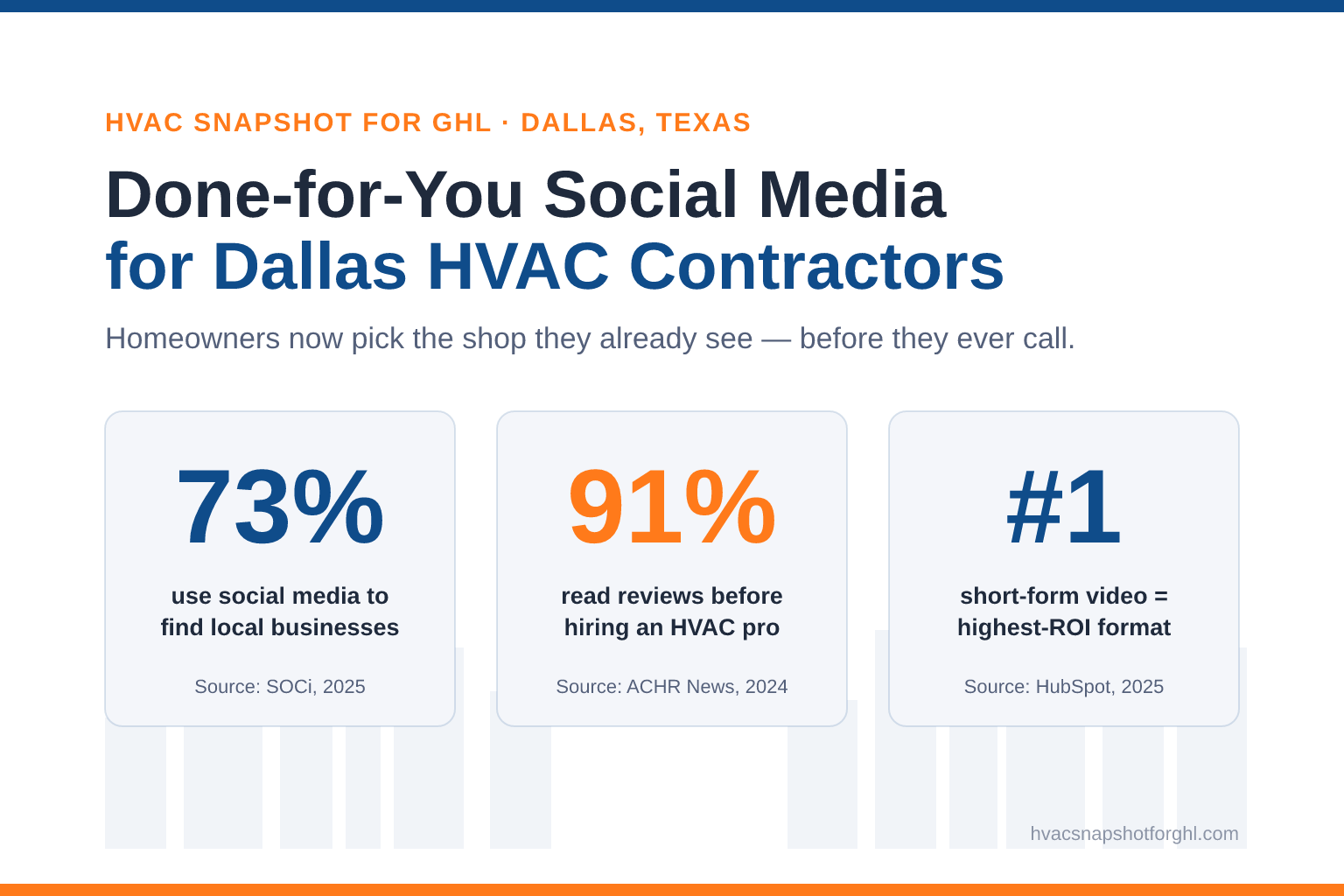
Start with where homeowners actually look. SOCi’s 2025 Consumer Behavior Index found that 73% of consumers now use social media to find and choose local businesses — social sits second only to traditional search and ahead of navigation apps and dedicated review sites (SOCi, 2025). For younger buyers the shift is sharper: 62% of 18–24-year-olds use TikTok to search for local businesses (SOCi, 2024), and Gen Z now bounces across an average of 3.6 apps before settling on one business. Those are the first-time homeowners in Frisco and McKinney buying their first AC replacement — and they’re forming an opinion of your shop on a feed, not a website.
The second half of the discovery story is trust. Homeowners are inviting a stranger into their house and handing over four or five figures for a system swap, so they research first. 91% of homeowners rely on online reviews before picking an HVAC contractor (ACHR News, 2024), and BrightLocal’s 2025 survey found that after Google, consumers increasingly read reviews and check profiles on Facebook (40%), YouTube (34%), and TikTok (20%) (BrightLocal, 2025). Your social profiles aren’t a billboard anymore — they’re the reference check. An active, reviewed, on-brand presence closes the trust gap before the phone rings; a dormant one quietly opens it for the competitor next door.
The Dallas reality: a huge, hot, crowded market
Dallas–Fort Worth is close to an ideal market for this — and a brutal one to stand out in. The metroplex passed 8.34 million residents in 2024, making it the 4th-largest metro in the country and one of the fastest-growing, adding roughly 178,000 people in a single year (U.S. Census / FRED, 2024). The climate guarantees demand: Dallas averages about 22 days a year at or above 100°F, with summer highs sitting in the upper 90s for months (NOAA 1991–2020 normals). When a system fails in that heat, it’s an emergency — and the homeowner books fast, usually with whoever they already trust.
The trouble is that everyone else knows this too. Nationally, HVAC is a $158 billion industry spread across roughly 118,000 contractor businesses (IBISWorld, 2025), and DFW carries thousands of them. The homeowner in that 101°F Plano house isn’t choosing between you and nobody — they’re choosing between you and the four other shops whose vans and feeds they’ve seen. Being visible, active, and instantly responsive is one of the cheapest ways to be the name they already recognize. It’s the same reason strong local SEO and a fast, conversion-ready website matter: you want to own every surface a Dallas homeowner checks before they dial.
The shops winning on social in Dallas aren’t the ones with the slickest production. They’re the ones still posting in month six — while their competitors’ feeds went silent in February and never came back.
What “done-for-you social media” actually includes
“Post more on social” is useless advice for an owner already running dispatch, installs, and 9 PM no-cool calls. A done-for-you system exists to make the posting happen without the owner touching it — a locked content engine, published everywhere, with AI catching every reply. Here’s the whole machine end to end.
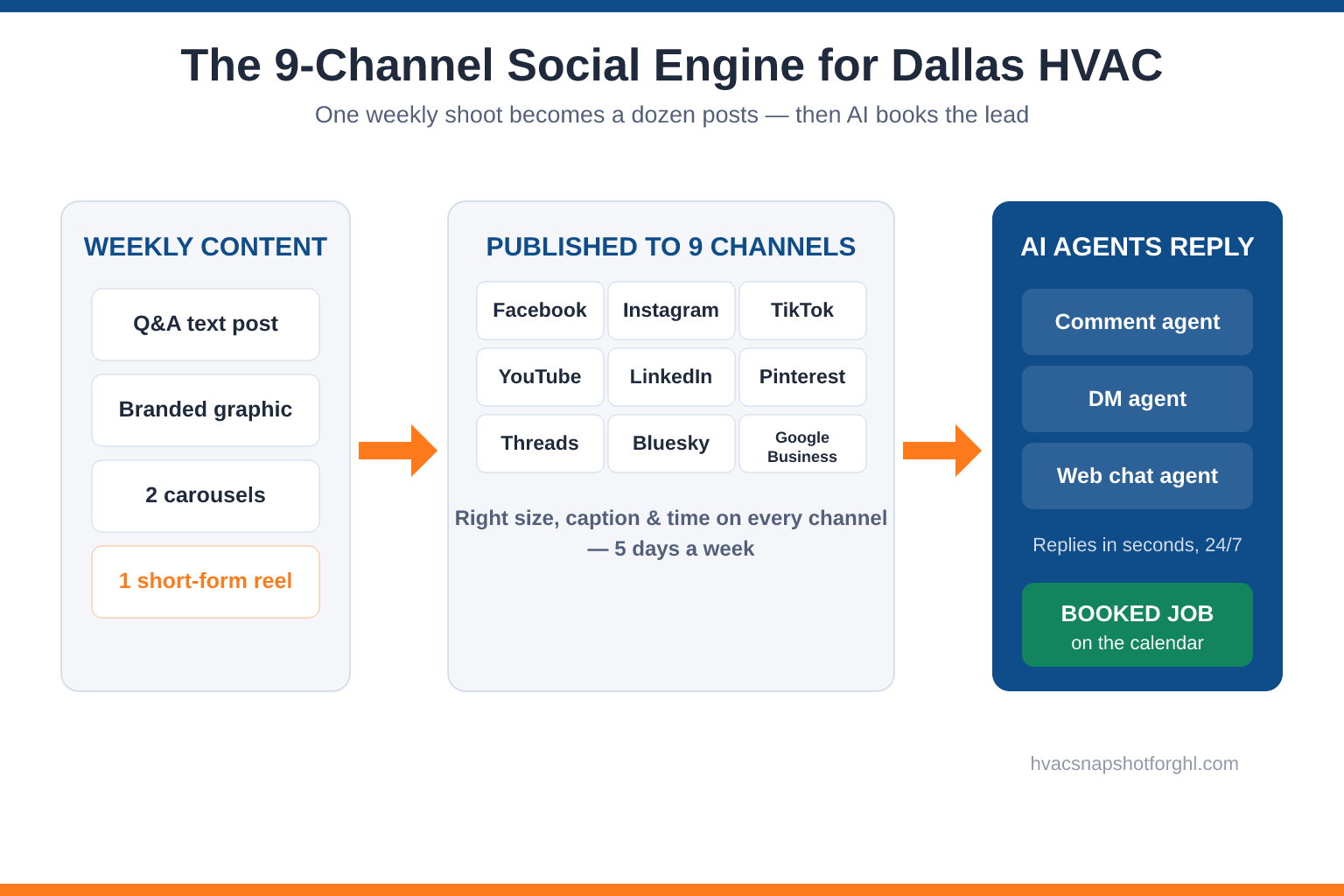
A seasonal content engine, five days a week. The calendar is mapped to the DFW HVAC season — spring AC tune-ups, brutal-summer emergency readiness, fall furnace prep, rebate windows — and written in your shop’s voice. A typical week per brand is one Q&A text post (“Why is my AC freezing up in July?”), one branded graphic (a tune-up offer or financing highlight), two swipeable carousels (the highest-engagement format on Facebook and Instagram), and one short-form reel. One filming session on the truck feeds the whole week.
Publishing across all nine channels. Everything ships to Facebook, Instagram, Google Business Profile, TikTok, YouTube, LinkedIn, Pinterest, Threads, and Bluesky — each at the right size, caption, and posting time. Google Business Profile posts feed the map pack; LinkedIn reaches property managers for light-commercial work; TikTok and Reels reach the young first-time buyers using them as search engines. One shoot becomes a dozen-plus posts.
Three AI engagement agents that never sleep. This is the piece that turns attention into revenue. An AI comment agent replies under your TikTok, Instagram, and Facebook posts; an AI DM agent answers Facebook and Instagram messages, qualifies the homeowner, and books the call; and an AI web-chat agent does the same on your website. High engagement is exactly what the algorithm rewards with more reach — and no missed message means no cold lead.
Monthly reporting you can read in five minutes. A clear per-channel report on the 1st, so you always see what the investment is doing — reach, engagement, DMs, and booked calls attributed to social. That’s the entire loop our done-for-you social media service runs for contractors who don’t have time to film, edit, and answer nine inboxes.
Why attention only pays when you answer instantly
Views and comments are worthless if nobody answers the DM. In home services, speed decides who wins the job. The classic MIT / Lead Response Management study of thousands of leads found that a lead contacted within 5 minutes is about 21× more likely to qualify than one contacted at 30 minutes, and the odds of even reaching a lead drop roughly 100× after the first 30 minutes (MIT, 2007). When a homeowner comments “do you service Irving?” at 9 PM on a Saturday, the shop that replies in seconds books the job; the one that replies Monday morning finds it gone.
No human can watch nine channels around the clock, which is why the AI agents matter more than the content itself. They capture the consent, qualify the homeowner, and drop the booking onto the calendar 24/7 — the same speed-to-lead engine we break down in our San Diego DM automation playbook and our speed-to-lead guide. One note for Dallas shops: the moment an automated conversation moves a homeowner into SMS follow-up, you need TCPA-compliant consent and a registered 10DLC campaign — a proper done-for-you setup captures that inside the chat and only texts homeowners who opted in.
The content that actually books HVAC jobs
Not all posts pull equal weight. When HubSpot asked thousands of marketers which format delivers the best return, short-form video came out #1 for the fourth year running (HubSpot, 2025) — and it converts: 85% of people say a video has convinced them to buy, and 82% of video marketers report a positive ROI (Wyzowl, 2026). For a trade where the buyer can’t judge the work and is nervous about being upsold, 30 seconds of a real tech recovering refrigerant or cleaning a filthy coil builds trust faster than a page of copy. Short-form video also travels: Reels and TikToks routinely reach roughly two to three times more non-followers than static photo posts in third-party benchmark studies, which is how a local shop reaches homeowners who’ve never heard of it.
That doesn’t mean video is the only thing to post. The engine that performs is a mix: reels for reach and trust, carousels for saves and shares, Q&A text posts that answer the exact questions homeowners type (“why is my upstairs so hot?”), branded graphics for offers, and Google Business Profile posts that feed the map pack and your Google reviews engine. Consistency across that mix — not one viral swing — is what compounds. For the full video-specific playbook, see our Atlanta short-form video guide; the same filming loop works on a Dallas job site.
DIY vs done-for-you: the honest tradeoff
Plenty of Dallas shops can run this in-house — the recipe isn’t secret. The real question is whether the owner or a tech will actually do it every week, across nine channels, on top of a full summer service load. Most won’t, which is why the DIY grid goes quiet by week three and the DMs pile up unanswered on nights and weekends. Here’s the honest comparison.
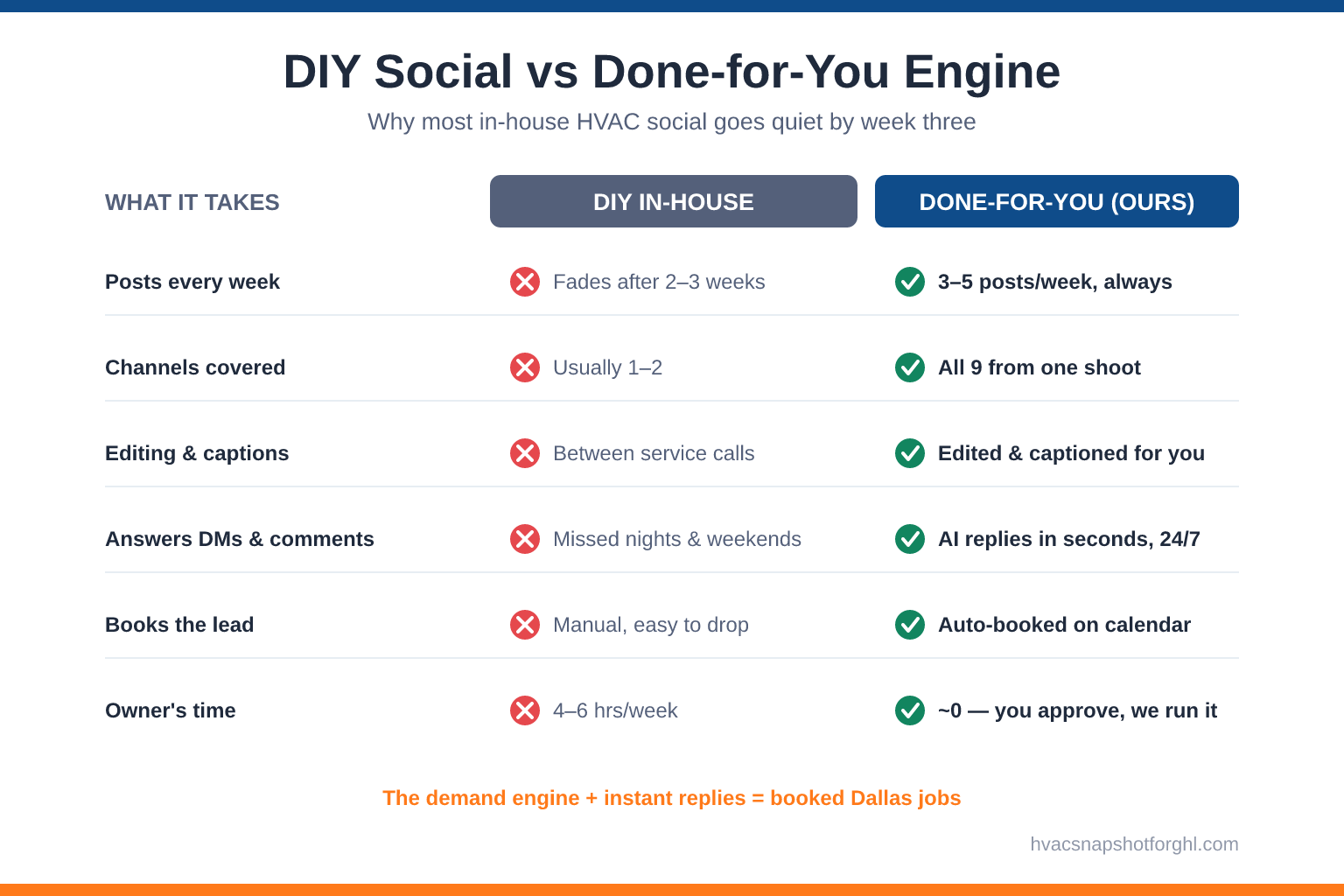
Running social media: DIY vs done-for-you
| What it takes | DIY in-house | Done-for-you (our service) |
|---|---|---|
| Posting cadence | Strong for 2–3 weeks, then fades | 3–5 posts/week, every week |
| Channels covered | Usually 1–2 | All 9 from one shoot |
| Content mix | Whatever there's time for | Reels, carousels, Q&A, offers, GBP |
| Editing & captions | Tech does it between jobs | Edited, captioned, localized for you |
| Answering DMs/comments | Missed on nights & weekends | AI replies in seconds, 24/7 |
| Booking the lead | Manual, easy to drop | Auto-qualified onto your calendar |
| Owner's time | 4–6 hrs/week | ~0 — you approve, we run it |
The math is simple. A consistent presence is the demand engine; instant AI replies and a booking flow are what convert the attention into revenue. Do both every week and you compound — this week’s posts keep getting found while next week’s go up, and every DM lands on the calendar. Skip either one and you’re handing Dallas jobs to the shop that didn’t. If you’d rather own the whole stack — a fast site, CRM, and the automation behind it — that’s the complete HVAC snapshot; if you just want the social engine run for you, that’s done-for-you social media.
Frequently asked questions
How many social channels should a Dallas HVAC contractor be on?
As many as your homeowners use — which in 2026 is effectively all of them. Facebook and Instagram reach the bulk of DFW homeowners, Google Business Profile feeds the local map pack, TikTok and YouTube reach younger first-time buyers who now search those apps for local pros, and LinkedIn reaches property managers for commercial work. The efficient play isn't choosing one; it's producing content once and repurposing it across all nine channels, which is exactly what a done-for-you system automates.
Does social media actually book HVAC jobs, or just get likes?
It books jobs when you pair it with instant replies and a booking flow. Social is now where homeowners discover and vet contractors — 73% of consumers use it to find local businesses (SOCi, 2025) and 91% of homeowners read reviews before hiring an HVAC pro (ACHR News, 2024). But the DM has to be answered fast: a lead contacted within 5 minutes is about 21x more likely to qualify than at 30 minutes (MIT, 2007). Track DMs received and booked calls attributed to social, not likes, and the ROI is clear.
Why not just have someone at the shop post when they have time?
Because 'when they have time' never comes during a Dallas summer. The recurring failure isn't a bad first post — it's inconsistency: the feed goes quiet by week three, and comments and DMs pile up unanswered on nights and weekends when the emergency calls actually come in. A managed system keeps the cadence running five days a week and uses AI agents to answer every message in seconds, so the leads you're paying to generate don't go cold.
Is automated commenting and DMing on social TCPA-compliant?
Public comment and DM replies on social are low-risk, but the moment an automated conversation moves a homeowner into SMS follow-up, you need TCPA-compliant consent, opt-out handling, and a registered 10DLC campaign. A proper done-for-you setup captures consent inside the conversation and only texts homeowners who opted in. See our HVAC TCPA and 10DLC guide before you turn on text follow-up.
How fast does done-for-you social media show results for an HVAC shop?
Expect a ramp, not an overnight spike. In the first month or two your brand voice and content engine go live across all nine channels and the AI agents start catching every reply. Around months three to five the algorithm begins pushing your reels and carousels to new local homeowners and organic reach compounds. By month five-plus, consistent posting plus instant replies make you the obvious local shop and inbound calls from social become measurable and steady. Because you're posting across every channel weekly, you also get dozens of shots at a breakout reel.
About the author
Rachel Okonkwo is a GoHighLevel Automation Consultant based in Columbus, OH. She builds GoHighLevel workflows for home-service contractors and the agencies that white-label for them — review engines, maintenance-plan renewals, AI receptionists, and the comment, DM, and web-chat agents that turn social attention into booked jobs. She writes the implementation-heavy pieces on pipelines, tags, triggers, and the systems that actually pay back inside 30 days.
Related posts
- How Atlanta HVAC Contractors Turn Short-Form Video Into Booked Jobs: A 2026 Reels Playbook
- Why San Diego HVAC Contractors Need Facebook & Instagram DM Automation in 2026
- HVAC Social Media Marketing: The 2026 Playbook to Turn Followers Into Booked Jobs
- Speed to Lead for HVAC: Why the First 5 Minutes Decide Who Wins the Job
- HVAC AI Chatbot: How to Turn Website & Social Visitors Into Booked Jobs