
It’s a 94°F afternoon in Atlanta, a compressor in a Decatur split-level just gave out, and the homeowner does what most people under 45 now do before they open Google: they thumb through Instagram and TikTok, watch a 30-second clip of a local tech recovering refrigerant and explaining a capacitor, and think “these people know what they’re doing.” Thirty seconds of video did what a page of website copy never could — and the shop that posted it is the one that gets the DM.
Here’s the short version: short-form video — Reels, TikTok, and YouTube Shorts filmed on your own job sites — is the highest-leverage marketing an Atlanta HVAC shop can run in 2026, because it’s the content format homeowners actually watch, trust, and use to pick a contractor, and it feeds the same channels where they now search for local pros. This is the step-by-step playbook to produce it consistently, post it across every channel, and turn the views into booked calls — and it’s exactly what our done-for-you social media service runs for contractors who don’t have time to film and edit.
On this page
- Why short-form video is the highest-leverage HVAC marketing in 2026
- The Atlanta reality: a big, hot, year-round market
- The 7-step short-form video playbook for HVAC
- What to actually film (10 ideas that book jobs)
- DIY vs done-for-you: the honest tradeoff
- Frequently asked questions
Why short-form video is the highest-leverage HVAC marketing in 2026
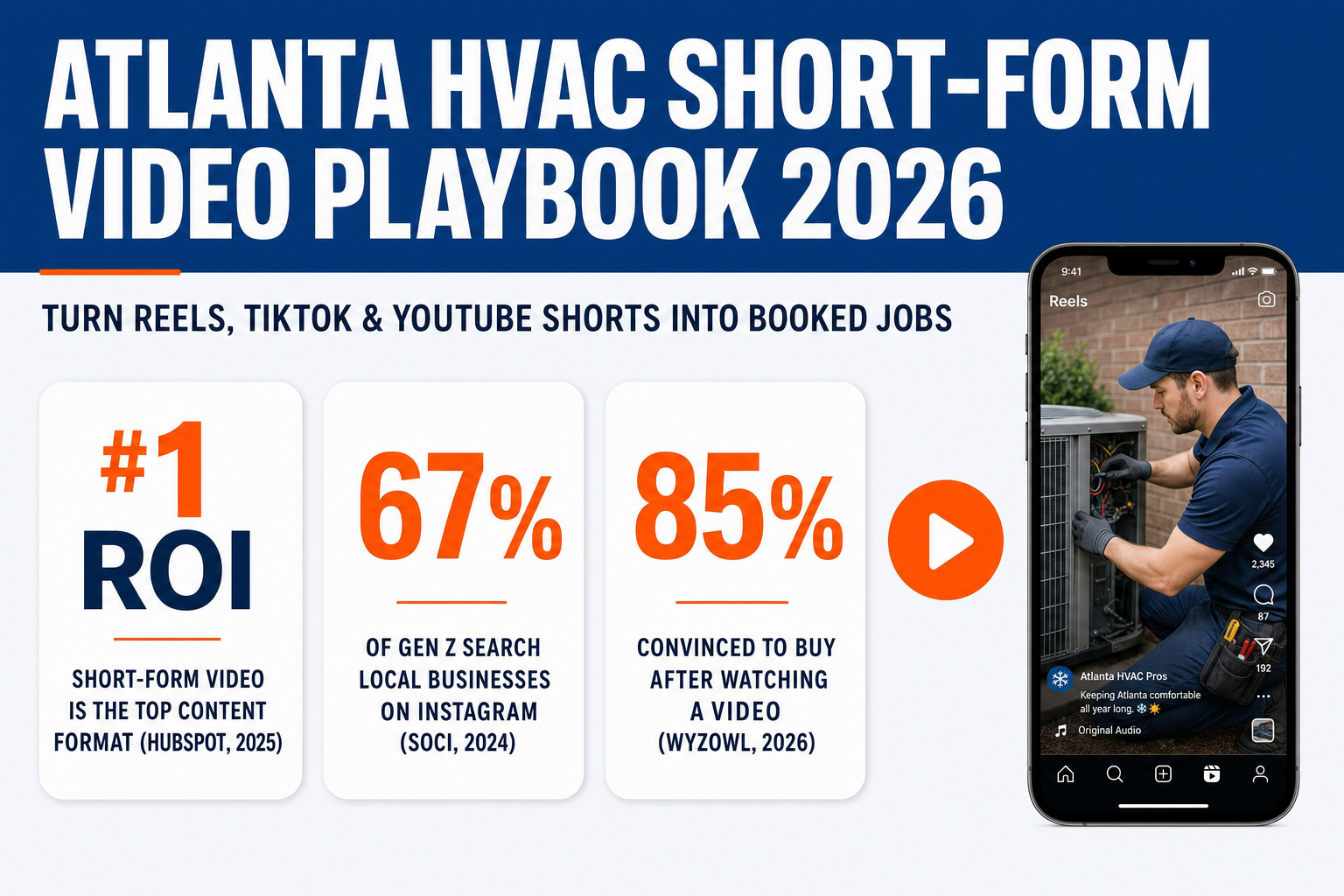
Start with where the money is. When HubSpot asked thousands of marketers which content format delivers the best return, short-form video came out on top for the fourth year in a row — the single highest-ROI format, and the one the largest share of marketers plan to spend more on (HubSpot, State of Marketing 2025). That’s not a trend piece; it’s four straight years of budget voting with its feet.
The reason it works is that video converts in a way text and photos don’t. In Wyzowl’s long-running survey, 85% of people say a video has convinced them to buy a product or service, and 84% want to see more video from the brands they consider (Wyzowl, 2026). For a trade like HVAC — where the buyer is nervous about being upsold, can’t judge the work themselves, and is inviting a stranger into their home — a short clip of a real tech doing careful, competent work is the fastest trust you can build without knocking on the door.
The second shift is bigger than “video is engaging”: social has quietly become a local search engine. SOCi’s Consumer Behavior Index found that among 18–24-year-olds, 67% use Instagram and 62% use TikTok to search for local businesses — putting both ahead of Google for that age group (SOCi, 2024, via Marketing Dive). It’s not just the youngest buyers, either: BrightLocal’s 2025 survey found 40% of 18–24-year-olds now use social networks like TikTok to look up local businesses (BrightLocal, Local Consumer Review Survey 2025). Those are the first-time homeowners and young renters buying their first AC replacement. When they type “HVAC near me” into TikTok instead of Google, the shop with a wall of helpful local Reels is the one that shows up — and the one with an empty grid is invisible.
The Atlanta reality: a big, hot, year-round market
Atlanta is close to an ideal market for this. The metro is home to roughly 6.4 million people and keeps growing (USAFacts / Census, 2024), and its humid subtropical climate means long, punishing cooling seasons — highs near 90°F for months and about 31 days a year over 90°F — followed by real winters that keep the phones ringing for furnaces and heat pumps. Demand is not the problem. Standing out is.
Nationally, there are roughly 120,000 HVAC contractor businesses competing in a $159 billion industry (IBISWorld, 2026), and metro Atlanta carries thousands of them. In a market that crowded, the homeowner isn’t choosing between you and nobody — they’re choosing between you and the four other shops whose vans they’ve seen. A steady feed of short, useful, clearly-local video is one of the cheapest ways to be the shop they already feel like they know. It’s the same reason strong local SEO and a fast, conversion-ready website matter — you want to own every surface where an Atlanta homeowner looks for a pro.
The shops winning on social in 2026 aren’t the ones with the slickest production. They’re the ones that post two or three real, unpolished job-site clips a week, every week, while their competitors post nothing.
The 7-step short-form video playbook for HVAC
Here’s the repeatable system. It’s built so a busy shop can run it in a few minutes a day — or hand the whole thing off. The process flow below is the loop you’ll repeat every week.
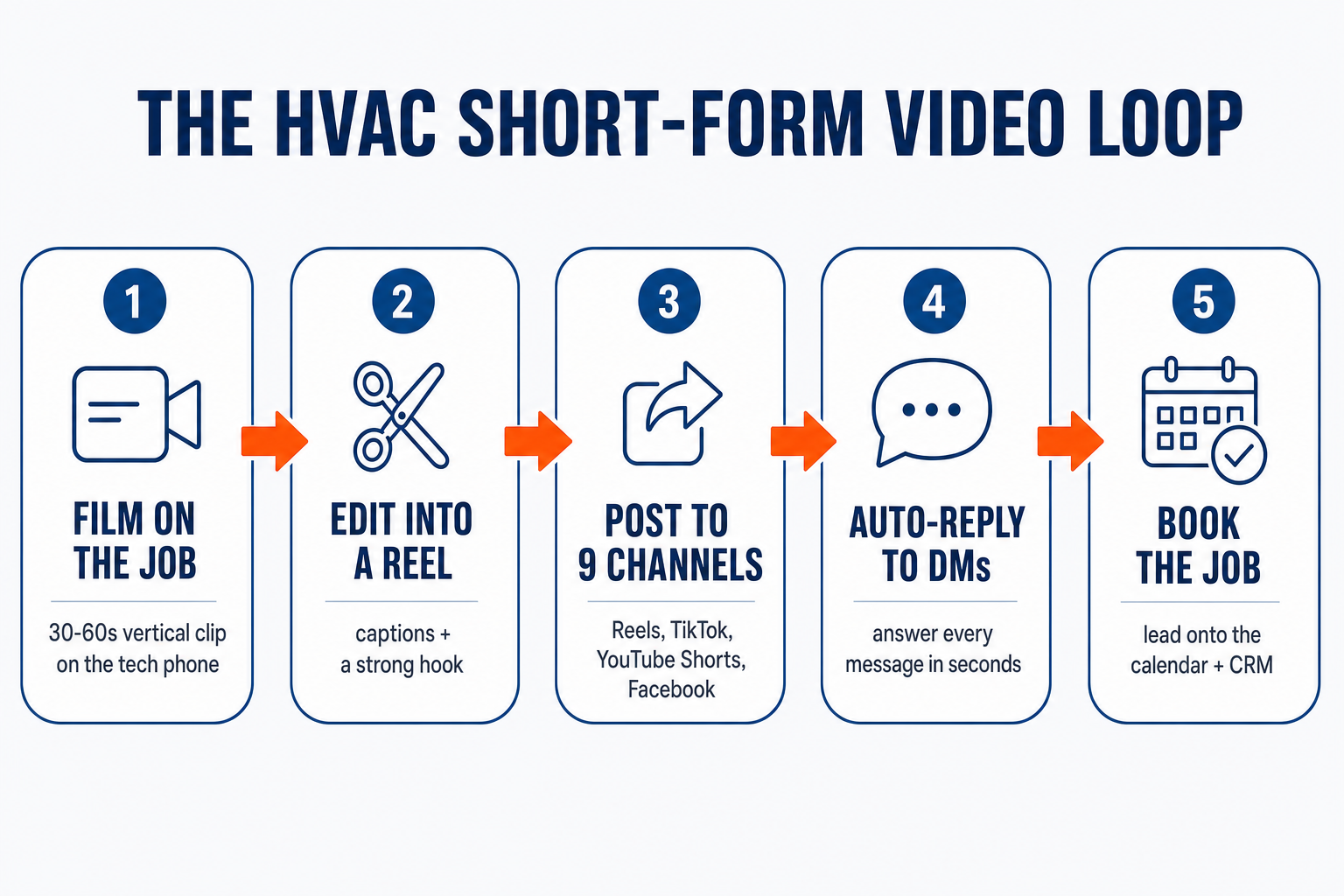
Step 1 — Film on the job (30–60 seconds, vertical, on a phone)
The raw material is already happening on your trucks every day. Have the tech shoot short vertical clips on their phone: the before-and-after of a filthy vs. cleaned coil, a quick “here’s why this capacitor failed,” a time-lapse of a clean install, a homeowner’s honest reaction to a fixed system. No gimbal, no crew. Vertical (9:16), good light, steady hands, and one clear idea per clip. Authentic beats polished every single time in this trade.
Step 2 — Edit into a Reel with captions and a hook
The first 1–2 seconds decide whether anyone watches. Open with the payoff or the problem — “This is why your AC freezes up in July” — not a logo intro. Add burned-in captions (most people watch muted), keep it under 60 seconds, and end with a soft prompt: “Atlanta homeowners — comment ‘TUNE-UP’ and we’ll DM you our summer checklist.” Free apps like CapCut handle the whole edit on a phone.
Step 3 — Localize the caption and hook
This is the step that turns a generic clip into an Atlanta lead magnet. Put the location and the neighborhood in the caption and, where natural, in the spoken hook: “Decatur furnace tune-up,” “why Marietta homes ice up,” “heat pump rebates for Georgia homeowners.” Local keywords help you surface when someone searches the platform for a nearby pro — the exact behavior the SOCi data above describes.
Step 4 — Post consistently across every channel
Consistency, not perfection, drives the algorithm. Buffer’s analysis of more than 52 million posts found that accounts posting 3–5 times a week grow their following roughly twice as fast as accounts posting once or twice (Buffer, State of Social Media Engagement 2026). So aim for 3–5 posts a week and repurpose each clip everywhere it fits: Instagram Reels, TikTok, YouTube Shorts, Facebook, Google Business Profile, and your other social channels. One shoot becomes six-plus posts. This is where most shops fail — they post for two weeks and quit. A done-for-you social media system exists precisely to keep that cadence running across all nine channels without the owner touching it.
Step 5 — Turn on comment and DM automation
Views are worthless if nobody answers the DM. When a homeowner comments “TUNE-UP” or messages “do you service Sandy Springs?”, the reply has to be instant — a lead contacted within 5 minutes is about 21× more likely to qualify than one contacted at 30 minutes (Lead Response Management / MIT, 2007), and 73% of consumers will simply buy from a competitor if a brand doesn’t respond on social (Sprout Social Index, 2025). No human can watch every channel 24/7; AI comment and DM agents can. This is the same speed-to-lead engine we break down in our San Diego DM automation playbook.
Step 6 — Route the lead to a booking
The reply should end in a booked call, not a conversation that fizzles. The automation qualifies the homeowner (“what’s the system doing? what’s your ZIP?”), then drops them onto your calendar or into your AI chatbot’s booking flow — and syncs the whole thread into your CRM so a human can pick up anything complex. Video creates the demand; the booking flow captures it.
Step 7 — Measure what actually matters
Ignore vanity likes. Track the two numbers that pay you: DMs/comments received per week and booked calls attributed to social. If a clip about frozen coils drives ten DMs, make three more like it. Video is a compounding asset — the reel you post today keeps getting found and generating DMs for months, unlike an ad that stops the second you stop paying.
What to actually film (10 ideas that book jobs)
Blank-page paralysis is the real reason shops don’t post. Keep this list in the truck:
- Dirty vs. clean coil before-and-after — the single most-watched HVAC content there is.
- “Why your AC freezes up” — a common problem explained in 30 seconds.
- Clean-install time-lapse — competence you can see.
- Capacitor / contactor swap — “here’s the $15 part that saved a $600 call.”
- Thermostat tips — quick homeowner wins build trust and follows.
- Real customer reaction to a fixed system (with permission).
- “What a tune-up actually includes” — kills the “it’s just a sales visit” objection.
- Seasonal alert — “Atlanta pollen season is here; change these filters.”
- Rebate / financing explainer — pair with our HVAC financing guide.
- Behind-the-scenes / meet-the-tech — the human face homeowners are inviting inside.
DIY vs done-for-you: the honest tradeoff
Plenty of shops can run this themselves — the playbook above is the whole recipe. The question is whether the owner or a tech will actually do it every week, month after month, on top of a full service load. Most won’t, which is why the DIY grid goes quiet by week three. Here’s the honest comparison.
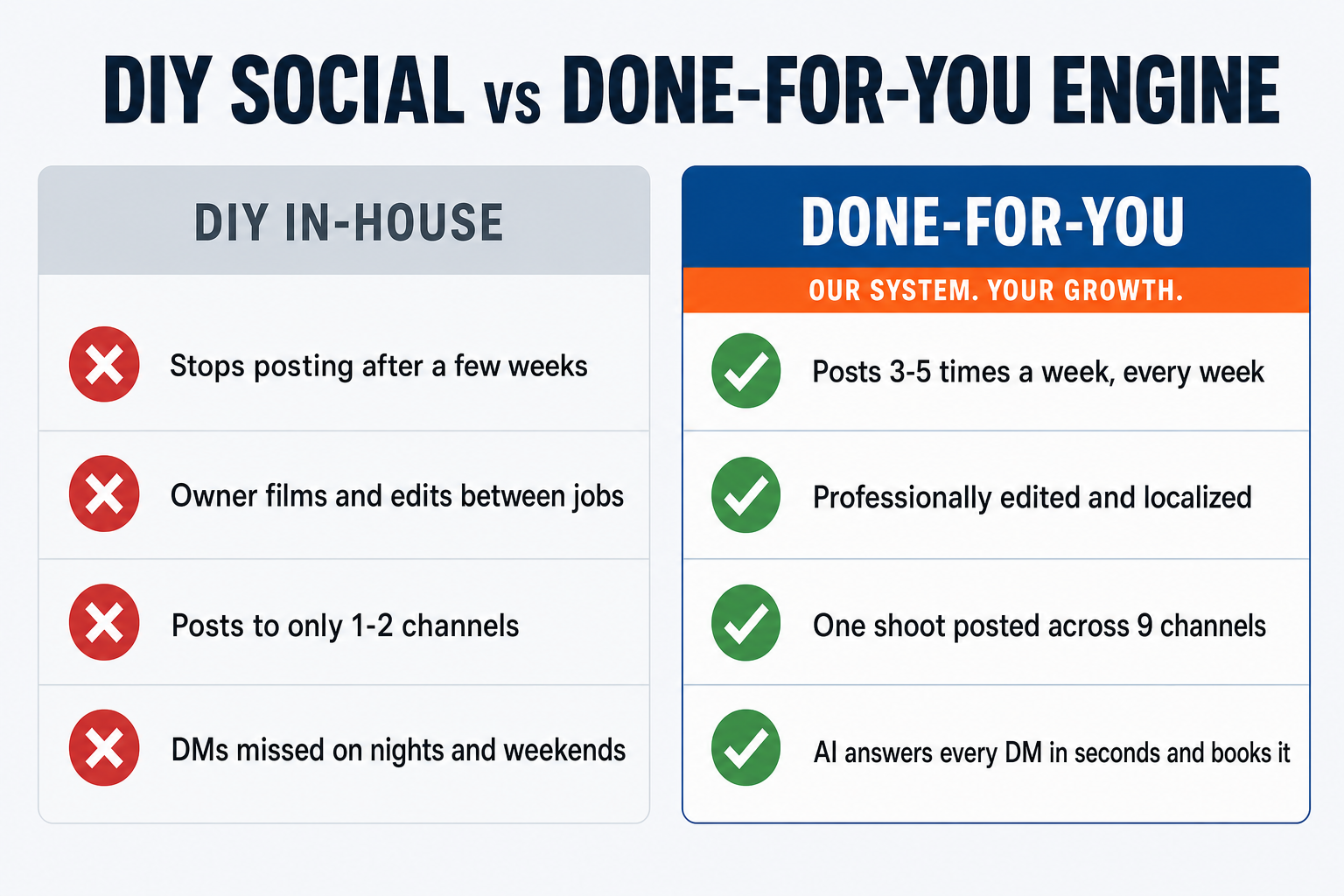
Running short-form video: DIY vs done-for-you
| What it takes | DIY in-house | Done-for-you (our service) |
|---|---|---|
| Posting cadence | Strong for 2–3 weeks, then fades | 3–5 posts/week, every week |
| Channels covered | Usually 1–2 | Up to 9 channels from one shoot |
| Editing & captions | Tech does it between jobs | Edited, captioned, localized for you |
| Answering DMs/comments | Missed on nights & weekends | AI replies in seconds, 24/7 |
| Booking the lead | Manual, easy to drop | Auto-qualified onto your calendar |
| Owner's time | 3–6 hrs/week | ~0 — you approve, we run it |
Short-form video is the demand engine; instant replies and a booking flow are what convert the views into revenue. Do both consistently and you compound — every week’s clips keep getting found while the next week’s go up. Skip either one and you’re leaving Atlanta jobs on the table for the shop that didn’t.
Frequently asked questions
How often should an Atlanta HVAC shop post short-form video?
Aim for 3–5 short clips per week, posted consistently across Instagram Reels, TikTok, YouTube Shorts, Facebook, and your Google Business Profile. Consistency matters more than volume or polish — the platforms reward accounts that post steadily, and one job-site shoot can be repurposed into six or more posts. The shops that win are the ones still posting in month six, not the ones with the fanciest single video.
Do I need expensive gear or an editor to make HVAC Reels?
No. Techs film 30–60-second vertical clips on their phones — a dirty-vs-clean coil, a quick 'why this failed' explainer, an install time-lapse — and a free app like CapCut handles editing and captions. Authentic, unpolished job-site video outperforms slick studio production in the trades because it reads as real. If you'd rather not touch any of it, a done-for-you service directs the shots, edits, and posts everything for you.
Does short-form video actually generate HVAC leads, or just likes?
It generates leads when you pair it with a reply-and-booking system. Video builds the trust and discovery — 85% of people say a video has convinced them to buy (Wyzowl, 2026), and most young homeowners now search Instagram and TikTok for local pros (SOCi, 2024). But the DM has to be answered fast and routed to a booking. Track DMs received and booked calls attributed to social, not likes, and the ROI is clear.
Which platform matters most — TikTok, Instagram, or YouTube?
For a local Atlanta HVAC shop, don't choose — repurpose the same vertical clip to all of them. Instagram Reels and Facebook reach the homeowners already in your service area, TikTok captures younger first-time buyers using it as a search engine, and YouTube Shorts keeps working for months as evergreen search results. One shoot, every channel, is the efficient play.
Is a video-and-DM strategy TCPA-compliant?
Public comment and DM replies are low-risk, but the moment an automated conversation moves a homeowner into SMS follow-up, you need TCPA-compliant consent, opt-out handling, and a registered 10DLC campaign. A done-for-you setup captures consent inside the conversation and only texts homeowners who opted in. See our HVAC TCPA & 10DLC guide for the specifics before you turn on text follow-up.
About the author
Tom Becker is a Home-Services Marketing & Compliance Writer based in Minneapolis, MN. He covers the demand-generation and compliance side of running an HVAC shop — seasonal tune-up campaigns, rebate and tax-credit funnels, and the messaging rules that keep SMS and AI outreach on the right side of the regulators. With a background in heating-season marketing for furnace contractors, he translates dense topics like short-form video, TCPA, and 10DLC into checklists owners can actually act on.
Related posts
- HVAC Social Media Marketing: The 2026 Playbook to Turn Followers Into Booked Jobs
- Why San Diego HVAC Contractors Need Facebook & Instagram DM Automation in 2026
- Speed to Lead for HVAC: Why the First 5 Minutes Decide Who Wins the Job
- HVAC AI Chatbot: How to Turn Website & Social Visitors Into Booked Jobs
- HVAC Local SEO: How to Rank in the Map Pack and Get Found by Nearby Homeowners