
It’s a 91°F Saturday in San Diego, the AC in a Clairemont ranch house just quit, and the homeowner does what most people do now before they ever pick up the phone: they open Instagram, find two local HVAC shops, and send both a DM — “Do you service Clairemont? How soon can someone come out?” The shop that answers in two minutes books the job that afternoon. The shop that answers Monday at 9 a.m. is answering a customer who’s already scheduled with someone else.
Here’s the short version: Facebook and Instagram DM & comment automation is the system that instantly answers every message and comment a homeowner leaves on your social profiles — qualifying them, answering the “do you service my area?” questions, and booking the call onto your calendar 24/7 — so a San Diego shop stops losing jobs to whoever replied faster. In a market this crowded and this reliant on social discovery, it’s one of the highest-return marketing systems a contractor can run — and it’s exactly what the AI comment and DM agents in our done-for-you social media service are built to do. Let’s look at why the math is so lopsided.
On this page
- What is Facebook & Instagram DM and comment automation?
- Homeowners now find and message HVAC shops on social
- The San Diego reality: a crowded, year-round market
- Speed-to-lead is the whole game
- The response-time gap: what homeowners expect vs what shops deliver
- How DM & comment automation actually works
- Comments are public proof — automating them compounds reach
- Keeping automated messaging compliant
- Frequently asked questions
What is Facebook & Instagram DM and comment automation?
Facebook and Instagram DM and comment automation is a system of AI agents that watch your social profiles, reply to every direct message and public comment within seconds, answer common homeowner questions (“do you service my area?”, “how much is a tune-up?”), qualify the lead, and book a service call straight onto your calendar — around the clock, in your shop’s voice. It replaces the reality most shops live with — messages piling up unseen until someone at the office gets a spare minute — with an always-on responder that never sleeps, never takes a lunch break, and never leaves a homeowner on read.
Think of it the way you think of your after-hours phone coverage. You wouldn’t let the office phone ring into a void at 8 p.m. in July — that’s an install walking to the next contractor. A DM sitting unanswered on Instagram overnight is the exact same leak, just on a channel you probably aren’t watching as closely. Automation plugs it on both the public comment thread and the private inbox.
Homeowners now find and message HVAC shops on social
Social media stopped being just a billboard years ago; it’s now a search-and-contact channel. About 40% of consumers use Facebook to find and read local business reviews, and 34% use Instagram (BrightLocal, 2025). More broadly, 37% of consumers now go to social first when they’re looking for reviews and recommendations, and 76% say social content influenced a purchase in the past six months (Sprout Social, 2025). For a homeowner with a dead condenser, “influenced a purchase” means picking which HVAC shop to message.
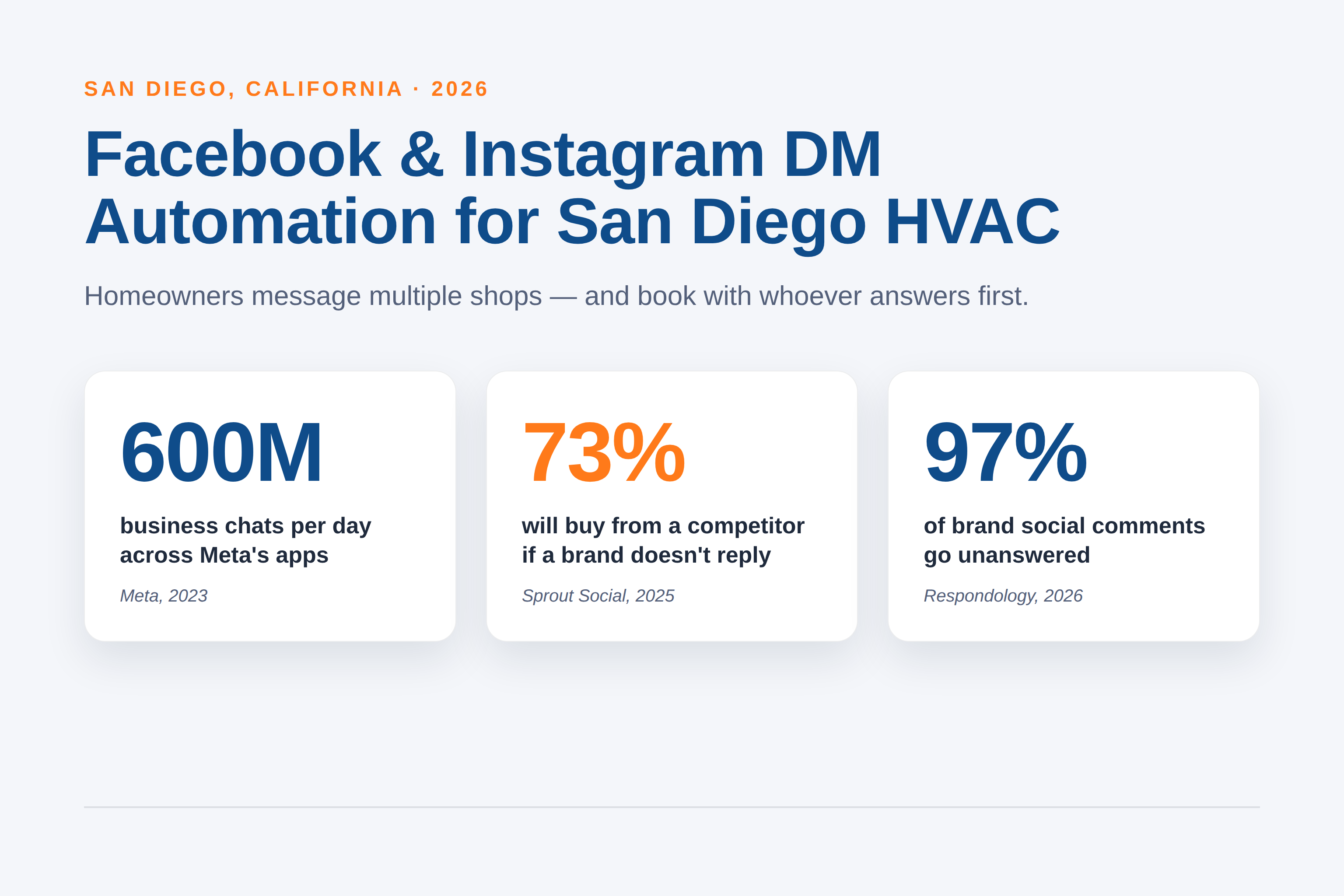
And messaging is where that discovery turns into a conversation. Meta reports roughly 600 million conversations a day between people and businesses across Messenger, Instagram, and WhatsApp (via TechCrunch, 2023), and about 1 billion people message a business every week (U.S. Chamber of Commerce, 2024). This isn’t a fad — consumers have preferred messaging for years. Even back in a Nielsen study Facebook commissioned, 53% of people said they’re more likely to shop with a business they can message directly (Meta / Facebook IQ, 2016). The behavior only got stronger; in 2026, Meta says its business AI now handles roughly 10 million conversations a week, up from about 1 million at the start of the year (TechCrunch, 2026).
The takeaway for a contractor is simple: a growing share of your next jobs will start as a comment or a DM, not a phone call. If your profiles don’t answer, you’re not “missing a message” — you’re missing the lead.
The San Diego reality: a crowded, year-round market
San Diego makes this urgent for two reasons. First, the field is packed. California’s heating and air-conditioning contractor industry is worth roughly $18.6 billion, spread across 13,333 businesses employing more than 65,000 people (IBISWorld, 2026). A San Diego homeowner searching “AC repair” or scrolling Instagram sees a wall of shops with similar-looking profiles. When every option looks comparable, the tiebreaker isn’t your workmanship — the homeowner hasn’t seen it yet. The tiebreaker is who replies first.
Second, San Diego’s climate keeps the phone — and the inbox — busy far more of the year than people assume. The region’s mild Mediterranean pattern means temperatures typically range from the low 50s to the high 70s°F across the seasons, with heat spells that push cooling demand and cooler, damp stretches that drive heating and indoor-air-quality work (Weather Spark, from NOAA normals). There’s no dead season where the messages stop — which means there’s no season where an unanswered inbox stops costing you.
In a market with thirteen thousand California competitors, a San Diego homeowner isn’t choosing the best HVAC shop — they’re choosing the first one that answers. Speed isn’t a nice-to-have on social; it’s the entire competitive advantage.
Speed-to-lead is the whole game
The single most-cited number in lead response comes from a landmark study run by Dr. James Oldroyd (then at MIT Sloan) analyzing more than 15,000 leads and 100,000 call attempts: a lead contacted within 5 minutes is 21 times more likely to qualify — to enter the sales process — than one contacted at 30 minutes, and you’re 100 times more likely to even make contact (Lead Response Management / MIT, 2007). The window is measured in minutes, and it slams shut fast.
That was a study about web-form leads and phones, but it maps perfectly onto social. A DM or comment is a warm inbound lead — the homeowner already found you and raised their hand. The problem is that no human can sit on Facebook and Instagram 24/7 waiting to pounce inside five minutes, especially during a San Diego heat spell when the whole team is on trucks. The 5-minute standard is impossible to hit by hand and trivial to hit with automation — an AI agent replies the moment the message lands, day or night.
The cost of missing that window is documented too. When Harvard Business Review audited 2,241 U.S. companies, it found the average firm took 42 hours to respond to a web lead, and 23% never responded at all (HBR, “The Short Life of Online Sales Leads,” 2011). Firms that reached a lead within an hour were about seven times more likely to qualify it than those that waited even one more hour. Most shops aren’t slow because they’re lazy — they’re slow because answering is a manual task competing with real work in the field. Automation removes the competition.
The response-time gap: what homeowners expect vs what shops deliver
Homeowners’ patience has collapsed while most businesses’ response times haven’t moved. On social specifically, 73% of consumers expect a response within 24 hours, 76% say they value how quickly a brand responds, and — the number that should sting — 73% will simply buy from a competitor if a brand doesn’t respond (Sprout Social Index, 2025). HubSpot’s research is even tighter: 42% of customers expect a reply within 60 minutes on social, and 90% rate an “immediate” response as important — with 60% defining “immediate” as 10 minutes or less (HubSpot, 2024).
Now the reality: in an analysis of 169 million comments, 97% of brand social comments went unanswered (Respondology, 2026 — a comment-automation vendor’s report, but consistent with how thin most shops’ social coverage is). That gap between what a homeowner expects and what the average shop delivers is the whole opportunity. You don’t have to be brilliant on social to win — you just have to answer, fast, every time, while your competitors leave the comment sitting there.
How DM & comment automation actually works
The fix is to take the “watch every channel and reply instantly” job off your team entirely and hand it to AI agents that live on your profiles. Here’s the flow our social media DM and comment agents run:
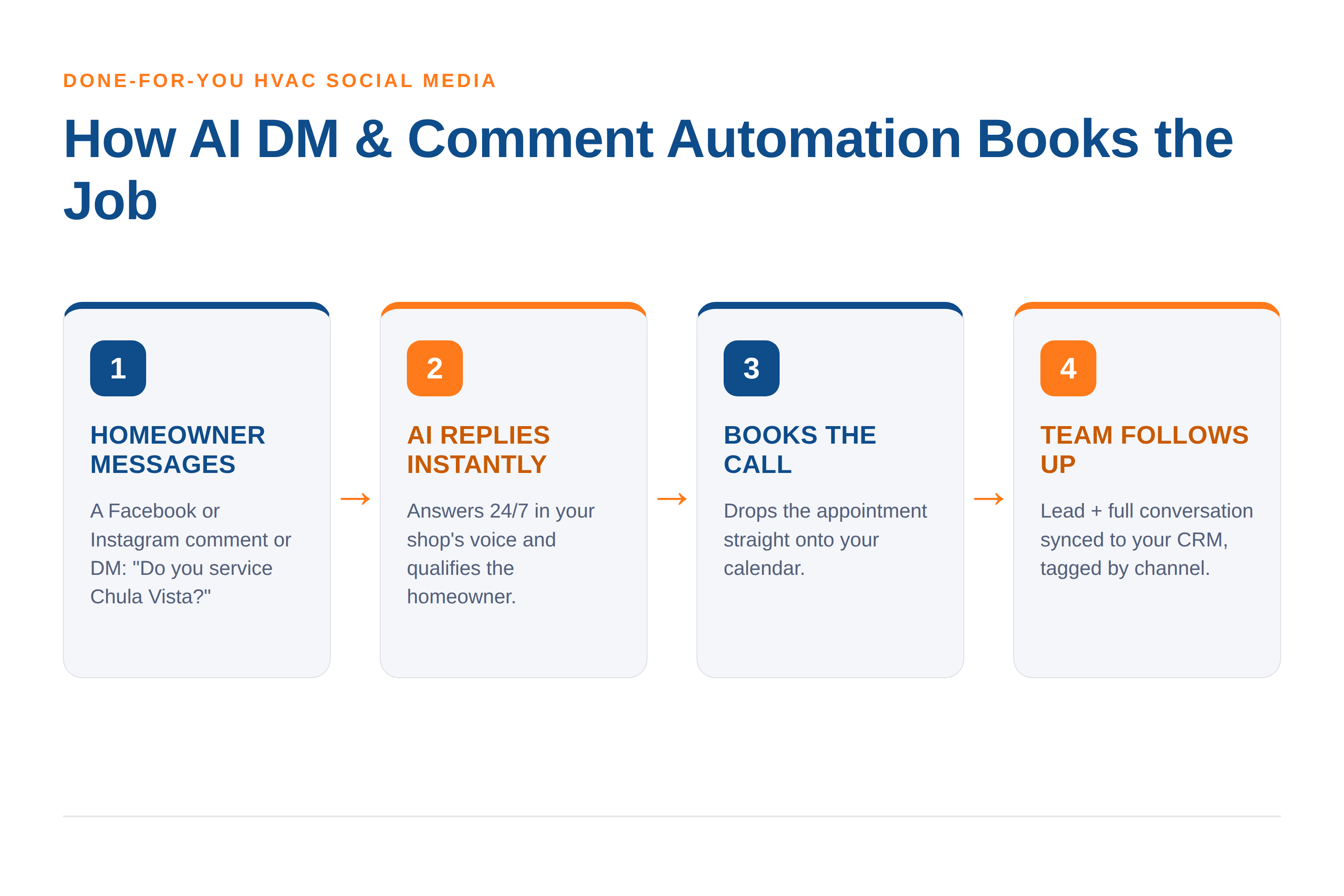
- A homeowner messages or comments. Someone drops a DM or leaves a comment on your post — “Do you service Chula Vista?” or “How much for a mini-split install?” That message is the trigger.
- The AI replies instantly. A comment agent answers publicly under the post, and a DM agent replies in the private inbox — within seconds, 24/7, in your shop’s voice — answering the question and qualifying the homeowner (service area, problem, urgency).
- It books the call. When the homeowner is ready, the agent offers real appointment slots and drops the booking straight onto your calendar — no phone tag, no “we’ll call you back.”
- Your team follows up. The full conversation, the homeowner’s name, phone, email, and the service they asked about all sync to your CRM, tagged by channel, so your office picks up a warm, qualified lead instead of a cold notification.
The result is a responder that hits the 5-minute window on every message, on every platform, at 2 a.m. or during the July rush — without adding a task to anyone’s day. Pair it with the AI chatbot on your website and the same instant-answer coverage extends from social to your site, so no channel goes cold. It’s the social-first cousin of the speed-to-lead system every fast-growing shop is building.
A San Diego HVAC shop's social inbox, before and after automation
DMs and comments pile up until someone at the office has a free minute — usually hours or a day later. 'Do you service my area?' comments sit public and unanswered. Weekend and after-hours messages go cold. The homeowner books with whoever replied first, and you never knew you were in the running.
Every comment and DM gets an instant, on-brand reply, day or night. Homeowners are qualified and booked onto the calendar automatically. Public comment threads look responsive and active. Warm, tagged leads land in the CRM for your team — and the jobs you used to lose to slow replies stay yours.
Comments are public proof — automating them compounds reach
There’s a second payoff most owners miss. Replying to a private DM wins one job. Replying to a public comment wins that job and works as free advertising to everyone else who sees the thread. When a prospective customer scrolls your Facebook or Instagram post and sees the shop answering every “do you service X?” comment quickly and helpfully, that responsiveness reads as trust before they’ve said a word to you.
It also feeds the algorithm. Platforms reward engagement — comments and replies signal an active, worth-surfacing account, which pushes your posts (and especially your Reels and short-form video) to more local homeowners. A comment agent that answers every question under every post keeps that engagement loop spinning instead of letting good posts die with a single unanswered “how much?” in the comments. So automation doesn’t just save the leads you already have — it earns you more reach to generate new ones. That’s the compounding effect we build into our done-for-you social media program, where content and AI agents run together.
Keeping automated messaging compliant
Automating conversations with homeowners means playing by the messaging rules, and this is where a done-for-you setup earns its keep. Public comment replies are low-risk, but the moment an automated conversation moves a homeowner into SMS follow-up, you’re in TCPA and 10DLC territory: you need proper consent, clear opt-out handling (“reply STOP”), and a registered 10DLC campaign for business texting. A sloppy DIY automation that blasts texts without consent is a compliance problem, not a growth strategy.
The right approach captures consent inside the conversation, keeps the audit trail, and only texts homeowners who opted in — all handled by the workflow, not left to memory. We break the rules down in the HVAC TCPA & 10DLC guide, and compliant messaging is wired into how our agents are configured from day one. Done right, you get the speed of automation without the regulatory exposure.
What it’s worth to a San Diego shop
Put the pieces together and the return is hard to argue with. Every DM and comment is a lead you already earned — someone found your profile and reached out. Automation makes sure each one gets answered inside the window that actually converts, on every platform, at every hour, in a market where 13,000-plus California competitors are one reply away. It captures the job, feeds your CRM a warm lead, and — through public replies — advertises your responsiveness to the next homeowner scrolling by.
The alternative isn’t “a few missed messages.” It’s someone else booking the San Diego jobs you were already in the running for, decided by nothing more than who answered first. The shop that automates its inbox isn’t working harder than you — it just built the system once and let it answer every message, day and night, so it never loses the job to a slow reply again.
Frequently asked questions
Facebook & Instagram DM automation for HVAC — common questions
What is Facebook and Instagram DM automation for an HVAC business?
It's a system of AI agents that instantly reply to the direct messages and public comments homeowners leave on your social profiles. The agents answer common questions ('do you service my area?', 'how much is a tune-up?'), qualify the homeowner, book a service call onto your calendar, and sync the lead and full conversation to your CRM — 24/7, in your shop's voice, so no message goes cold.
Why does response speed matter so much on social?
Because homeowners message multiple shops and book with whoever answers first. A lead contacted within 5 minutes is about 21 times more likely to qualify than one contacted at 30 minutes (MIT/Oldroyd, 2007), and 73% of consumers will buy from a competitor if a brand doesn't respond on social (Sprout Social, 2025). No human can watch Facebook and Instagram around the clock; automation hits that window every time.
Will automated replies sound robotic or hurt my brand?
Good automation is configured in your shop's voice and handles the routine, repetitive questions — service area, pricing ranges, availability — instantly, then hands genuinely complex or sensitive conversations to your team. Homeowners overwhelmingly prefer a fast, helpful answer to waiting a day for a 'human' reply. The public comment replies also make your profile look active and responsive, which builds trust with everyone who sees the thread.
Is automated messaging TCPA-compliant?
Public comment and DM replies are low-risk, but once an automated conversation moves a homeowner into SMS follow-up, you need TCPA-compliant consent, opt-out handling, and a registered 10DLC campaign. A done-for-you setup captures consent inside the conversation and only texts homeowners who opted in. See our HVAC TCPA & 10DLC guide for the details.
Does this only help shops in San Diego?
No. The system works for any residential or light-commercial HVAC contractor in the U.S. or Canada — San Diego is just a clear example of a crowded, year-round-demand market where answering first is the whole edge. Our done-for-you social media service deploys the comment, DM, and web-chat agents for any market, and also posts across 9 channels 5 days a week.
How is this different from just having someone check the inbox?
Speed and consistency. A person checking the inbox a few times a day still misses the 5-minute window and goes dark nights and weekends — exactly when many homeowners message. The average business takes 42 hours to respond to an online lead and 23% never respond at all (HBR, 2011). Automation answers every message in seconds, every day, without competing with the real work your team is doing in the field.
About the author
Tom Becker is a Home-Services Marketing & Compliance Writer based in Minneapolis, MN. He covers the demand-generation and compliance side of running an HVAC shop — seasonal campaigns, rebate and tax-credit funnels, and the messaging rules that keep SMS and AI outreach on the right side of the regulators. With a background in heating-season marketing for furnace contractors, he translates dense topics like TCPA and 10DLC into checklists owners can actually act on.
Related posts
- HVAC Social Media Marketing: The 2026 Playbook to Turn Followers Into Booked Jobs
- Speed to Lead for HVAC: Why the First 5 Minutes Decide Who Wins the Job
- HVAC AI Chatbot: How to Turn Website & Social Visitors Into Booked Jobs
- HVAC Lead Nurture: The Follow-Up Sequence That Books the Leads Who Don’t Call Back
- Is Your HVAC AI Receptionist TCPA-Compliant? The 2026 Rules