
It’s 95°F with a Gulf-coast heat index near 108 in Carrollwood, a homeowner’s AC just quit, and they do what nearly everyone does now: they pull out their phone and tap the first two or three Tampa HVAC shops that show up. The site that loads instantly gets the tap-to-call. The site that spends four seconds spinning a logo and loading a slider gets the back button — and that job goes to the shop whose site was faster, not better.
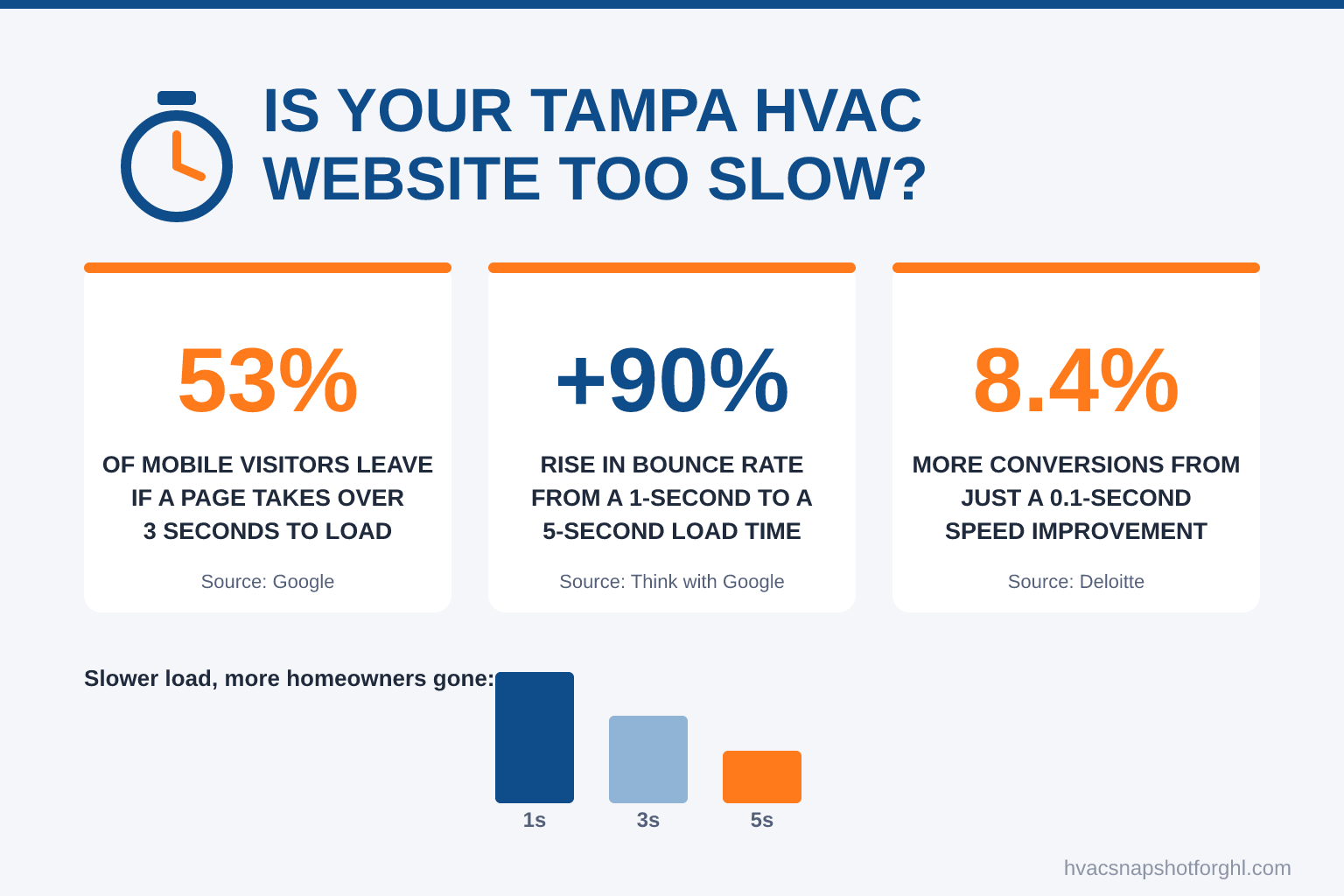
Here’s the short version: for a Tampa HVAC contractor, website speed is a revenue system, not a technical nicety — a slow site loses booked calls before a homeowner ever sees your pricing, your reviews, or your five-star reputation. Google’s own research found that 53% of mobile visits are abandoned if a page takes longer than three seconds to load (Google / Marketing Dive, 2016). In a hot, crowded, phone-first market like Tampa, that’s not a rounding error — it’s half your ad spend leaking out the bottom of the funnel. This is exactly the problem a blazing-fast HVAC website is built to fix. Let’s look at the numbers.
On this page
- What “website speed” actually means for an HVAC shop
- The Tampa reality: a hot, crowded, phone-first market
- How a slow site leaks booked calls
- Speed is money: the conversion math
- Google now ranks you on speed, too
- Why most HVAC websites are slow
- What a fast Tampa HVAC site looks like
- Frequently asked questions
What “website speed” actually means for an HVAC shop
“Website speed” isn’t one number — it’s how fast the page becomes useful on a homeowner’s phone, on Tampa cellular data, in the parking lot outside a job. Google measures three things it calls Core Web Vitals, and they map cleanly onto what a frustrated homeowner feels:
- LCP (Largest Contentful Paint) — how long until the main content (your headline, your call button) actually appears. “Good” is under 2.5 seconds (web.dev, Google).
- INP (Interaction to Next Paint) — how fast the page responds when they tap “Call” or “Book.” “Good” is under 200 milliseconds.
- CLS (Cumulative Layout Shift) — whether the page jumps around as it loads, so they tap the wrong thing. “Good” is under 0.1.
You don’t need to memorize the acronyms. The plain-English version is: does the page show up fast, respond instantly when tapped, and hold still while it loads? When any of those fail, the homeowner is gone before your reviews or your 24/7 booking ever get a chance to work.
The Tampa reality: a hot, crowded, phone-first market
Two things make speed especially load-bearing for a Tampa contractor.
First, the demand is relentless and mobile. Tampa runs a long, brutal cooling season — hot, humid summers with heat indices regularly pushing past 100°F and a mild winter that barely gives the compressors a rest (Weather Spark, from NOAA normals). When an AC dies in that heat, it’s an emergency, and emergencies happen on phones. The homeowner isn’t researching on a desktop over coffee — they’re standing in a hot house, thumb already on the phone, patience already gone. That’s the exact moment a slow site fails.
Second, the field is packed. Florida’s heating and air-conditioning contractor industry spans roughly 10,579 establishments employing about 45,759 people (IBISWorld, 2026), part of a U.S. industry worth about $159.4 billion across more than 120,000 businesses (IBISWorld, 2026). A Tampa homeowner searching “AC repair near me” sees a wall of shops with similar names and similar promises. When every option looks comparable on the search results page, the tiebreaker isn’t your craftsmanship — they haven’t experienced it yet. The tiebreaker is which site loads and lets them call.
In a market with ten thousand Florida competitors, a Tampa homeowner in a 95-degree house isn’t grading your workmanship — they’re tapping the first site that opens. A four-second load is a door you closed on a customer who was ready to buy.
How a slow site leaks booked calls
The leak isn’t dramatic. There’s no error message, no crash — just a homeowner who taps back and calls the next shop, and a booking you never knew you were in the running for.
Google quantified exactly how fast that happens: as page load time goes from one second to three seconds, the probability of a bounce increases 32%; to five seconds, 90%; to six seconds, 106%; and to ten seconds, 123% (Think with Google, 2017).
Now stack that on top of the 53% who already leave after three seconds. A slow HVAC site doesn’t lose a few visitors — it compounds. It loses the impatient half at the three-second mark, then keeps shedding the rest as the seconds tick by. And this is the traffic you paid for: the Google Local Services click, the Facebook ad tap, the Google Business Profile visit. Every one of those costs money to earn, and a slow page throws a chunk of it away at the door.
Speed is money: the conversion math
Bounce is only half the story. The visitors who do stay convert at wildly different rates depending on speed. In a Portent analysis of more than 100 million page views, sites that loaded in under two seconds converted at 3.05%, versus 1.94% for sites loading in three to four seconds — and conversions dropped roughly 4.42% for every additional second of load time between zero and five seconds (Portent, 2022). For an HVAC shop, “conversion” is a booked service call. That gap between 3.05% and 1.94% is the difference between a site that pays for itself and one that quietly wastes your marketing budget.
Google and Deloitte found the same effect from the opposite direction. In their “Milliseconds Make Millions” study of 30 million sessions, a 0.1-second improvement in mobile site speed lifted retail conversions 8.4% and travel conversions 10.1% — and for lead-generation pages (the closest analog to an HVAC booking form), it cut the bounce rate 8.3% and raised page views 21.6% (Deloitte / Google, 2020). One-tenth of a second. That’s how sensitive a homeowner’s decision is to how fast your page feels. Speed multiplies everything upstream of it — the same way speed-to-lead multiplies every lead once it’s in your CRM.
Google now ranks you on speed, too
A slow site doesn’t just lose the visitors who arrive — it earns fewer of them in the first place. Core Web Vitals are a confirmed Google ranking signal. They won’t outrank genuinely better content on their own, but they act as a tie-breaker between comparable pages, and Google evaluates them on real visitor data at the 75th percentile — meaning 75% of your actual visits have to hit “good” for the page to pass (web.dev, Google).
Here’s the opportunity: most shops fail. Only about 47% of sites reached Google’s “good” thresholds in 2026, and INP — responsiveness to taps — is the most commonly failed metric, with 43% of sites missing the 200ms mark (corewebvitals.io, 2026). In a Tampa market where the top of the map pack is fiercely contested, being in the fast half is a real, measurable edge on the very local searches that drive emergency HVAC calls. Speed helps you rank, and ranking gets you the click — which then has to load fast enough to keep. It’s a loop, and a fast site wins at every step. That ranking edge is the foundation HVAC local SEO is built on.
A Tampa HVAC website, slow vs. fast
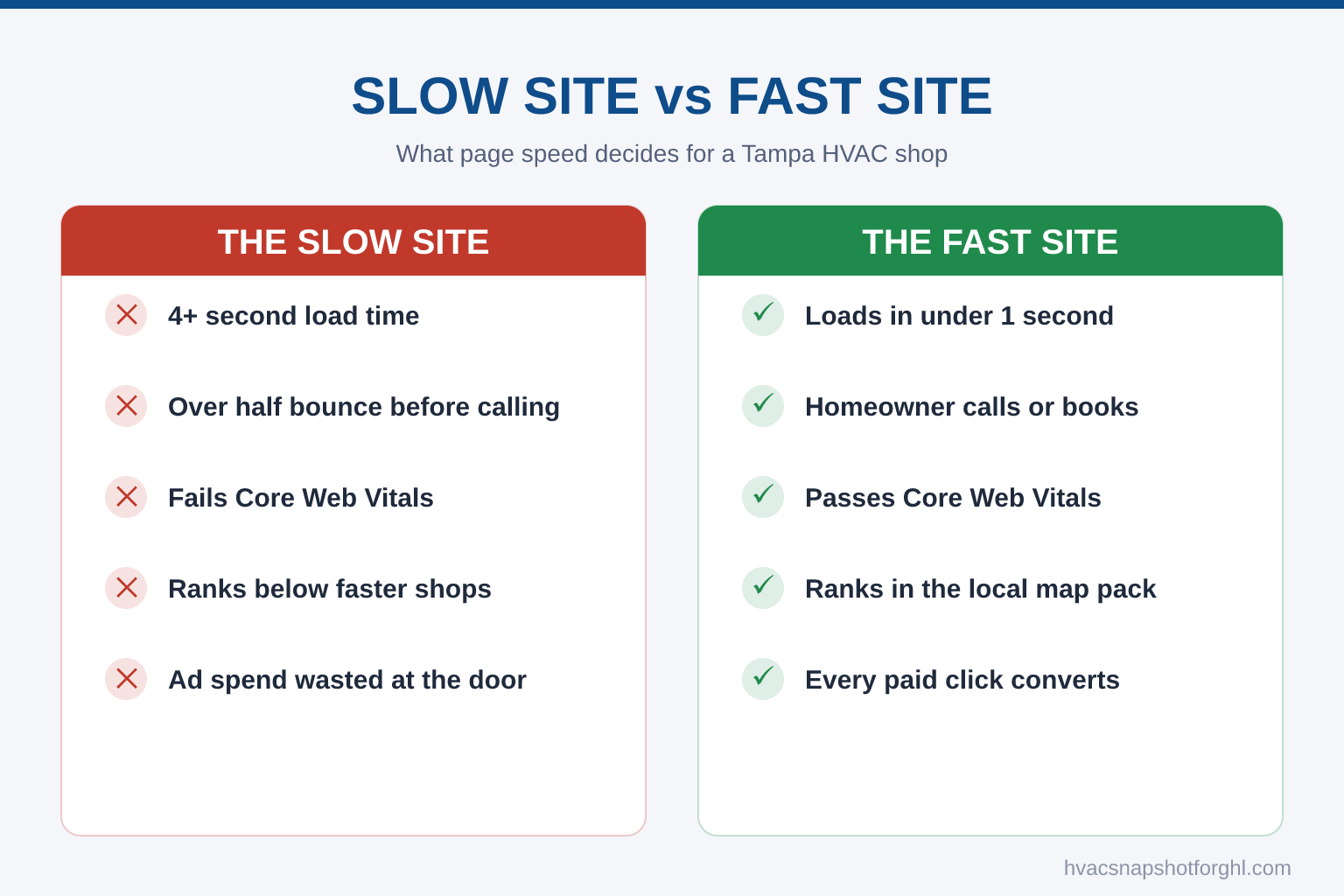
A homeowner taps your listing in 95° heat. A heavy theme and a half-dozen plugins spin for four-plus seconds; the layout jumps as images pop in and they mis-tap. Over half are already gone. The ones who stay hit a form that lags on tap. Google sees the poor Core Web Vitals and quietly ranks you below a faster competitor. You paid for the click and lost the call.
The page paints in under a second, the 'Call Now' button responds the instant it's tapped, and nothing shifts under their thumb. The homeowner calls or books before frustration ever sets in. Google sees strong Core Web Vitals and treats you as a fast, quality result. The traffic you paid for actually turns into booked jobs — because the site got out of its own way.
Why most HVAC websites are slow
If speed is this valuable, why are so many HVAC sites slow? Almost always, it’s the platform — not the shop. The common culprits:
- WordPress plus a pile of plugins. WordPress powers a huge share of the web, but every visit runs PHP and loads whatever plugins the site has accumulated — a slider, a form builder, a chat widget, three analytics scripts. Each one adds weight. We break down the trade-offs in Astro vs WordPress for HVAC websites.
- Page-builder bloat. Drag-and-drop builders (and the site builder inside GoHighLevel) are easy to edit but ship heavy, generic markup that drags down Core Web Vitals. See Astro vs GoHighLevel websites for the speed comparison.
- Huge, unoptimized images. A single full-resolution photo of a condenser can weigh more than an entire well-built page. Most slow HVAC sites are slow because nobody compressed the images.
- No edge hosting. A site served from one origin server is slow for anyone far from it. Static pages served from a global edge network load fast everywhere.
The fix isn’t “clean up the plugins.” It’s building on a framework designed to be fast from the start. That’s why our Get a Website service builds on Astro — which ships almost no JavaScript and serves static-first pages from Cloudflare’s edge — and guarantees a 90+ PageSpeed score most WordPress and page-builder sites never reach.
What a fast Tampa HVAC site looks like
If you’re weighing a rebuild, here’s the spec a modern, fast HVAC site should hit:
- 90+ Google PageSpeed on mobile and desktop — verifiable, not a vague promise. That’s the threshold that keeps homeowners on the page and signals quality to Google.
- LCP under 2.5s, INP under 200ms, CLS under 0.1 — the three Core Web Vitals, passing on real Tampa mobile connections.
- Tap-to-call and book above the fold — the two actions an emergency homeowner needs, instant and impossible to miss.
- Location pages for every suburb you serve — Carrollwood, Brandon, Riverview, Wesley Chapel, St. Pete — each fast and individually optimized for local search.
- An AI chat widget that answers “do you service my area?” and books the call 24/7, so a fast page also captures the after-hours visitor.
- Compressed images and edge hosting so the site is fast for every homeowner, everywhere, every time.
Hit that spec and speed stops being a leak and starts being a lever — every dollar you spend driving traffic converts harder, and Google rewards you with more of it. A fast site won’t fix bad service or thin reviews, but for the shop that already does good work, it’s often the single highest-leverage marketing upgrade available, because it multiplies everything else you’re already paying for.
Frequently asked questions
HVAC website speed — common questions
How fast should my HVAC website load?
Aim for the main content to appear in under 2.5 seconds (Google's 'good' LCP threshold) and ideally a full load in under 2 seconds on mobile. It matters because 53% of mobile visitors abandon a page that takes more than 3 seconds to load (Google, 2016), and sites loading under 2 seconds convert about 57% better than those loading in 3–4 seconds (Portent, 2022). In an emergency-driven market like Tampa, that speed directly decides who gets the call.
What are Core Web Vitals and do they affect my Google ranking?
Core Web Vitals are Google's three page-experience metrics: LCP (loading, good under 2.5s), INP (responsiveness, good under 200ms), and CLS (visual stability, good under 0.1). They're a confirmed ranking signal that acts as a tie-breaker between comparable pages, measured on real visitor data at the 75th percentile. Only about 47% of sites pass in 2026 (corewebvitals.io), so hitting them is a real competitive edge in a crowded local market.
Why is my current HVAC website slow?
Almost always the platform, not your content. WordPress with many plugins, drag-and-drop page builders (including GoHighLevel's site builder), huge unoptimized images, and single-origin hosting are the usual culprits — each adds weight that drags down load time and Core Web Vitals. The durable fix is building on a fast-by-default framework, not endlessly cleaning up plugins.
How much is a slow website actually costing my Tampa shop?
More than most owners realize, because it compounds. You lose over half your mobile visitors at the 3-second mark, and the ones who stay convert at a lower rate — sites loading in 3–4 seconds convert at 1.94% versus 3.05% under 2 seconds (Portent, 2022). Since that traffic comes from paid ads, Local Services Ads, and your Google Business Profile, a slow site wastes a chunk of every marketing dollar before the homeowner sees your pricing or reviews.
Can you build a fast website for my HVAC company?
Yes. Our Get a Website service builds HVAC sites on the Astro framework with a guaranteed 90+ Google PageSpeed score (often a perfect 100) on mobile and desktop — up to 60 pages, location pages for your service area, an AI chat widget that books 24/7, and managed edge hosting. It's $497 one-time plus $97/month, and you only pay the build fee after the site is live and you're happy.
Does website speed matter if most of my calls come from referrals?
Yes — because even referred homeowners look you up before they call. When someone recommends your shop, the homeowner searches your name, taps your site, and forms a first impression in seconds. A slow, dated site can undo a warm referral; a fast, clean one confirms the recommendation and makes booking effortless. Speed protects the leads you earn everywhere, not just from ads.
About the author
Tom Becker is a Home-Services Marketing & Compliance Writer based in Minneapolis, MN. He covers the demand-generation and compliance side of running an HVAC shop — seasonal campaigns, rebate and tax-credit funnels, and the messaging rules that keep SMS and AI outreach on the right side of the regulators. With a background in heating-season marketing for furnace contractors, he translates dense topics like page speed, TCPA, and 10DLC into checklists owners can actually act on.
Related posts
- Astro vs WordPress for HVAC Websites: Speed, SEO, and Cost Compared
- Astro vs GoHighLevel Websites for HVAC Contractors: The Speed Breakdown
- HVAC Local SEO: How to Rank in the Google Map Pack in 2026
- Speed to Lead for HVAC: Why the First 5 Minutes Decide the Job
- HVAC Online Booking: Turn Website Visitors Into Booked Jobs