
A Bronx HVAC shop signs up for GoHighLevel, imports its contacts, wires up a missed-call text-back, and calls it done. Six months later the owner is still keying every booked job into QuickBooks by hand, still copying tech assignments from GHL into a whiteboard dispatch board, and still can’t answer a simple question — how many of last month’s leads actually turned into paid installs? — without opening four different apps and a spreadsheet. GoHighLevel isn’t the problem. A half-connected GoHighLevel is.
Here’s the short version: a half-connected GoHighLevel is a GHL account that runs in isolation — not synced to your field-service software, your accounting, your phone system, or your website — so your team re-enters the same data by hand, leads slip through the cracks between tools, and no one has a single screen that shows what’s really happening. The fix isn’t another platform; it’s custom GoHighLevel development — the integrations, connectors, and custom builds that make GHL actually fit how a New York City HVAC shop runs. Let’s look at what the gap quietly costs, and what closing it is worth.
On this page
- What “half-connected GoHighLevel” actually means
- The NYC reality: a dense, high-cost, always-on market
- Hidden cost #1: double data entry and the toggling tax
- Hidden cost #2: leads leak between disconnected tools
- Hidden cost #3: the owner flies blind
- What GoHighLevel custom development fixes
- Half-connected vs. custom-developed GHL
- When does it pay off — and what does it cost?
- Frequently asked questions
What “half-connected GoHighLevel” actually means
GoHighLevel is a genuinely capable CRM and automation platform — it’s why so many HVAC shops and the agencies serving them run on it. But out of the box, GHL is one app among the dozen a working shop touches every day: your field-service management (FSM) tool, your accounting, your dispatch or scheduling board, your phone/voice system, your website, your ad accounts. A half-connected GHL is one that hasn’t been wired to any of them. It captures leads beautifully and then hands them off to… a human who re-types everything into the next tool.
You can spot it by the symptoms. A booked job in GHL doesn’t create a customer in QuickBooks, so someone re-enters it. A completed job in Housecall Pro doesn’t tell GHL to fire the review request, so it never goes out. A call that comes through your phone system isn’t logged against the GHL contact, so the history is split in two. The owner wants “leads by source vs. booked revenue” and there’s no screen that has both. None of this is a GHL limitation you can’t solve — it’s a limitation of leaving GHL unconnected.
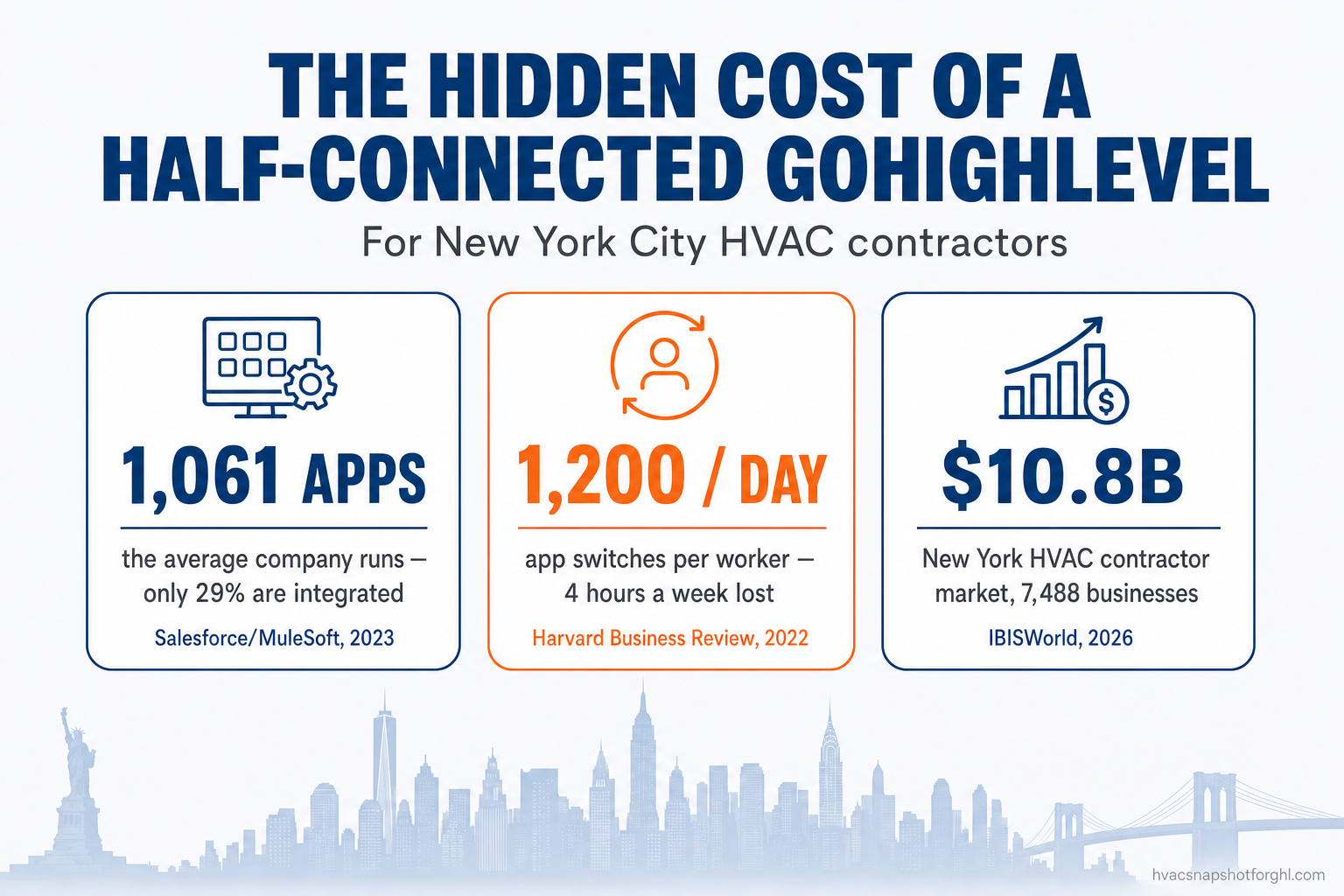
The scale of the problem is industry-wide, not a you-problem. In Salesforce’s MuleSoft Connectivity Benchmark, the average organization reported using 1,061 separate applications — and integrating only 29% of them (Salesforce / MuleSoft, 2023). Seven of every ten tools sit in a silo. For a small HVAC shop the app count is lower, but the ratio is the same: a pile of good tools that don’t talk, with a person bridging every gap by hand.
The NYC reality: a dense, high-cost, always-on market
New York makes the cost of a disconnected back office sharper than almost anywhere. The state’s heating and air-conditioning contractor industry is worth roughly $10.8 billion, spread across 7,488 businesses employing more than 35,000 people (IBISWorld, 2026; cross-check the free U.S. Census County Business Patterns and BLS OEWS NAICS 238220 for the NYC-metro cut). A homeowner in Queens or Brooklyn with a dead system has a wall of shops to choose from — and the tiebreaker is rarely workmanship they haven’t seen yet. It’s who answers, who books cleanly, and who follows up.
Two things about the five boroughs turn a paperwork problem into a revenue problem. First, labor and overhead are among the highest in the country, so hours your office staff spend re-keying data are expensive hours — that’s margin, not just annoyance. Second, demand is genuinely year-round: brutal summer cooling loads on pre-war walk-ups with window and mini-split units, then a hard heating season the moment the cold sets in, plus steam-heat and boiler work older NYC buildings still run. There’s no quiet quarter where the admin catches up on its own. The gap between what comes in and what your system captures never gets a break.
Most NYC shops I see don’t need a new platform — they need the one they already pay for to stop being an island. GoHighLevel captures the lead perfectly, then a person re-types it into QuickBooks and the dispatch board. That handoff is where the money and the hours quietly leak.
Hidden cost #1: double data entry and the toggling tax
The most visible cost of a half-connected GHL is the human bridge — the office manager who copies a booked job from GoHighLevel into QuickBooks, then into the scheduling board, then texts the tech. Every one of those hops is manual, and manual work carries a tax that’s now well measured.
Harvard Business Review researchers who observed real workers found people toggle between applications about 1,200 times a day, and that switching adds up to nearly four hours a week — roughly 9% of the entire work year — lost to reorienting and reconciling (HBR, 2022). Zoom out and it’s worse: Asana’s Anatomy of Work Index found employees spend 58% of their day on “work about work” — coordinating, searching, and duplicating — rather than the skilled work they were hired for (Asana, 2023). For a dispatcher, “work about work” is copying data between GHL and everything else.
Re-keying doesn’t just cost time — it corrupts your data. Every hand-typed transfer is a chance to fat-finger a phone number, misspell an address, or drop a job. Gartner pegs the cost of poor data quality at a staggering $12.9 million a year for the average organization (Gartner, 2021). A shop won’t lose millions, but it will lose the specific things bad data breaks: a truck routed to the wrong cross-street, a review request sent to a misspelled email, a maintenance-plan renewal that never fires because the record didn’t sync. When GHL and your other tools share one clean source of truth, the re-entry disappears and so do the errors it creates.
Hidden cost #2: leads leak between disconnected tools
The second cost is the one that actually hits the top line: leads that die in the gap between systems. A half-connected GHL captures a lead, but if the next step lives in a tool GHL can’t reach — a dispatcher’s inbox, a voicemail on the shop phone, a note on a legal pad — the follow-up depends on a human remembering. Humans in a July heat wave don’t.
The research on lead response is brutal and consistent. In an audit of 2,241 U.S. companies, Harvard Business Review found the average firm took 42 hours to respond to an online lead, and 23% never responded at all (HBR, 2011). Only 37% responded within an hour. And speed is everything: the landmark MIT study by Dr. James Oldroyd found a lead contacted within 5 minutes is 21× more likely to qualify — and 100× more likely to even be reached — than one contacted at 30 minutes (MIT / Oldroyd, 2007). Every hour a lead sits unrouted because two systems didn’t talk is a homeowner booking with the shop that answered.
The fix is to make the handoffs automatic. When a new lead lands, a connected GHL routes it to the right tech instantly, logs the call against the contact, and starts the follow-up sequence without anyone touching a keyboard. When a job completes in your FSM, GHL knows — and fires the review request and the maintenance-plan clock on its own. That’s the difference between a CRM that stores leads and one that works them. It’s the same speed-to-lead advantage we break down in the HVAC speed-to-lead playbook, applied to the seams between your systems.
Hidden cost #3: the owner flies blind
The third cost is the quietest and, for an owner, the most dangerous: you can’t manage what you can’t see. When leads live in GHL, jobs live in your FSM, money lives in QuickBooks, and ad spend lives in Meta, there is no single screen that answers the questions that actually run the business. What did we spend to book a job last month? Which lead source turns into real revenue, not just calls? Which tech’s jobs generate the most repeat work? Booked-vs-missed calls this week?
To answer any of those today, someone exports three spreadsheets and stitches them by hand — which means it happens rarely, late, and with errors. That’s not an edge case; it’s the norm when tools don’t talk. McKinsey’s classic workplace study found knowledge workers spend nearly 20% of the week just searching for internal information and another 28% on email (McKinsey Global Institute, 2012). For an HVAC owner, “searching for information” is chasing numbers across five logins to build a picture the business should hand you automatically.
A connected GHL closes that gap with one owner dashboard that pulls from every system — leads by source, booked vs. missed, seasonal conversion, revenue per tech, review velocity — updated in real time instead of reconstructed at month-end. That’s not a report you buy; it’s a custom build wired to your GHL data. And it changes how you run the shop: you stop guessing which marketing works and start cutting what doesn’t.
What GoHighLevel custom development fixes
“Custom development” sounds heavier than it usually is. For most NYC HVAC shops it means a handful of targeted builds that close the specific gaps above — not ripping anything out. Here’s what our GHL development work actually covers:
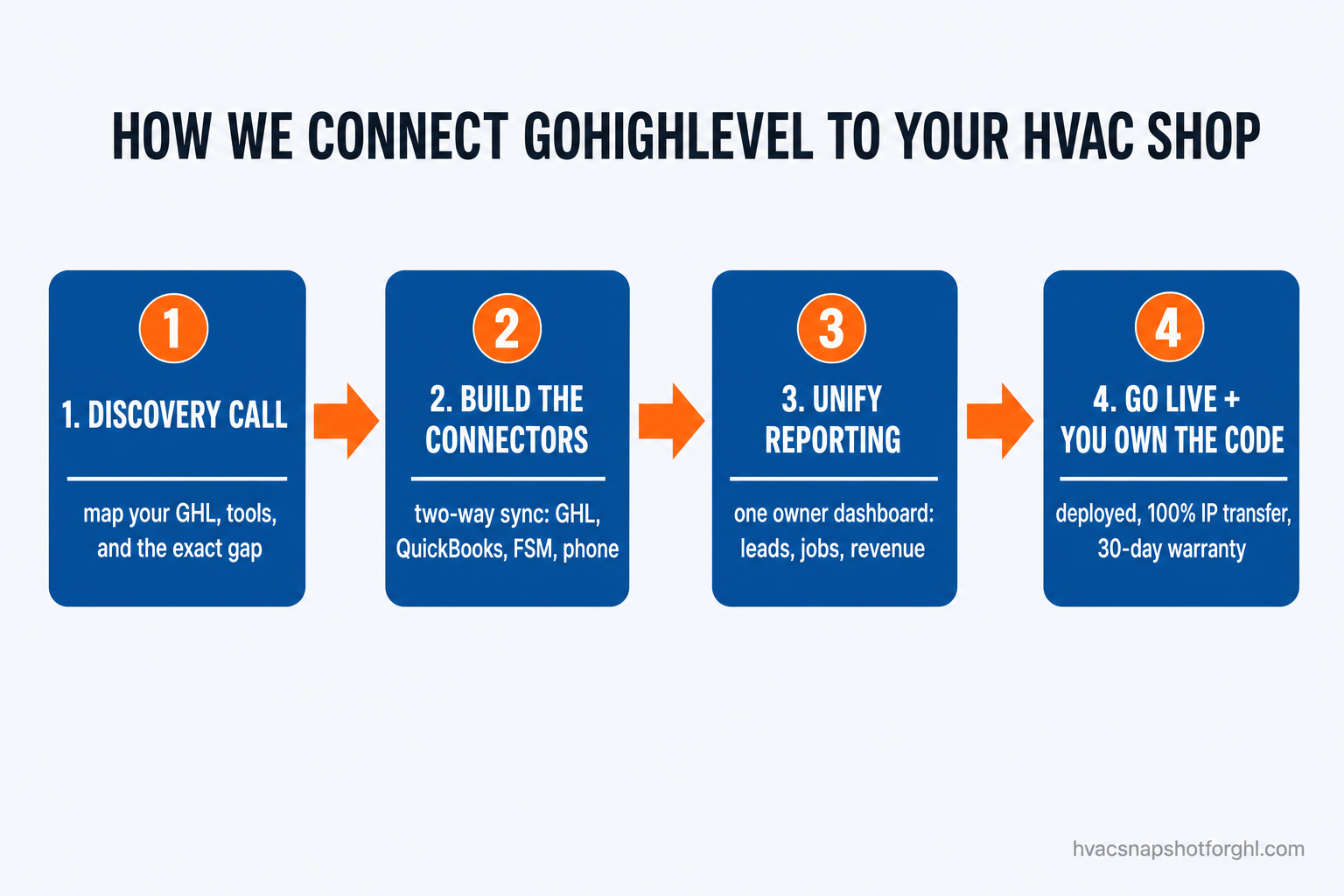
- Connect any platform to GHL. Two-way integrations between GoHighLevel and ServiceTitan, Housecall Pro, Jobber, FieldEdge, QuickBooks, Stripe, your dispatch board, or any tool with an API. Push GHL leads in as customers; pull completed-job status back to fire review and follow-up automations — so double data entry ends and the review engine runs itself.
- Build the feature GHL doesn’t ship. A homeowner self-service portal, a live dispatch dashboard, an equipment-history view, a maintenance-plan renewal engine — built on the GHL API v2 to match your exact process when no marketplace plugin fits.
- Unify reporting into one owner screen. A dashboard pulling GHL + FSM + QuickBooks so leads, jobs, and money finally reconcile on one line — the single source of truth that ends the month-end spreadsheet stitch.
- Wire in custom AI agents. HVAC-trained chat and voice agents — no-heat vs. routine triage, after-hours booking, reactivation calls — plugged straight into your GHL pipeline, not a generic bot bolted on the side.
Half-connected vs. custom-developed GHL
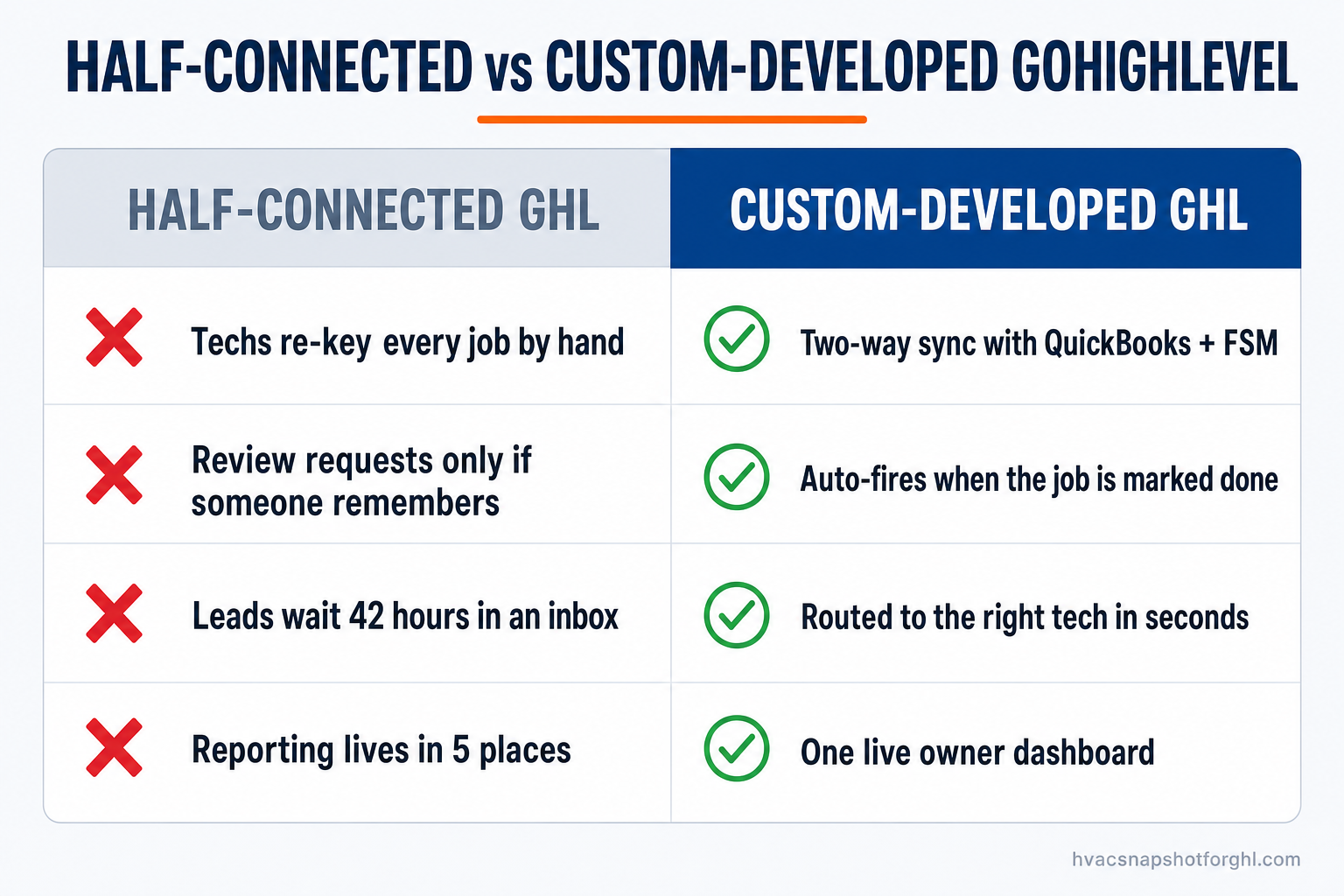
The difference isn’t which platform you run — it’s whether the platform you already pay for is connected to the rest of your shop. Here’s the day-to-day contrast.
Half-connected GHL vs. custom-developed GHL
| What happens | Half-connected GHL | Custom-developed GHL |
|---|---|---|
| Booked job → accounting | Office manager re-keys it into QuickBooks | Syncs automatically, two-way |
| Job completed → review request | Someone has to remember to send it | Fires the instant the FSM marks it done |
| New lead → follow-up | Waits in an inbox until a human sees it | Routed and nurtured in seconds, 24/7 |
| Owner asks 'what's working?' | Export 3 spreadsheets, stitch by hand | One live dashboard: leads, jobs, revenue |
| Data accuracy | Every re-type risks an error | One clean source of truth |
| Who owns the code | n/a | You do — 100%, full IP transfer |
An NYC HVAC shop's back office, before and after connecting GHL
The office manager re-keys every booked job into QuickBooks and the dispatch board. Review requests go out only when someone remembers. Leads sit in an inbox until a person routes them. The owner rebuilds the same three spreadsheets every month to guess which marketing worked — and half the numbers don't match.
A booked job flows to QuickBooks and the schedule on its own. A completed job auto-fires the review request and the maintenance clock. New leads route to the right tech in seconds and start nurturing 24/7. The owner opens one dashboard — leads by source, booked vs. missed, revenue per tech — updated live, no stitching required.
When does it pay off — and what does it cost?
The math is usually simple. If a half-connected GHL costs your office staff even a few hours a week of re-keying — squarely in line with the ~4 hours a week the toggling research documents — that’s expensive NYC labor spent on work a one-time integration erases. Add back the jobs you stop losing to slow, manual follow-up and the return compounds. Forrester’s Total Economic Impact analysis of workflow automation found a composite organization realized a 248% three-year ROI with payback in under six months (Forrester TEI, commissioned by Microsoft, 2024) — vendor-commissioned, but directionally in step with what a well-scoped integration returns.
On price, custom GHL development is more accessible than “custom software” sounds. Fixed-price quotes start around $3K for a small connector, $5K–$15K for custom AI agents and integrations, and $15K–$40K for full dashboards or homeowner portals; prefer flexible, it’s $75/hr with no minimums. Critically, you own 100% of the code — full IP transfer by default, with a 30-day bug-fix warranty. Full pricing lives on the GHL development page.
If you’re weighing whether to extend GoHighLevel or replace it entirely, that’s a real fork. This piece is about making the GHL you already run fit your shop; if you’re still choosing systems or moving off ServiceTitan or a pile of spreadsheets, start with the migrate-to-GoHighLevel guide or, for builds that may not touch GHL at all, custom software for HVAC companies. And if the real gap is that no one has time to run GHL day to day, a GHL virtual assistant may be the cheaper first move.
The point isn’t to spend on software for its own sake. It’s that a half-connected GHL charges you every single week — in re-keyed data, leaked leads, and decisions made blind — and that bill never shows up on an invoice. Closing the gap turns the platform you already bought into the system you actually needed.
Frequently asked questions
GoHighLevel custom development for HVAC — common questions
What does 'custom GoHighLevel development' mean for an HVAC shop?
It's the integrations and custom builds that connect GoHighLevel to the rest of your tools and add features GHL doesn't ship. In practice that means two-way syncs with QuickBooks and your field-service software, a unified owner dashboard, homeowner portals or dispatch views, and HVAC-trained AI agents wired into your GHL pipeline — so your team stops re-keying data and leads stop leaking between systems.
Can you connect QuickBooks, ServiceTitan, or Housecall Pro to GoHighLevel?
Yes — connecting field-service and accounting tools to GHL is one of the most-requested builds. We create webhook or API integrations that sync customers, jobs, invoices, and paid status two ways between GoHighLevel and ServiceTitan, Housecall Pro, Jobber, FieldEdge, or QuickBooks, so techs stop re-entering data and your review and follow-up automations fire automatically when a job is completed.
Do I need to leave GoHighLevel and buy something new?
Usually not. The whole point is to make the GHL you already pay for fit your shop — extending and connecting it rather than replacing it. If you're not yet on GHL, or you're moving off a legacy system, that's a migration project instead. See our migrate-to-GoHighLevel guide for that path.
How much does GHL custom development cost?
Fixed-price quotes start around $3K for a small connector, $5K–$15K for custom AI agents and integrations, and $15K–$40K for full dashboards or homeowner portals. Prefer flexible? Hourly is $75/hr with no minimums. You own 100% of the code with full IP transfer, and every fixed-price build includes a 30-day bug-fix warranty. Book a call for a firm quote.
How long does an integration take to build?
A focused connector — say a GHL ↔ QuickBooks or GHL ↔ FSM sync — is typically a matter of a few weeks, built in 1–2 week sprints with weekly demos on a staging environment tied to your real GHL sub-account. Larger dashboards and portals take longer, but you see data flowing through real code every week rather than waiting for a big-bang reveal.
Does this only apply to New York City HVAC shops?
No. The disconnected-tools problem is universal for any residential or light-commercial HVAC contractor in the U.S. or Canada — NYC is just a clear example of a dense, high-cost, year-round market where the wasted hours and leaked leads are especially expensive. Our GHL development service works for shops and agencies anywhere.
About the author
Rachel Okonkwo is a GoHighLevel Automation Consultant based in Columbus, OH. She builds GoHighLevel workflows and integrations for home-service contractors and the agencies that white-label for them — review engines, maintenance-plan renewals, AI receptionists, and the connectors that tie GHL to QuickBooks, field-service software, and phone systems. She writes the implementation-heavy pieces: pipelines, tags, triggers, and the plumbing that makes a CRM actually run a shop.
Related posts
- How to Migrate Your HVAC Business to GoHighLevel: A Chicago Contractor’s Step-by-Step Guide (2026)
- Custom Software for HVAC Companies: When Off-the-Shelf Field Service Software Stops Scaling
- The Real Cost of Running GoHighLevel Yourself: Why Houston HVAC Owners Hire a GHL VA in 2026
- GoHighLevel’s AI Employee for HVAC Contractors: What Voice AI & Conversation AI Actually Do in 2026
- Speed to Lead for HVAC: Why the First 5 Minutes Decide Who Wins the Job (2026 Data)